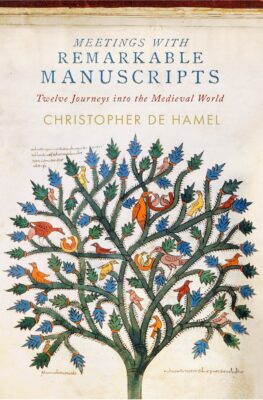
 Christopher de Hamel
Penguin Press, 640 pages.
Reviewed by Karen R. Dukes
Many experts have attempted to write about their field of interest for a wide audience, with greater or lesser success. In “Meetings with Remarkable Manuscripts,” de Hamel invites us to share his love of ancient handcrafted books. He takes us with him as he sits down with 12 stellar manuscripts and “interviews” them, as a journalist might interview 12 people who have lived long and interesting lives. The author’s extensive career at Sotheby’s, and his former position of librarian of the Parker Library in Corpus Christi College at Cambridge, have given him both knowledge of and access to these valuable and fragile manuscripts. He describes his visits with these books in detail — from his arrival at the library or museum where each is housed, meeting staff members and the particulars of the book’s creation, history and physical appearance. Each book is given its own chapter, in chronological order, beginning with the oldest (and arguably most famous), “The Book of Kells.” Each chapter begins with a full-page photograph of the closed manuscript, as if we are approaching the book with him. His descriptions of what he finds between the covers are rich and informative, with minimal technical jargon.
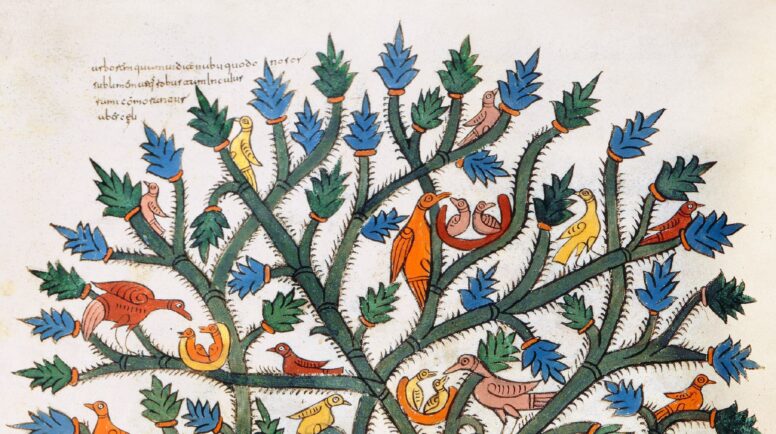
There are interesting and beautiful illustrations from each one. The manuscripts are lovingly described, even to the stitches that repair holes in the parchment. He shows us both the books’ beauty and the scars left by use and abuse. Through his descriptions, he leads us into a deeper understanding of their creators, owners and repairers. Most of the books are overtly Christian (including a Bible, a Psalter and a book of hours); their texts, decorations and contexts provide interesting clues about the history of our faith and the church. The other volumes he meets give us important insights into a world in which politics and science were even more inseparable from religion than they are now.
De Hamel is a specialist in medieval manuscripts whose expertise, writing style and love for his work are both infectious and welcoming to a neophyte. If anything, I found myself wanting more technical information, or at least an easier way to locate quantitative data such as each manuscript’s dimensions. His combination bibliography and endnotes were well worth reading, despite the tiny print. His epilogue urges us to join in on the fun as “new recruits to the field.” While he does suggest ways and means for the interested beginner to study ancient manuscripts, I was left wishing for a separate list of recommended reading in a more legible type size. Such a list would have been especially helpful to those of us eager to accept his invitation.
“Meetings with Remarkable Manuscripts” is a great book for people who love books. More than that, the books and de Hamel’s “interviews” provide and spark insights on a wide variety of topics: medieval life, church history, the role of women, music, agriculture, science, travel, language, art, warfare, humor. It had me pulling out my small selection of books on illuminated manuscripts and examining the illustrations with new eyes and a magnifying glass. It led me to the art reference library at our local art museum and to the British Library’s website, with its generous online offering of scanned manuscripts. Where will it take you?
Karen R. Dukes is a minister in New Hope Presbytery who is finding creative ways to live out her vocation with energy and imagination.