Guest commentary by Harry Heintz
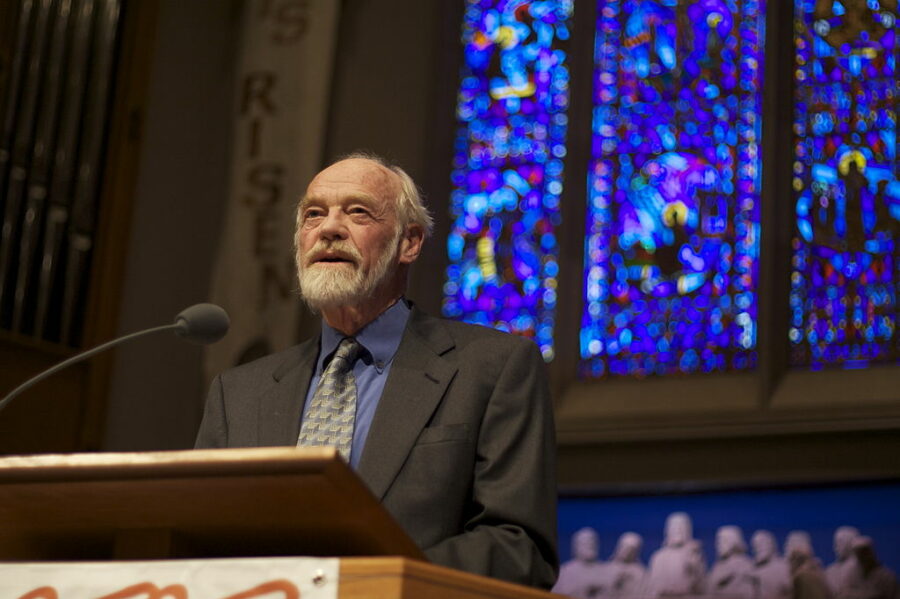
I don’t know just how I found the writings of Eugene Peterson. Once I did, it seemed his writings were everywhere. He was a long-tenured pastor of a Presbyterian Church in Maryland. Once I started reading Peterson, there was no turning back. He wrote with deep biblical insight and pastoral authenticity about the spiritual life and the rhythms of pastoring and congregational life. There were no charts or statistics in his books — just penetrating thoughts about long-term obedience to the Lord of the church. His paraphrase of the Bible, “The Message,� is my favorite paraphrase. I love its playfulness and depth of insight; I frequently use it in sermons to add shades of meaning to a biblical passage.
I like church growth. Seeing a congregation growing in spirit, vision and number of people served, especially new believers, is a good thing. Some Christians make it something of a cottage industry to condemn churches that grow numerically. I am not among them. The New Testament picture of the church is all about growth. The Acts of the Apostles, the first and most amazing book about church growth, is not shy to count converts and disciples. If we’re going to take Jesus seriously about making disciples in all nations, then we will take numbers seriously, if those numbers refer to people. And there is a book in the Old Testament named Numbers.
In the 1970s and 80s, the early years of my pastorate at Brunswick Church in Troy, New York, I came under the influence of people committed to understanding and promoting church growth, especially C. Peter Wagner of the Church Growth School at Fuller Seminary. His books were filled with statistics, charts and stories of church growth overseas and in North American.
I began to tell people near me that I kept Peter Wagner whispering in one ear and Eugene Peterson whispering in the other. Wagner was whispering, “Let the church grow; reach more people with the Good News; be a faithful and fruitful pastor.� Peterson was whispering, “Attend to your soul; don’t sell out to methods and techniques; be a faithful and godly pastor.� I wanted to be a faithful, fruitful and godly pastor. I was well served by listening to both Wagner and Peterson, rather than listening to just one of them.  Through with the years, I found myself reading more of Peterson and letting him introduce me to other authors (and reading less of church growth, though not giving it up entirely).
In 1989 I took a two-week course on spirituality and ministry led by Peterson. It was offered by the same Fuller Seminary that employed Wagner. (That is one of the reasons I have become so fond of Fuller — it has a broad view of evangelical Christianity and refuses to settle in one rut.) That course took place at Rancho Capistrano, a retreat setting in Orange County, California. It was nestled in dusty hills, though not far from the ocean and the interstate, with a pond, walking trails and lovely buildings reflecting the Mexican heritage and culture of southern California.
I was not disappointed by the two-week experience. Peterson made sure that the 20-some of us got to know one another by first names and become friends, even if just for two weeks.  Peterson laid down one ground rule: We were not to ask each other the size of the congregations we served or volunteer that information. From being in other courses, seminars and conferences with pastors, I knew that the size of congregation was often the second question asked of a pastor (after “What church do you serve?�). That often made me uncomfortable. If I told the size of the Brunswick congregation, it could make me seem very successful to some and not so successful to others. It could feel like the answer to the “how many� question determined if you were successful. It tended to create a pecking order. The big-church pastors would hang out together and tell big-church stories. Small-church pastors could readily feel intimidated. That never happened in our two weeks together.
Peterson took us deeper into a number of the classic disciplines for developing the inner life. Though I knew of most of them from previous readings and experiences, some of them were not my natural home. I was acquainted with them, but not at the deepest levels. On the last day of the course, as we were seated in a circle in our meeting room, Peterson asked us, “Wouldn’t you like to stay here?� We all understood the question, at least so it seemed to me. Wouldn’t we like to leave the rat race that modern pastoring has become: endless administration, church growth charts, attention to everything but one’s soul? A number nodded or said yes. I quietly said no. I wanted to get back to my pastorate. I also wanted to have experiences like this: to know retreat settings, and to have friends – both living and literary – that spoke to me as Peterson did. But I am more of an activist. I like to do things, to respond to challenges and to see churches growing. I am not spiritually wired like Peterson — I could sense that an hour into our first day. I could be jealous of him or choose to ignore him. Neither option was acceptable or right for me. Eugene is at comfort in his own skin. He is not against church growth, but he rightly sees that it is not the point and can become unhealthy, like a cancer, growing irresponsibly. Peterson told us that Christ Our King Presbyterian Church in Bel Air, Maryland, where he was the founding pastor and pastored for well over two decades, grew mainly because some developers bought up beautiful farmland and built ugly new suburban neighborhoods.
Peterson helps me to know who I am and to be a better follower of Jesus and a better pastor. Sometimes I wish I were wired more like Eugene Peterson, but I am not. He continues to whisper in my ear. When I am wise I listen. And respond.
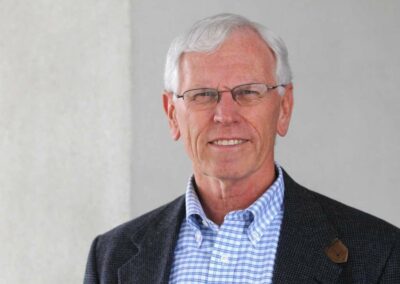 HARRY J. HEINTZÂ is a retired pastor. After 38 years serving Brunswick Church in Albany Presbytery, he retired to western New York, where he does a lot of supply preaching and is an adjunct professor at Northeastern Seminary in Rochester, New York.