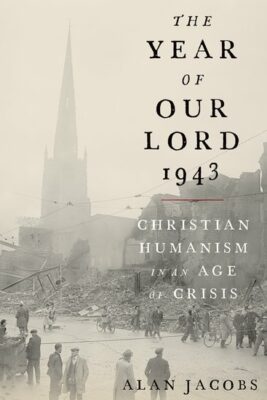
 Alan Jacobs
Oxford University Press, New York, 280 pages
Amid the horrors of World War II, Christian humanist thinkers came suddenly to see that Christian values were collapsing all around them. Alan Jacobs, a humanities professor at Baylor University, presents the thought of five of these Christian intellectuals: Jacques Maritain, T.S. Eliot, C.S. Lewis, W.H. Auden and Simone Weil. Though the war was waged with instruments formed by technology, they came to see it primarily as a spiritual conflict. Auden summarized this perspective best: “The English intellectuals who now cry to Heaven against the evil incarnated in Hitler have no Heaven to cry to: they have nothing to offer and their prospects echo in empty space.”
Christian thinkers had long been aware of the challenge posed by modernism, yet it took the shock of a brutal world war – the second in a generation – to force them to come to grips with the reality of a world increasingly based on science and technology. They feared that postwar society, while extolling efficiency and technical prowess, would shed Christian humanist values and ultimately evolve into totalitarian states.
Lewis in “The Abolition of Man” identified the cause to be the rootless, relativistic education of the time: “We make men without chests and expect of them virtue and enterprise. We laugh at honour and are shocked to find traitors in our midst. We castrate and bid the geldings be fruitful.”
By 1943, as the fear and panic of the first years of the war gave way to confidence in eventual Allied victory, these Christian thinkers began to contemplate the need for a postwar society grounded in Christian values. All of them, following different paths, concluded that educational reform could restore the moral and spiritual foundations of Western culture. As so often happens, their diagnosis of the problem was insightful and profound while their solutions were vague and untenable.
All agreed that the enemy was technocracy and the solution some form of Christian humanism. Weil warned, “If we are only saved by American money and machines we shall fall back [after the war], one way or another, into a new servitude like the one which we now suffer.”
Above all, they believed that education should not be directed by “technicians” who would emphasize practical fields while trivializing the humanities. This was clearly Auden’s concern. In a poem written in 1946, he warned that if Western education resumed emphasizing not “Truth” but “Useful Knowledge,” the culture would continue to “Extol the doughnut and commend/The Common Man.”
Jacobs shines a spotlight on a moment in history when intellectuals became acutely aware of the dangers posed by technocratic society, but he concludes that the “wisdom” they bore came perhaps a century too late when “the reign of technocracy had become so complete that none can foresee the end of it while this world lasts.” He paints an accurate if forlorn picture of one aspect of the intellectual life of the 1940s — one still relevant for our own time. That the intellectuals singled out by Jacobs also felt the full force of the bleakness of their situation is revealed in that after the war, when the immediate danger had passed, they all – with the except of Weil who had died – quietly “turned to other matters.”
Michael Parker is Presbyterian World Mission’s interim coordinator for Europe and the Middle East. He lives in Louisville, Kentucky.