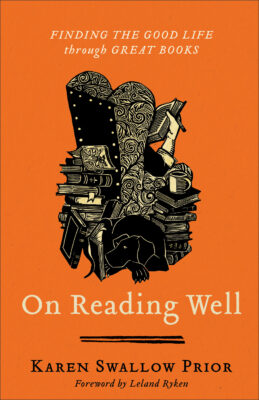
 Karen Swallow Prior
Brazos Press, 272 pages
Reviewed by Marlise Burr-Asher
Karen Swallow Prior’s second book, “On Reading Well,” is an intriguing read if for no other reason than because the reader is confronted with antediluvian language in a modern context. Words like “prudence” and “chastity” just don’t pop up in our everyday vernacular. Prior, an English professor from Liberty University, deconstructs 12 influential pieces of literature. Each novel is scrutinized through the lens of a different virtue. For example, Prior examines justice in “A Tale of Two Cities.” She revisits “Huckleberry Finn” and considers what it teaches us about courage. She unpacks “Pilgrim’s Progress” and what it has to say about diligence.
Beating at the heart of her analysis is the belief that virtue can be found in literature, and therefore consuming great literature has the potential to make us more virtuous. Virtue, according to Prior, is excellence and is perceived in the Aristotelian tradition that ties it to purpose or telos. Prior argues that our ultimate purpose is to serve God, and in so doing draws a straight line between virtue and God.
Sound a little heady? It is. But there are elements here for those of us who aren’t literary types. For example, Prior chose one of my favorite novels, “The Great Gatsby,” to consider what Fitzgerald might teach us about temperance. Against a backdrop of excess, the characters in this book are out of balance in life and, consequently, void of purpose. Intemperance abounds. Prior points to a scene in the novel where Daisy is coddling expensive shirts and crying over their beauty — a poignant reminder, according to Prior that “consumption does indeed consume us.”
Prior’s evaluation, a throwback to traditional literary criticism, is arguably thought-provoking. Prior has chosen to use antiquated language. Instead of judgment, she discusses “prudence.” Instead of moderation, she dissects “temperance.” Of course, these specific words have historical significance within the church, and as such echo meaning. However, I would argue that they also relegate the work to mostly scholarly audiences or to those who are looking for what Leland Ryken describes in the foreword as a revisionist agenda — a necessity, he argues, to counter the “secular literary guild and public school classrooms” where Christianity has been attacked.
This is actually unfortunate because Prior has presented a new way to look at familiar stories, which I believe has relevance in a much larger space. She also presents one of the best arguments for why one should read that I have ever seen. Prior’s love for reading oozes off the page and seeps into you because it is so genuine. She uses engaging terms like “reading promiscuously” and argues against censorship. This is a woman who believes that reading can transform the human condition, and she presents a credible argument as to why that is. “On Reading Well” is strongest in these moments. It might be tempting to dismiss Prior’s work as no more than a scholarly stake plunged into the ground, one that marks the validity of a particular literary theory. But that would be a mistake. Prior says, “Great books offer perspectives more than lessons,” and that is a virtuous sentiment we can all appreciate.
Marlise Burr-Asher is a librarian, a student at Wesley Theological Seminary and a member of Saint Mark Presbyterian Church in Bethesda, Maryland.