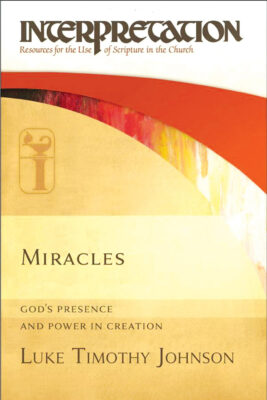
 Luke Timothy Johnson
WJK Press, 392 pages
True story: A young pastor wrote an article for the church newsletter one Easter making the point that the resurrection was the keystone of the Christian gospel. Two families declared that that was too much for them to swallow, and they hit the road.
Anyone who has been on a pastoral staff knows there are others with similar sympathies who keep it to themselves. Such knowledge tempts those who preach to turn the volume down when it comes to the bolder affirmations of the gospel. Embarrassed by and recoiling from aggressive fundamentalisms, mainstream Protestants risk a theological timidity meant to calm those in the pews for whom a polite skepticism seems the best way to defend their integrity.
Luke Timothy Johnson is professor of New Testament emeritus at Candler School of Theology in Atlanta, and decades of observation leave him dismayed that “Christians have more or less given away the game by debating things like miracles in terms dictated by Enlightenment epistemology.” He worries that biblical teaching in the seminaries is marked by “rationalistic skepticism.” When the gospel taught and preached is staked on a narrow version of rationality, the result is a drifting Christianity, “passionless and pointless.”
The author urges us to think of miracles “less as unassailable facts to which all must consent and more as deeply ambiguous signals that require a transformed imagination to be perceived.” The challenge is to approach the miracles not trying to determine which happened as reported and which did not, but “with the eyes of faith, seeking to understand the meaning of the signs and wonders they narrate.” Christians cannot give up the conviction that God’s presence and power has and is made manifest within creation. Faith is the language of the heart that makes the Bible intelligible. Faith is a way of “knowing.”
Johnson’s book is the tenth to be published in the new “Interpretation” series (to which this writer contributed a volume). He divides the book into four parts: Framing the discussion; God’s presence and power in the Old Testament; God’s presence and power in the New Testament; and Four pastoral implications. He makes good use of his exegetical skills. Some of the most interesting treatments are noting parallels between, say, stories of the manna in the wilderness and the feeding of the multitudes, or the exodus through the waters of the sea and Jesus walking on water.
If I were to quarrel with Johnson at all, my nitpick might be the use of the word “myth.” His point, of course, is that a narrative may be true even if it is not an objective report of an event. The problem with the use of this word is that “myth” is a vehicle for imparting generic and autonomous truths, while, as Hans Frei argues, the New Testament narratives are meant specifically to render to us the character of Jesus Christ, not “truths” independent of the story.
Johnson concludes: “The church ought to be the place in the world where God’s continuing self-revelation is discerned, celebrated, and embodied. … Failure at this is utter failure.”
The book is a demanding but intriguing read, and important enough to be worth the effort.
 Ronald P. Byars is professor emeritus of preaching and worship at Union Presbyterian Seminary in Richmond, Virginia.