 Anne Lamott
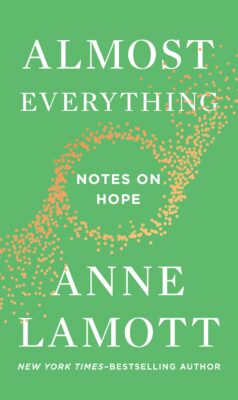
Riverhead Books, 208 pages
Who doesn’t love Anne Lamott? I know there must be some, but that’s a group I would not want to be around for long. Seriously, reading Lamott is like eating comfort food when you’ve heard some dismal news, only much healthier. There is nothing quite like meatloaf with a side of mac and cheese when you are down. Likewise, when you need to hear some good news, pull Lamott off the shelf. She is so reliable that even the New York Times called her the “guru of optimism.” While that’s a fair description, it’s a bit misleading because there is more to Lamott than funny stories with a happy ending.
In “Almost Everything,” she delivers plenty of the humor, yet the beauty of her humor is that she never flinches in the face of horrible human tragedy. In a chapter on death, she reveals that her mother, aunt and maternal grandmother died from complications of Alzheimer’s disease. Terrified at first of death, Lamott describes how hospice taught her to wash the body of a dying friend. This became a spiritual practice for her. “At some point, you experience that a body is a just the shell of a person, a cocoon that’s been outgrown. This is a sacrament, because our people are still so precious and when you learn this, you experience it as privilege.” In this same essay, which I think is her finest, Lamott comments about the virtues that rise up among people at a funeral service. Virtues like gratitude and love emerge when people long for “immersion in the right now, and to share their love out loud with those whom they love the most.”
Lamott is funny, but her humor works because it comes from facing the worst and carrying on anyway. Revealing her understanding of the human condition, she says, “Almost everything will work again if you unplug it for a few moments, including you.” Comedians know that humor works best when it is juxtaposed with its opposite. This is what gives it the power to see life differently and laugh at our foibles. Lamott reminds us that hope is in fact possible without denying the brutal realities of cancer, climate change, inexplicable deaths, incurable disease and, her favorite example, snakes. These days Lamott seems intent on finding ways to bring people together on the common ground of our flawed, fallen humanity. While this may sound shmaltzy, for those of us trying to bridge the relational chasms in our congregations, families and communities, it is a moral necessity. Like a good theologian, Lamott advises us to face the paradoxical nature of truth. One can gaze upon the horrors of famine and simultaneously marvel at the outpouring of compassion. Marvel long enough and hope will burst your heart.
In a coda simply titled “Hope,” Lamott sums up her method with the biblical story of the flood. Noting that rabbis have disagreed for centuries on what moved God to cause the devastating flood in response to atrocious human behavior, she points instead to God’s repentance and the everlasting sign of God’s desire to be in covenant with us. This leads her to suggest we can start over too. We can choose to hope rather than despair. “If God gets to start over, then it’s a free-for-all, even for cowardly lions like me.” Indeed.
 Roy W. Howard is the pastor of Saint Mark Presbyterian Church in North Bethesda, Maryland, and the book editor of The Presbyterian Outlook.