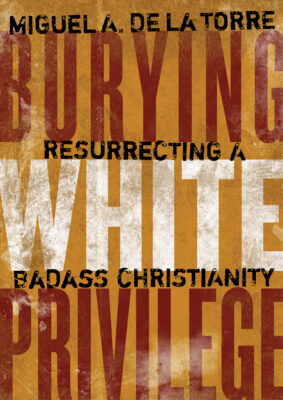
 Miguel A. De La Torre
Eerdmans, 168 pages
Reviewed by D. Mark Davis
Miguel A. De La Torre’s book, “Burying White Privilege,” gives name to a problem in American society and points us toward the solution. The problem is generally “whiteness,” and specifically “white Christianity,” which De La Torre argues has been coopted historically into a legitimation theory for activities as heinous as the genocide of Native Americans, buying and selling slaves, dehumanizing African-Americans during the Jim Crow era and exploiting Chinese railroad workers as well as Hispanic farm workers. Any solution, De La Torre says, begins with crucifying “white Christianity” in order for new life to emerge.
This book is a tough reading assignment. The language is intentionally and effectively provocative, rather than a clinical diagnosis with objective language and a clear protocol for addressing the disease. The book has no intention of offering either a happy ending or a how-to guide. Instead, it is a mirror with harsh lighting, intended to expose flaws with genuine righteous indignation. And it is unrelenting, because De La Torre anticipates the reader’s defense mechanism – an inclination to respond, “But I’m not like that!” – and shows how that response itself is characteristic of privilege.
It is not a perfect book. The most egregious examples of white Christianity tend to come from evangelical voices, yet there are many occasions where De La Torre reminds progressive voices that they too are equally complicit. However, he seems to leave it up to them to figure out how they are to change. If a group were to study the book chapter by chapter, it may not be clear how each chapter develops internally, or how they are related to one another. And while De La Torre’s powerful rhetoric is the book’s greatest strength, it can feel forced at times.
But, those are critiques more suited to a writing class than a prophetic utterance. And De La Torre’s book is, from start to finish, a prophetic utterance. People of faith should read it as such. Individuals should read it with an open heart, setting aside initial objections and listening for how the Spirit is calling them to respond. Church groups should read this book together, discuss it and actually do as the book suggests toward the end: Have an altar call. Repentance is a more befitting response than analysis.
One final note: This book is unafraid to offer partisan political commentary. It names names and cuts through the niceties. Even if that is not your cup of tea, then you should read this book, because the rarified space where politics and religion don’t mix is a symptom of white Christianity that has allowed the misrepresentation of the gospel to go un-criticized for way too long.
Read this book. Hate it if you must. Argue that it over-speaks. Cringe at its language. Imagine how it might be different. Then read it again, because without this kind of radical, systemic challenge, Christianity is simply lost.
D. Mark Davis is pastor of St. Mark’s Presbyterian Church in Newport Beach, California.