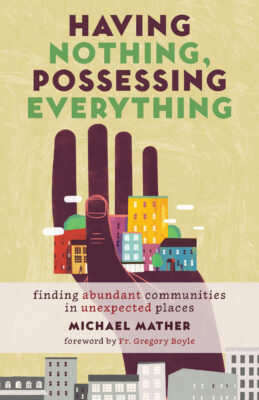
 Michael Mather
Eerdmans, 160 pages
It’s hard to imagine any pastor in their right mind closing down a basketball program that brings in 250 inner-city youth from 9 a.m.–5 p.m. Monday-Friday, but Mike Mather did.
Why? While patting himself on the back from the media coverage Mather received as a young associate pastor presiding over 250 “impoverished” souls, nine young men in a four-block radius around Broadway United Methodist Church in Indianapolis died from violence in nine months. His church was “helping a few people beat the odds,” but not “changing the odds for everyone.” And he was determined to do the latter.
Later, as a solo pastor in South Bend, Indiana, on Pentecost Sunday, he read aloud Joel’s prophecy: “I will pour out my spirit on all flesh.” But after church a congregant called his bluff: “If what God said is true, why don’t we treat people like that? … At the food pantry, we ask people how poor they are rather than how rich they are. Peter is saying all people have God’s Spirit poured into them.”
This conversation sent Mather on a journey to figure out what it would look like to assume that the Spirit of God is alive in every human soul, especially the poor. It took a radical shift in how his church viewed those in poverty, which in turn caused the end of several “successful” outreach ministries like tutoring and a food pantry. Their new way of being centered on listening, neighborhood gift mapping and assisting the newly discovered gifts to flourish.
Many of us have learned about strengths-based leadership and asset-based approaches to congregational development, but the implementation often falls prey to organizational navel gazing. Through over 30 years of pastoral ministry, however, Mather figured out how to cast a wider net, taking the best of these approaches to the streets where he discovered the Spirit alive and well in homes, kitchens and porches. Through his own endless walks around the neighborhood and eating meal after meal within the homes of community residents, Broadway UMC began to see the rich gifts surrounding them where they had for so long only seen scarcity. This is no small feat: the two census tracts closest to Broadway report poverty rates of 36 and 33 percent, and Indianapolis’s history of racial segregation is by some measures worse than any other northern city.
But no statistic can capture the marvel that is the Spirit-filled soul. Once Mather and Broadway dedicated themselves to discovering the gifts around them, they found in their “poor” neighborhood everything from cooks who have since opened profitable restaurants to tutoring groups run much more effectively than the church-led program. In an illustration-packed memoir, Mather shows that scarcity narratives create self-perpetuating results. In Mather’s hard-fought but humbly presented work, readers see a tapestry of kingdom comings; in story after story, those with their head hung low rise up to new life when given a chance to celebrate their essence.
This is the kind of book with the potential to upend every facet of church and society. When we stop looking for needs and start identifying gifts, we will be one step closer to ending poverty. Does the church have the humility to stop programming and to start listening for the Spirit?
 Eric Peltz is associate pastor of Chevy Chase Presbyterian Church in Chevy Chase, Maryland.