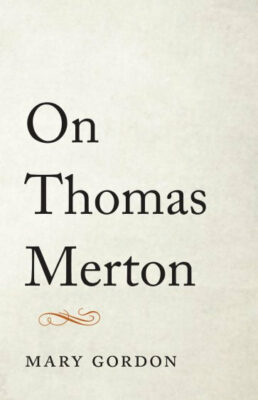
 Mary Gordon
Shambhala Press, 160 pages
The renowned novelist Mary Gordon has done what few people can do: say something new about Thomas Merton.
She begins by announcing the paradox: A monk vowed to silence produced more words than most writers. Though Merton was dedicated to solitude as a Trappist hermit, nevertheless an international company of seekers, celebrities, writers and activists were drawn to him for guidance. Thus the paradox: solitude gives birth to community — a community that continues 40 years after his death. Silence brought forth the written word akin to a tsunami.
Gordon explores the paradox that is Merton, choosing selections from his writings that give insight into him not only as a monk, but as a writer. We learn that Merton was forever chafing under the strictures of his monastic life, especially the demands placed upon him by his superior to write for an audience that would be drawn to Catholic spirituality. What kind of writer would he be? That is a difficult question for a writer committed to a monastic vow of obedience, which by necessity gives little room for independence. This theme runs through Gordon’s book. She describes Merton’s struggles throughout his life. While committed to his vocation, he resisted what he considered the superficialities of American monasticism. Merton was a curious intellectual who had a profound conversion that led to his monastic vow described in his most famous book, “The Seven Storey Mountain.” We come to know Merton as he grew beyond his initial enthusiasm as new monk at Gethsemani, expressing his frustration with the lassitude of his fellow monks (who found themselves offended by Merton’s criticism). Gordon reveals the serious conflicts between Merton and his superior, Dom James Fox, and the ways they negotiated that relationship. Dom Father, for instance, chose Merton as his confessor. And he granted Merton the status of hermit that he longed for, away from the community to which he was vocationally bound.
Many people know and admire Merton for his deep commitment to peacemaking. Gordon devotes a chapter to a little-known novel, “My Argument with the Gestapo,” for an unlikely way to see Merton’s deep political engagement and commitments. The final chapter of this brief book is the most rewarding. It is focused on the journals that contain the most candid writings of Merton as he increasingly opened his horizon to the experience of God in nature. Here we learn of the famous affair he had while in Louisville, Kentucky, that was akin to an epiphany of God. Walking the streets of Louisville opened his eyes in a whole new way.
In this book we discover a complicated Merton. Yet, that is the great gift that Mary Gordon has rendered to her readers. Thomas Merton is complicated! He struggled with his vocation to prayer and monastic obedience. He sought to be a Christian peacemaker and did his part from his own hermitage.
The journals reveal to us a man who sought after God. Here we see a man – a human – who revels in God and is committed to prayer. This is the same man who counsels writers and poets, social activists and seekers. Mary Gordon’s fine book makes one wish Thomas Merton were with us in these days of deep division and spiritual yearning. We can be grateful that she has written this book.
 Roy W. Howard is the book editor of the Presbyterian Outlook and pastor of Saint Mark Presbyterian Church in North Bethesda, Maryland.