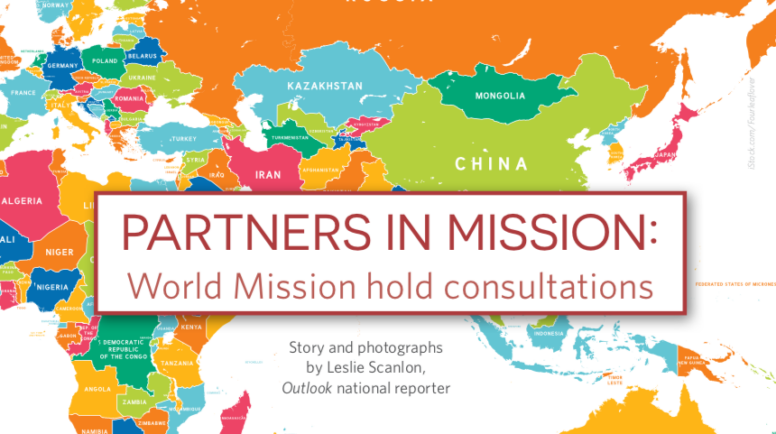
Sometimes, the day-to-day complexities of working in mission around the world can be all-consuming: there’s always a crisis, pain or joy, places in transition. So part of the work of Presbyterian Church (U.S.A.) World Mission in recent months has been to hold a series of consultations, first with key global partners and then with domestic constituencies, to ask these broader questions:
- What is our calling in mission today?
- What does it mean to be partners in mission?
As part of that process, World Mission leaders have held four international consultations beginning in late 2018 with global partners in Africa, Asia Pacific, the Middle East and Europe, and Latin America and the Caribbean.
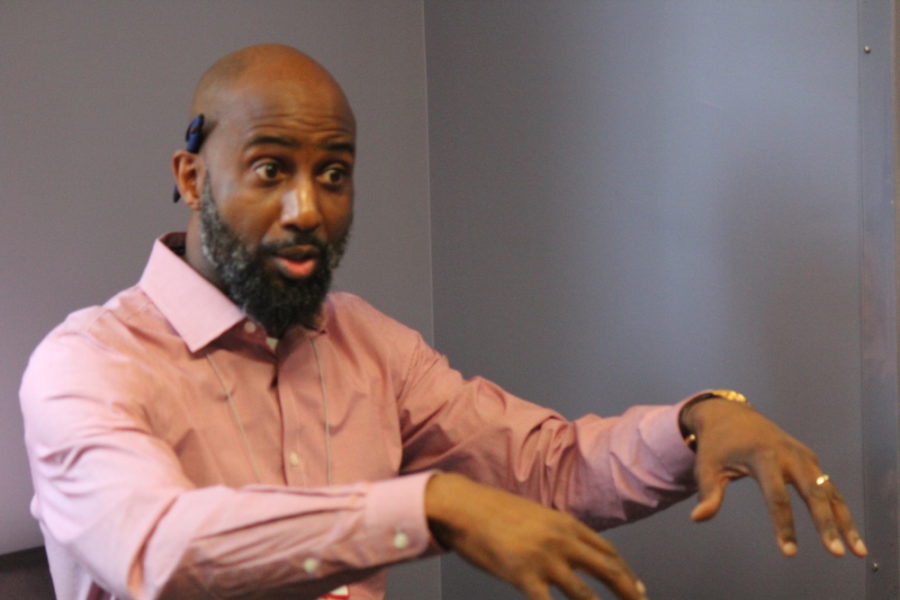
That’s being followed by a series of consultations in the U.S. with representation from mission networks, advocacy groups and congregations and mid councils that are involved in international mission work. “It’s designed to be a collaborative process,” said Philip Woods, World Mission’s associate director for strategy, program and recruitment. “It’s designed to start the conversation.”
 Woods helped design the consultations, along with Debbie Braaksma, coordinator of World Mission’s Africa Area Office. Among the strategic questions that World Mission staff members have explored with international partners are these:
- How effective have we been as partners sharing together in mission?
- Where is God calling us to put our energy today?
- What does it mean to be partners in mission?
- What might this look like in practice?
- What resources are needed?
What have been some of the findings (recorded in more than 200 pages of table notes taken during the discussions)? First, lots of appreciation for the journey so far, Woods said.
Second, an invitation to go deeper.
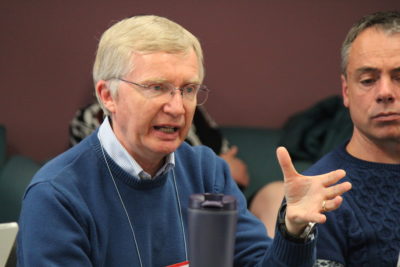
Around the world, pretty much everyone is talking about poverty, income inequality, climate change, racism, discrimination, violence, how to live with one’s neighbors – and “what does that look like in our different contexts” of religious or cultural difference? – Woods told a committee of the Presbyterian Mission Agency Board.
Partners spoke of the importance of mutuality – of networking, making connections, sharing resources and ideas. Participants were asked to lift up one thing they wanted the PC(USA) to hear. More than anything else, it was mutuality – exploring “how can we be equal partners together accompanying each other in God’s mission?” Woods said. “That’s a big challenge, but it also is a profound insight as to how the church is maturing and shaping up today,” opening space for considering how the PC(USA) can play a role in building mutual relationships.
The consultations are lifting up learnings that will affect how World Mission will do its work going forward, Woods said. Among them:
Mission as transformation
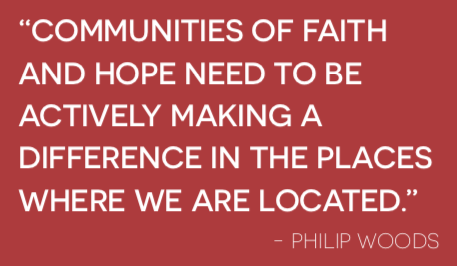
An evolving missiology increasingly sees mission as transformative – creating change for a better world. “It’s about making a difference,” Woods said. In too many places, the only impact of our churches is as a landmark for navigation — as in, “when you get to the church on the corner, turn left.” But “the call to mission is to be a transformative presence in the community,” he said. “Communities of faith and hope need to be actively making a difference in the places where we are located.”
Mission from the margins
That’s a difficult term, Woods said, because the meaning of “margins” can be relative and nuanced. The idea emerging from the consultations is “to identify who it is who is being marginalized in your church, in your community and your society. And how are you listening to the witness of these people? How is God speaking to us through the people who for whatever reasons we have pushed to the margins?”
Mission right here
There is an increasing understanding, Woods said, that the impact of more than a century of international evangelism is now being felt in the U.S. “The world church is no longer ‘over there,’ ” he said. “It is in our midst. That changed a long, long time ago, and we’re still struggling to get to grips with it. U.S. society today is incredibly diverse. We have people living here from all over the world.”
When Presbyterians from other countries come to the U.S., “they bring their community with them,” Woods said. Some partner churches have congregations or fellowships in the U.S. – for example, the Presbyterian Church of Ghana or Presbyterian Church of Myanmar. Some are in partnership with PC(USA) congregations, and how relationships evolve varies, Woods said. The challenge for the PC(USA) is “how do we affirm” what comes from those connections — showing both flexibility and welcome?
Mission in local contexts
Presbyterians in the U.S. have much they can learn from global partners — from the experience those partners bring of doing ministry in local contexts. For example, Presbyterians in Madagascar use their congregations to deliver healthcare to remote communities. “We could learn from that,” Woods said. “They have experience in the challenges we are facing,” delivering health care to rural America, “but we don’t think to ask them to help us. We don’t ask them.”
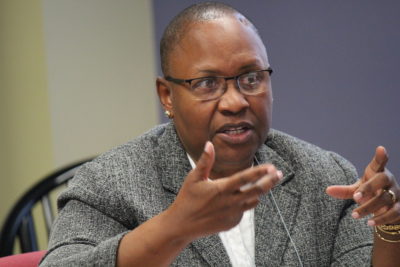
He said during a question-and-answer session: “One of the challenges of global ministry is the challenge of privilege,” that “sometimes we think that money answers every problem. We’re blinded to the gifts our partners bring to the table,” which may not involve lots of money but ideas, creativity, expertise.
In the U.S., consultations have been held in Atlanta, at Stony Point Center outside New York City and at Zephyr Cove in Nevada. This summer, World Mission will hold a similar consultation with the Presbyterian Mission Agency — with the goal of continuing to shape World Mission’s strategy going forward.
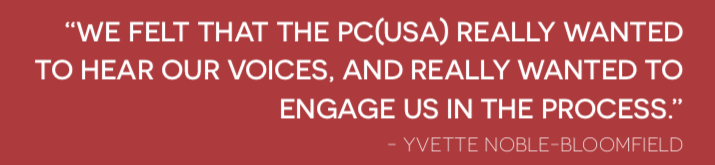
Yvette Noble-Bloomfield, an ecumenical representative to the Presbyterian Mission Agency Board from the United Church in Jamaica and the Cayman Islands, said she participated in the Latin America and the Caribbean consultation, and “we felt that the PC(USA) really wanted to hear our voices, and really wanted to engage us in the process.”
 The idea of relying only on resources from the church in the U.S. — “that must end,” Noble-Bloomfield said. “There is theology from the South or the East,” a wealth of voices, theological perspectives, ideas.
Following the last consultations, the World Mission staff will present some of the findings when the Presbyterian Mission Agency Board meets at Stony Point September 26-28.