SEATTLE – What does it mean to be church?
For some, it’s gathering in pews in a sanctified space on Sunday mornings. For the Recovery Café community in Seattle, it’s offering connection, accountability, support and hope for a new day.
“We believe with all our hearts that being church is being in recovery,” said Killian Noe, the founding director of Recovery Café, a recovery support program in Seattle’s Belltown neighborhood. “Recovering from all kinds of things. … Most of us are recovering from an exaggerated need for control,” for approval, for security, for something to numb life’s pain. Those forces “make us hold on to more things than we need, rather than letting them flow through us to create a more just world.”
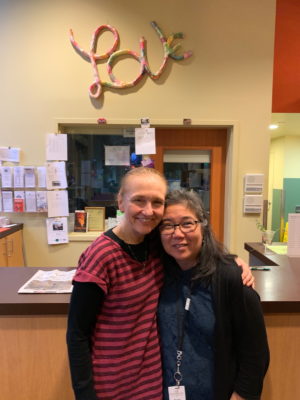
Recovery Café helps those struggling with addiction to drugs and alcohol — some of whom have mental health challenges or are also troubled with isolation and loneliness.
“We get to see them stabilize and build lives they are excited about living,” Noe said. “Every single person is a child of God. Every life is valuable. … No matter what a person’s last experience is, they deserve a place to heal, to belong, a place to know – even if they have never known it before – that they are loved. That’s at the heart of this place.”
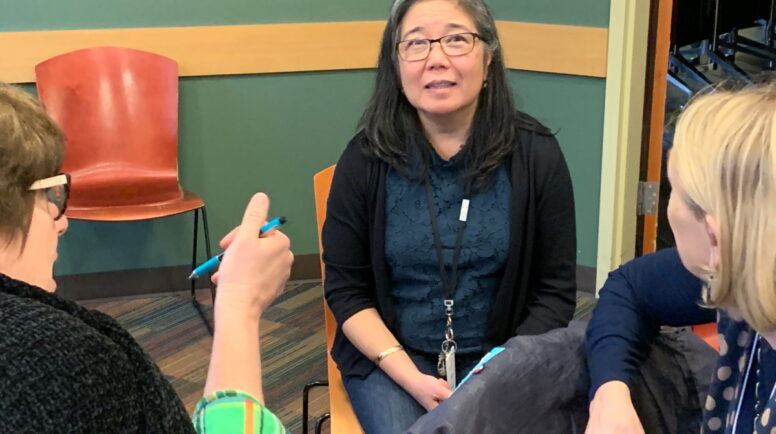
Recovery Café also has begun creating a network to help churches and nonprofits in other parts of the country start their own similar programs — with 15 in the network already, and five more getting ready to start soon. In March, Noe and Ruby Takushi, Recovery Café’s director of programs, invited a group of pastors and others from the NEXT Church National Gathering to visit and talk about the intersection between the challenges of homelessness so many cities are facing, and the possibilities of a compassionate, faith-based response.
The conversation resonated – in part because Presbyterians in many communities are trying to figure out how to be part of the response to homelessness with work that is often done in partnership with others in the community and in response to complicated public policy realities.
Among those in the conversation that day was Erin Thomas, co-pastor of Calvary Presbyterian Church in Riverside, California, a downtown congregation that every Sunday night for more than 30 years has provided meals for more than 150 homeless or food-challenged people from the community through the Hot Meals program. The outreach involves more than food – with partnerships that include providing dental services, medical exams and care for the pets of homeless people.
Also there: Christopher De La Cruz, associate pastor of First Presbyterian Church in Jamaica in Queens, a borough of New York City, which is involved with the Tree of Life affordable housing development — and where De La Cruz is working with young adults from the neighborhood to create a “Twenty Thirty Dream Hub” with co-working space for young adult entrepreneurs and “Adulting 101” workshops on issues such as financial literacy and goal setting. De La Cruz had questions about some of the practical parts of working in ministry with homelessness and housing insecurity issues — not the vision, but more the nuts-and-bolts specifics.
 Noe said that before moving to Seattle, she and Takushi were part of an ecumenical faith community in the tradition of The Church of the Saviour in Washington, D.C.
Part of that culture is “discover what your call is, and step into it,” Noe said. “And you don’t need to wait until you’re 100% sure. … If you’re 51% sure, take the next step. You’ll get the guidance that you need.”
She and Takushi felt a felt a call to work with the homeless — in part out of a recognition that for so many, housing insecurity is related to other experiences of loss and brokenness.
In a video, members of the Recovery Café community tell a bit of their stories – a common denominator of which is the experience of trauma.
A woman describes being raped, beaten, having nowhere to live.
“My kids were living in the car,” a parent says — the pain of not being able to provide ringing clear.
A man describes his suicide attempt, saying: “I had nowhere to go.”
A veteran tells of using heroin, running out of money, feeling dope-sick, addicted but unable to get drugs. He lost his career in the military. He lived on the street.
Recovery Café is built on an idea of membership in a recovery community. The idea is that “we recover and we heal when we are both deeply known and loved,” Noe said.
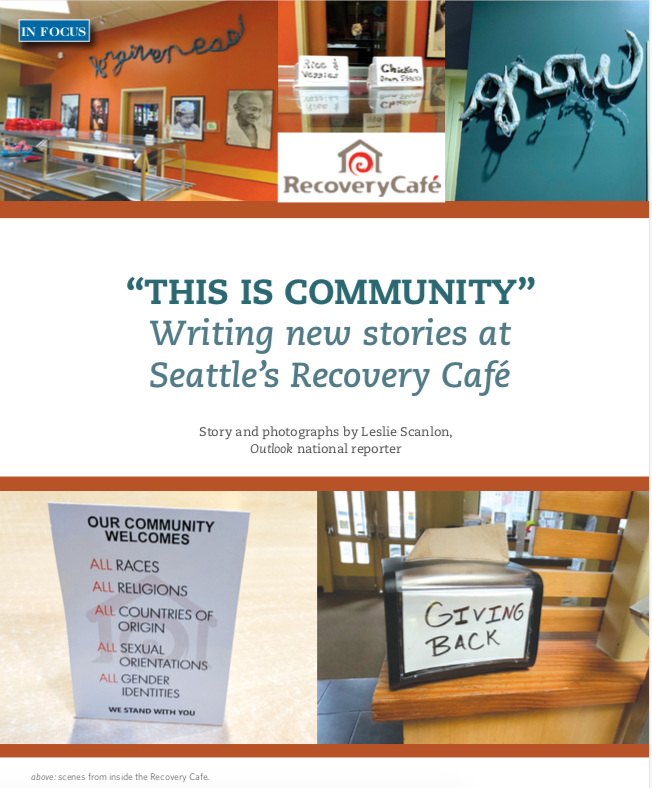
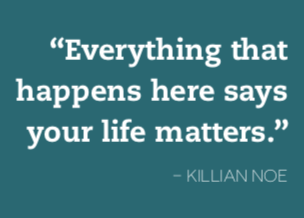
At Recovery Café, there’s an emphasis on beauty – “everything that happens here says your life matters,” Noe explained – so the meals are nutritious and art and words of inspiration cover the walls.
In Seattle, Recovery Café has about 300 active members in 40 recovery circles. Members are accountable for three things: being drug and alcohol free for at least 24 hours; participating once a week in a circle; giving back. The staff is small – fewer than a dozen people – so the members are involved in washing dishes, preparing food, cleaning up.
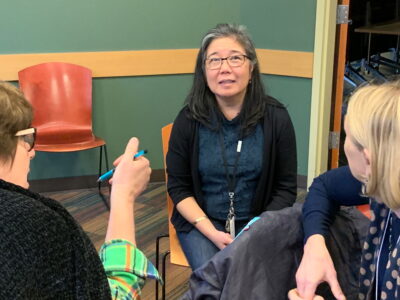
Recovery Café also has found “a gaping hole” in the community for recovery support, Takushi said: a place for people to go between appointments, a place for homeless people to rest when they’ve been kicked off a park bench or shooed out of the coffee shop.
The Café is open noon to 6:30 p.m. Tuesday through Saturday, free of charge, with most of the funding from foundations, individual donors and congregations.
Recovery Café rents space in its building to organizations that provide 12-step programs, but what it offers is distinct from recovery programs, Takushi said. “This is community. Come and stay.”
As the program evolved, people in recovery circles started asking for more — for chances to grow and to dream as people, beyond the focus on recovery from addiction. So the Café started the School for Recovery as a means of jump-starting creativity and self-expression — a place where people could learn to write, to make art or theater, to practice yoga, to run marathons, “to find something that they love,” Noe said.
A man who’d been addicted and homeless for 40 years started first with the walking club, and then joined the running club. He’s now 70, and being a runner has become a core part of his identity. He’ll walk in, saying, “I just knocked out 10” miles, Noe said.
Part of Recovery Café work, she said, is “helping people write new stories.”
Along with its small staff, Recovery Café relies on volunteers – including students, retirees and many who come from faith communities. Volunteers participate in their own accountability circle and have the opportunity to form relationships that cross socio-economic and racial boundaries.
Over time, the staff gets to know the members — working to identify their gifts, looking for leadership and other skills. Five circles meet off-site (three in places that provide transitional housing) and Recovery Café has built relationships with housing and service providers throughout Seattle, although often “the wait list is long,” Noe said.
The community is fluid: roughly a third of the members have been involved for less than 90 days; another third for about a year; and a third for more than a year. Some lose their sobriety, some leave and return later, and others drift away. Recently, a 32-year-old man who had been part of a Recovery Café circle relapsed and died on the street — a cause for real mourning for those who knew him.
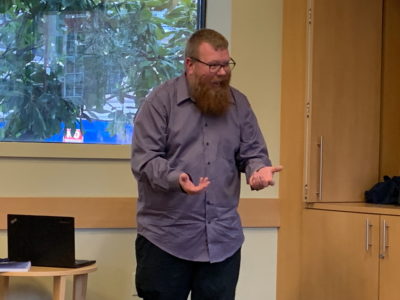
Jason Dunbar also spoke to the group gathered in March. He’s the services coordinator for the Jean Kim Foundation, a nonprofit organization that is based in Lynnwood, Washington, just north of Seattle, and was started by Presbyterian minister Jean Kim, who formerly served on the national staff of the Presbyterian Church (U.S.A.). The foundation provides a support network for the homeless and people living in poverty — meeting those who are homeless at community meals, in tent encampments and on the streets and trying to provide assistance in accessing services for housing, education, employment, mental health and drug and alcohol treatment.
“When I started, I thought I was going to be a hero,” Dunbar said. “God has humbled me several times.”
The work he does involves getting to know people who are homeless or housing challenged, and bringing services to where they spend time. For example, he’s part of an outreach called Shower to the People, started by his father-in-law Frank Fargo, which uses a mobile trailer to offer hot showers at the Wednesday night “Dinner at the Bell” community dinner at First Presbyterian Church in Everett, Washington, and on Saturday mornings at Trinity Lutheran Church in Lynnwood, where lunch is also served.
Another initiative: Wash Mobile, a mobile laundry facility that invites housing-insecure people to wash their clothes.
 Dunbar acknowledged that homelessness can be a polarizing issue for communities — raising concerns for some about garbage, crime, mental health, drug and alcohol use. Some oppose the use of Narcan to help those who are overdosing on heroin. He’s convinced, however, that relationships are key to the response.
As he makes the rounds to places where services are provided and to where those who are homeless camp out, Dunbar spends time talking to folks, asking them how they’re doing, what’s on their minds, what they need. “I get to know them — that’s super-important,” Dunbar said. “It starts with just caring. It starts with consistency.”
He sometimes goes with a friend named Robert, who was an addict himself and got sober through a 12-step program. “He goes where nobody else goes,” Dunbar said. “A lot of the homeless people are hidden. They are not seen. Robert goes into the woods. … He meets them where they’re at,” going into the camps with handfuls of cigarettes, and says: “Hi, I’m Robert. I love you. God loves you. That’s my job, is to love you.”
How can Presbyterians work in their own communities to help those who are homeless?
To build support for Recovery Café, Noe’s approach is to talk about the work to anyone who will listen — to describe the need and the work that’s being done. The initial funding (a $250,000 donation that subsidized the rent and operating costs for five years at a much smaller facility) came after she went for a run with a woman whose husband, a Microsoft executive, had died.
Running is a passion for Noe, part of how she keeps herself grounded. As they ran, the woman asked Noe, “What is it you’re doing right now?”
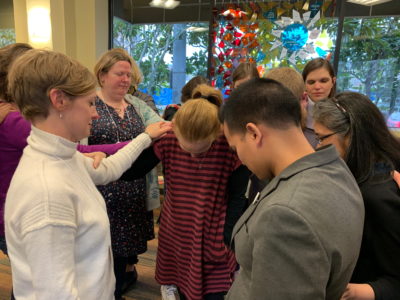
Noe’s answer; “I’m dreaming about this place.”
Talk to anyone who will listen about the need and the vision, she advised the Presbyterians. “I think you just start telling, telling, telling people, and the next step is given.”
Dunbar encouraged both persistence and flexibility. “The first word of warning I have for you is don’t hold on so tight that these stories don’t get created,” he said. “Allow people to blossom. Be a facilitator for inspiration, someone who allows things, people’s gifts, to emerge, because it’s bigger than you. The church is bigger than you. God is bigger than you.”