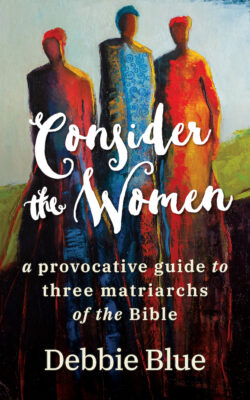
 Debbie Blue
Eerdmans, 224 pages
Reviewed by Deborah McKinley
Speaking about Mary, the mother of Jesus, author Debbie Blue reveals the point of her book: Help us to know in a very deep way that the divine is so much bigger than we think. Exploring three biblical matriarchs with an inquisitive and fresh perspective, Blue offers a great gift to the church: reading the Bible with the questions of our time.
This is a hope-filled book. As Blue explores the stories of Hagar, Esther and Mary, she reveals each woman’s strength and mystery, and shows that the divine is so much greater than we can imagine. Using these three women’s stories, Blue draws us together in an interfaith weaving, noting the important intersections between Islam, Judaism and Christianity.
Beginning with Hagar, Blue asks: How does this story reveal more of who God is? Blue notes that Hagar received the same promise as Abraham: “I will so greatly multiply your offspring that they cannot be counted for multitude.” So begins the exploration of how Hagar’s story parallels Abraham’s. Who is this God who brings an excluded matriarch on par with a patriarch? Blue opens up Hagar’s story by learning from Islam about how Muslims view her and how that informs a Christian understanding.
Blue notes that historically Christianity has been mostly silent on the book of Esther, whereas the rabbis couldn’t stop talking about her. Esther uses whatever means are at her disposal (love and eros) to save the Jewish people from a horrific extermination. Blue explores how eros and desire can be creative tools for living life faithfully. Blue also uses this section to loosen up those of us who are wound a bit too tightly, encouraging us to play. The Feast of Purim is a joyful, playful time in the Jewish community. Even with the playfulness, Blue never looses sight of the story, noting that this is a story about anti-Semitism and struggle. She calls upon the teachings of Jesus and takes us deeply in to lessons on humility and love.
Mary, the third matriarch, is no stranger to Protestants. Blue calls us to the biblical text to explore what is says about her, and to listen with new ears to what Mary says. Far from the demur, quiet, subservient character often portrayed in Christmas pageants, Mary is “the subversive mother of God.” Blue explores many avenues for deepening our understanding of Mary: the Magnificat, the story of wedding wine at Cana, sculpture and art, the cross, Guadalupe and more. The tapestry is rich with images and truth, expanding and challenging our notions of what it might mean to bear the presence of Christ in today’s world.
The book also contains a study guide and discussion questions. As with most study guides, the leader will need to tailor the questions for her own group and setting.
Blue is a pastor, and the book is written with a pastor’s perspective and heart. This is not academic biblical study, though there is plenty of intellectual grist for the mills of our minds. I found this a wonderful book. It’s easy to read, and every now and again I had to put the book down to ponder an idea or image. It will be a useful book for church leaders and members of congregations who wish to learn creatively about who God is and how God might be up to something new.
Deborah McKinley is pastor of East Craftsbury Presbyterian Church in Vermont.