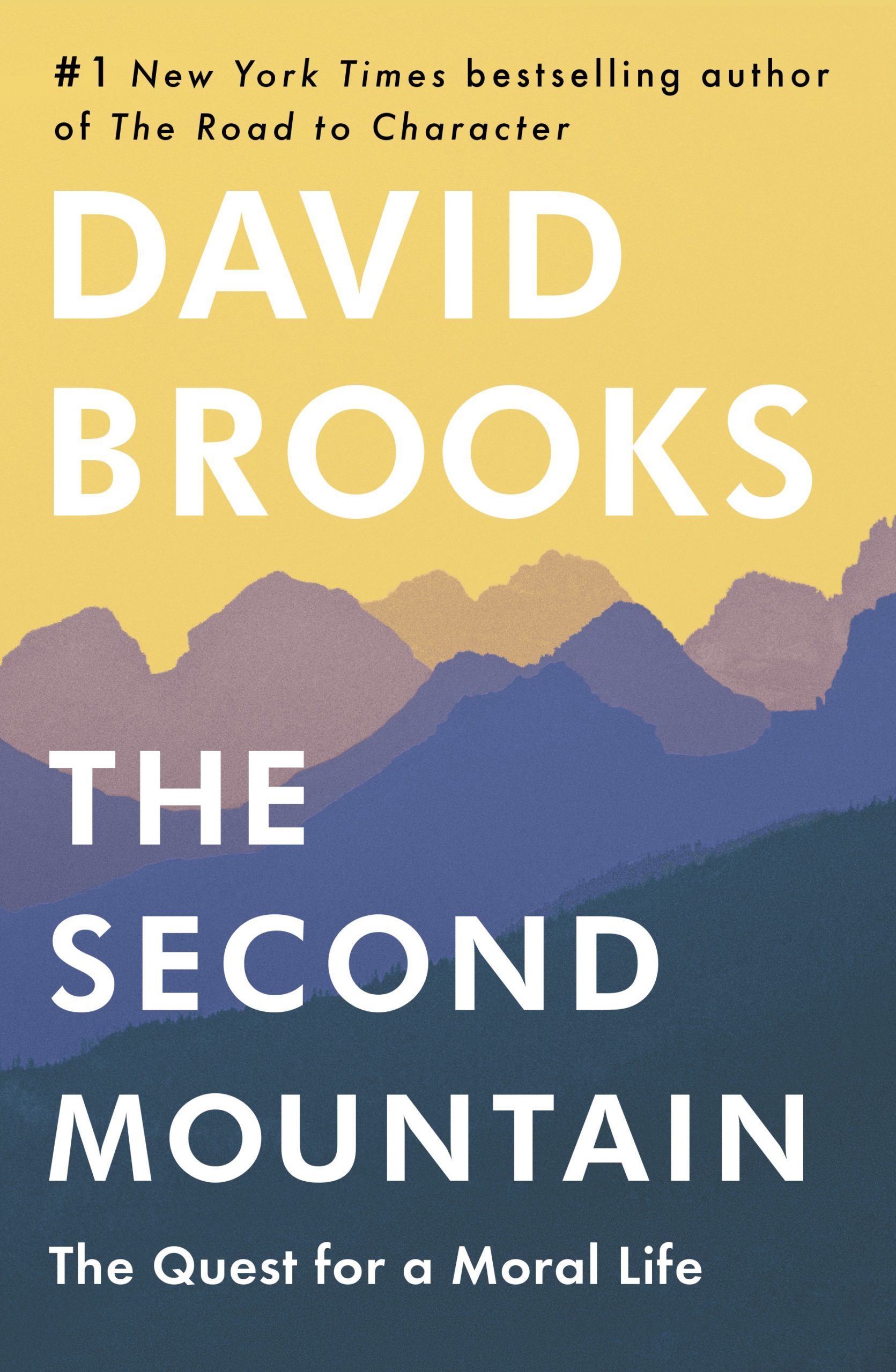
 David Brooks
Random House, 384 pages
Reviewed by Linda Danney Britton
The public man: Op-Ed columnist for The New York Times. Commentator on “PBS News Hour” and NBC’s “Meet the Press.” Author.
The private man: “Something unexpected happens that knocks them crossways. … They are down in the valley of bewilderment or suffering. It’s never too early or too late to get knocked off your first mountain.”
David Brooks, writing in “The Second Mountain,” uses the metaphor of mountains to tell his story. The first mountain is about climbing the ladders of success. The second mountain is “relationalist … where relation, commitment, and the desires of the heart and soul” bring meaning and purpose, “a better way to live.” In the book, he tries to show how people – and then societies – move from the first to the second mountain, “to show what the kind of deeper and joyful life looks like.”
The first part of the book is Brooks’ story of getting knocked off his first mountain and living in “the valley of bewilderment or suffering.” The first mountain is for climbing and conquering, he writes. The second mountain conquers the willing, and leads them to a transformed life. The appeal of this book is in the man himself and his story of suffering, pain and how he chose to respond. I read it as an Easter story: Brooks is transformed, is resurrected into new life defined by compassion and commitment.
As an eclectic reader myself, I was still amazed to read quotations from a diverse group of men and women. Brooks comes from a Jewish heritage and has eyes, ears and heart for Oswald Chambers, Viktor Frankl, Karl Barth, Matthew Arnold, Richard Rohr, the Beatles, Iris Murdoch, Parker Palmer, Elly Hillesum and more. Intriguing and often delightful are familiar words in our lexicon; in Brooks’ lexicon of the second mountain they come alive. He explains that joy is not only a feeling, but an outlook, an animating permanence that comes through second mountain folks. The annunciation moment can be any time in life when delight and challenge are hooked and the one hooked may have a passion and vocation for her entire life. Citing such a moment in Albert Einstein’s life, he tells of when his father gave him a compass; it led to “metaphysical curiosity,” which was a driving force all his life.
Brooks is a teacher at heart as well as a wordsmith. His book leaves no stone unturned as he concludes with manifestos that cover all his bases. But the real heart of this book, as I read it, is to tell the story of what happens when we fall into a valley of despair because of some grievous loss. How should we then live? This is the question Brooks answers with the telling of his own experience of finding hope, love in community and joy.
Linda Danney Britton is a wife, mother, educator and a caregiver who lives in Rockledge, Florida, and is clerk of the session of Rockledge Presbyterian Church.