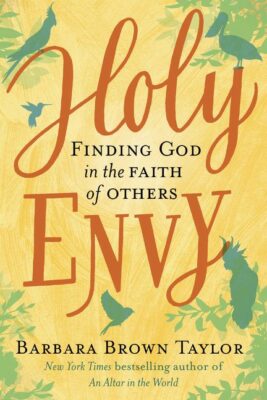
 Barbara Brown Taylor
HarperOne, 256 pages
Reviewed by Paul Rowland Jr.
In her essay on metaphor in the “Oxford Companion to the Bible,” Elizabeth Achtemeier says, “Language about God must be figurative, because it attempts to describe in terms of this world one who is totally different from this world.” In “Holy Envy,” Barbara Brown Taylor suggests that both our understanding of the billions of people of other faiths and our own faith can be enriched by learning about, appreciating and even envying those other faiths.
Since famously leaving church (after 20 years of parish ministry), Taylor taught world religion for two decades at a small, private college near Atlanta. She says that she’d promised her students “that studying other faiths would not make them lose their own.” Then she lost the faith with which she’d started.
“Holy Envy” tells “the story of how that happened and what happened next.” She interweaves her story with those of her students. She invites her students (and us) to be willing not just to learn about other faiths, but to learn from very different faith perspectives. Taylor stresses the importance of learning by visiting other places of worship and engaging people of other faiths, not in the abstract, but in person. As usual, the teacher learned as much or more than the students. Science fiction requires a suspension of disbelief, but this endeavor challenges us to a suspension of belief. As risky as that can feel, the payoff can be both deeper examination of our own beliefs and new appreciation of others’ views.
Taylor charmingly tells stories that edify and provoke unsettling thoughts. And she does both in such articulate fashion that we readers can hardly help nodding and adding a plea for her to tell us more. I believe that similarities allow us to communicate and differences make communication both necessary and interesting. In stories about Taylor’s students’ first encounters with other faiths, those of us raised in the church can identify with their naiveté and their anxieties. To the extent we have learned about other religions, we can identify with the professor’s observations of her students.
Taylor credits the term “holy envy” to Krister Stendahl, former dean of Harvard Divinity School. Taylor explicates Stendahl’s cautions to consider other faiths from the perspective of adherents rather than outsiders, to avoid unfairly comparing their worst to our best and to allow room for “holy envy.”
Those who have been befriended by and gotten to know people with worldviews very different from our own can agree with Taylor’s conclusion that what matters most is the quality of our relationships rather than the details of our faith statements. Taylor quotes 1 John 4:20 to remind us that if we don’t love other people we have seen, we really can’t love God whom we haven’t. She also reminds us of various people of other faiths who populate the Bible, from Melchizedek to Balaam to the Magi.
You can explore other religions by reading works by scholars such as Huston Smith or Karen Armstrong. You can learn why you need to know about other faiths with books such as Stephen Prothero’s “Religious Illiteracy.” But if you are open to personally engaging other faiths, both to know your neighbor’s faith and to enhance your own, I recommend Taylor’s “Holy Envy.”
Mary Louise Bringle begins her book “Envy” by asserting that, “Of all the seven deadly sins, envy alone involves no pleasure.” Barbara Brown Taylor will convince you otherwise.
Since retiring as the psychologist for North Carolina’s Services for the Blind, PAUL ROWLAND JR. has served as commissioned pastor of Berea Presbyterian Church in Four Oaks, North Carolina.