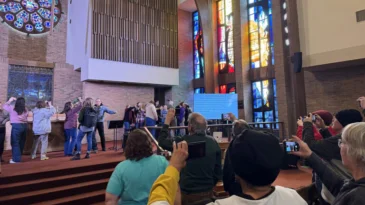
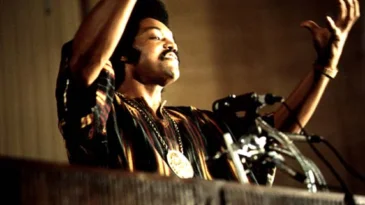
For some mainline Protestant churches and institutions, such as the historically progressive Union, the way forward has been to ally with the social justice movement — perhaps the closest thing the American left has to a civil religion.
“We live out the love of God justly by publicly saying #BlackLivesMatter,” wrote the United Church of Christ, in announcing its advocacy for the #BlackLivesMatter movement on its website, adding, “By insisting on the intrinsic worth of all human beings, Jesus models for us how God loves justly, and how his disciples can love publicly in a world of inequality.”
Prominent progressive Christians such as the Rev. William Barber II, a Union faculty member; former Riverside Church senior minister the Rev. Amy Butler; and Lutheran pastor the Rev. Nadia Bolz-Weber have all made issues of sexual and racial injustice integral to their ministry. Last year, Barber, along with another Union-affiliated pastor, the Rev. Liz Theoharis, led an interfaith revival of Martin Luther King Jr.’s 1968 Poor People’s Campaign, advocating for the poor through rallies, protests and teach-ins.
For these progressive Christians, addressing earthly inequality isn’t just necessary to reaching an increasingly secular America; it is part and parcel of the Christian mission.
While challenging the secular world with their Christianity, progressives also criticize what they see as insufficiently enlightened elements of Christian tradition, no matter how deeply ingrained. Writing on gender and sexuality in her latest book, Bolz-Weber said St. Augustine, the fourth-century author of a strict sexual ethic, “took a dump and the Church encased it in amber.”
When it comes to questions of gender and sexuality, progressive Christianity is often forced to balance values such as those seemingly espoused in its traditional texts (like Augustine) with far more inclusive contemporary principles.
For these progressive Christians, the language of social justice is a way of translating the gospel message of a kingdom of heaven on earth into a contemporary world, but they also are adamant that Christianity must adapt to stay relevant.
Union in particular has led the forefront of this charge. Its Episcopal Divinity School, for example,“intentionally engages disparities in society based on gender, race, class, sexuality and other marginalizing forces,” mandating specific courses in racial and sexual injustice (and Spanish-language liturgy) as part of its curriculum.
As early as 2015, it established a Center for Earth Ethics, devoted to addressing the environmental crisis from a theological perspective. “At the root of global climate change is human greed, and gross and violent power inequities,” Union President Serene Jones said in a statement at the time . “To address this social justice issue, we need wise, inclusive, justice-driven and well-informed leaders.”
For Union’s progressives, a world in which plants, animals and human beings live in harmony is held up as a corrective to a world spoiled by the original sins of structural inequality and conquest. In this view, the same ethos of violence underpinning patriarchy, racism, capitalist exploitation and colonialism also underpins human exploitation of the natural world.
This critique is not restricted to progressive mainliners. In 2014, Pope Francis called the exploitation of the Earth “our sin” and demanded that Christians “convert ourselves to a type of development that knows how to respect creation.”
By contrast, conservative Christians tend to celebrate the idea of dominion expounded in the Old Testament Book of Genesis, in which God gave control over Earth to humans. At a 2012 energy summit, Catholic politician Rick Santorum dismissed concerns about climate change, arguing, “We were put on this Earth as creatures of God to have dominion over the Earth, to use it wisely and steward it wisely, but for our benefit, not for the Earth’s benefit.”
Santorum’s vision and Union’s plant-based confession reveal the degree to which American Christianity has cleaved, with each side allying with their respective political camps. Even as white evangelicalism has moved further and further to the right in the past few years in its embrace of the GOP and Donald Trump, becoming a political entity in its own right, so too is progressive Christianity learning to sing, well, from a similar contemporary hymn sheet.