

A natural occurrence in the business world, mergers also happen with some regularity in faith communities. When two organizations – be they banks, nonprofits or congregations – find their relationship evolving into ever more cooperative processes, merging becomes a natural option. Sadly, this rarely happens amicably. After all, popular jargon connotes negative circumstances around mergers with phrases like “hostile takeover” or “absorption.”
Perhaps you serve as an executive of a nonprofit organization or as a ruling elder or pastor of a congregation that is considering a merger. The situation is likely replete with emotion. Shared histories, culture and supervisory infrastructure are possibly at odds. But your circumstance is not without precedent.
I am pleased to share the story of one merger that, while it presented unique challenges, has proven to be a unanimous success in the eyes of all stakeholders. As of January 1, 2018, Presbyterian Children’s Homes and Services (PCHAS) of Texas and Louisiana officially merged with Presbyterian Children’s Homes and Services of Missouri. United by a mission to deliver Christ-centered care to children and families in need, the new agency offers 12 programs across three states and serves approximately 5,000 clients. Our administrative, programmatic and funds development efforts are streamlined to increase our operational capacity and expand our reach to target audiences. We are financially secure, thanks to the generous philanthropy of a combined donor base that has been supporting the agency since 1903. And we continue to grow — perhaps the most reliable indicator of success.
A natural friendship
Key to this success is the fact that our merger was not an event — it was a process. Six years ago, the presidents of The Children’s Foundation of Mid-America (CFMA) and PCHAS of Texas and Louisiana met to discuss the compatibility of their programs. A friendship blossomed, and Jim Thurman of CFMA (headquartered in St. Louis) and Ed Knight of PCHAS (headquartered in Austin, Texas) began to discuss how each agency’s strengths complemented the challenges of the other. Both agencies had strong programs with excellent outcomes. CFMA was nationally accredited and had expertise in information technology, while PCHAS had a comprehensive fundraising and communication program, advanced financial systems and a significant endowment.
The similarity between the agencies’ histories was an obvious boon to negotiations. Both organizations were founded as Presbyterian orphanages more than 100 years ago. Both originally featured residential programs for children and more recently expanded their community-based programs to adapt to modern needs and best practices. As the two presidents and their respective boards entered into a dialogue, new options began to emerge.
In 2013, discussions between the two agencies revealed three options for partnership:
- PCHAS could serve as a consultant to CFMA.
- PCHAS and CFMA could merge.
- PCHAS and CFMA could adopt an affiliation agreement, allowing them to build mutual trust as ideas and processes were shared. PCHAS could direct CFMA’s financial management and funds development and CFMA could consult on technology.
After substantive meetings, both boards of trustees chose the third option. They elected Knight as president of the CFMA board and supervisor of Robert Giegling, CFMA’s executive director.
“Merger was not a foregone conclusion at the very beginning,” Knight recalls. “Foremost in my mind was the desire to do this ‘partnership’ as equitably as possible. I was confident that both agencies had a lot to offer each other. Ultimately, we could choose to merge or part as friends.”
“We weren’t ready to merge yet,” says David Thompson, current president and CEO of PCHAS. He served as vice president of PCHAS of Texas and Louisiana during the original negotiations. “We chose to ‘date,’ and what became a five-year courtship allowed us to build trust and learn about each other’s strengths and weaknesses. I would recommend it to other agencies considering a merger.”
Official affiliation
During the affiliation period, each agency learned a lot about the other. They wrestled with many of the same challenges regarding traditional, residential services versus more holistic community-based services whose goals were to prevent children from being separated from their families. Together, the agencies explored how to secure more private and government funding, and systematically identified administrative efforts that could be centralized.

“Looking back, it was a careful, thoughtful process with no predetermined outcome,” says Giegling, who now serves as senior vice president of programs for PCHAS. “We knew we could be stronger together, so we practiced what we teach our clients every day: We focused on our strengths, not our weaknesses; and we focused on our future, not our past.”
“We had faith,” says Thompson. “Faith in each other and our shared commitment to serve children and their families like Jesus. We had faith in God, and faith in the words of the apostle James, who told us to ‘care for orphans and widows in their distress.’”
That foundation in Christian faith has always been central to the people of CFMA and PCHAS. In fact, for many years, The Children’s Foundation of Mid-America had been known as Presbyterian Children’s Services. After the affiliation agreement, leaders agreed that CFMA should publicly and unabashedly return to its roots and become Presbyterian Children’s Homes and Services of Missouri. Now, the two affiliated agencies remained separate legal entities, but were closely aligned with a shared name, shared logo, shared displays and print material, and a shared mission statement.
During the five years of affiliation, three board members from Missouri served on the Texas board and vice versa. The Missouri agency guided the Texas agency through the process of accreditation. The chief financial officer for Texas and Louisiana was asked to supervise the finance team in Missouri. “We started working together from the very beginning,” shares Linda Bishop, now senior vice president of finance and administration for PCHAS. “We ensured each agency had a solid business plan in place so that we could all continue our mission. Our common interest was and continues to be a deep commitment to meet the evolving needs of children.”

Staff who worried about layoffs soon learned that there was enough work to keep everyone employed. Certainly, social work could not be outsourced. But a generalist in human resources could become a specialist in recruitment. A graphic designer in one location could take on assignments for other locations, freeing up time for someone else to improve our digital presence. Bishop comments, “We are committed to being good stewards of the talents of our employees. Our goal is to provide the foundational support to serve children and families.”
In 2014, the affiliation got underway and, as vice president of development for PCHAS of Texas and Louisiana, I immediately began supervising the development and communication staff in Missouri. Over the next four years, we shared best practices for special events and social media campaigns. We consolidated our databases into one system and strengthened Missouri’s planned giving efforts. We clarified our branding and created new marketing materials. We began to print publications in greater quantities at lower costs. All of these efforts enabled us to spread the message of PCHAS to more donors, clients and church partners.
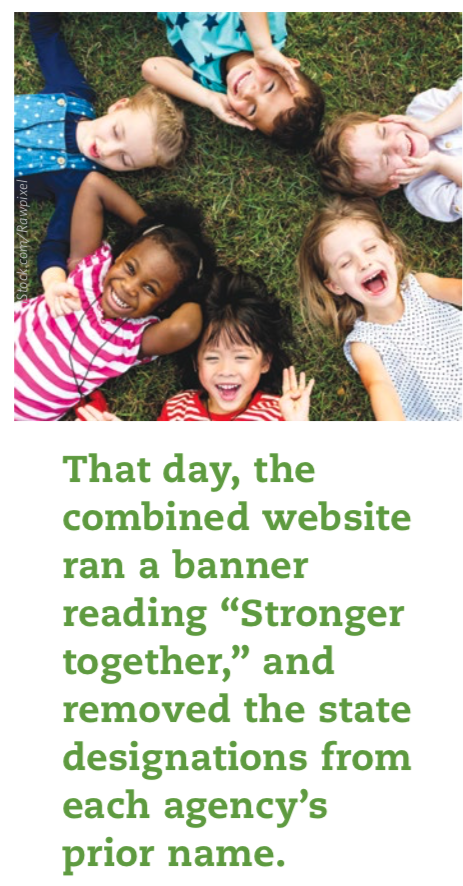
By 2017, the trustees and senior staff of both agencies felt the time was right to discuss the possibility of a merger. Knight announced his intention to retire at the end of 2017 and the trustees of each board were beginning to rotate off. After several discussions by a joint committee to explore merger, both boards unanimously voted to merge on January 1, 2018. That day, the combined website ran a banner reading “Stronger together,” and removed the state designations from each agency’s prior name.
Stronger together
A primary goal for the first year of the merger was to serve clients without interruption. The original agencies each had six programs and it was agreed that they should continue unchanged for at least a year. Clients did not see any disruption in service delivery. Counseling for families, housing for teenagers leaving foster care, adoption services and other programs continued as usual.
 Giegling, who now oversees all 12 programs, says: “Because our goals are permanency for children and self-sufficiency for adults, and our preventative programs are the most successful in achieving those, our early-intervention models have been growing and will continue to do so. We have been training all staff in a trauma-informed approach with a method called Trust-Based Relational Intervention or TBRI™. It is highly effective in treating children and adults who have endured trauma.”
Next, the board and executive staff focused on creating a new strategic plan. A consultant facilitated the process and helped us clarify our strengths and challenges. We also chose specific, measurable goals and strategies that clarify what we want to achieve as a merged organization.
A third important focus of the first year was employee satisfaction. Thompson made sure supervisors checked on team members and gave opportunities to express concerns or ask questions. The executive staff traveled between states making post-merger presentations, held smaller staff roundtable discussions to listen to their team members and conducted an anonymous survey. Naturally, we had staff members who were concerned about losing their jobs, changing duties and understanding who was in charge of what. All of these are normal responses to any merger and can cause frustration. Making a strong effort to address these questions head-on paid off in staff morale and productivity.

It was heartening that a number of employees considered us merged before the vote. Still, with staff spread across three states, we looked for ways to reinforce teamwork. Trainings occurred in various locations and we invested in travel arrangements so new co-workers met face to face. We created an optional, private Facebook group for employees to post their professional successes and share PCHAS-related stories about their office, work, events and other noteworthy topics.
Throughout 2018, Bishop directed efforts to increase the agency’s status as an employer of choice. “We continue to offer ‘total rewards’ benefits: medical, dental, vision, generous time off and retirement,” she explains. “Our staff surveys gave us a goal to promote health and work/life balance through flexible work schedules and another goal to increase employee retention by creating staff growth and advancement opportunities.”
A careful, prayerful partnership
Over a year has passed since our official merger. PCHAS continues to grow. We can do this because of the years of preparation and careful, prayerful partnership that preceded what could have been a much more tumultuous merger. Today, all PCHAS locations – from Baton Rouge, Louisiana, to Dallas, to Joplin, Missouri – benefit from a united brand that delivers consistent service and, at the heart of everything, a clear message of Christ’s love.
I believe that our mission is truly what united us all. Executive teams, boards of trustees, staff and even our donors all strove towards the same goal: to bring healing to children in need, as Jesus and his disciple James called us to do. When faced with questions of policy or procedure, we all felt that deference to those with the expertise to best achieve that mission was the only option.
To anyone in a faith community faced with the possibility of a merger, my advice is similar to what I might give a couple considering marriage. Before entering into the union, you must both leave your pride behind in favor of a new, shared understanding of what you can accomplish as a team. Your partnership must have its own identity that is defined by both of your talents and weaknesses. And you must both commit to helping each other achieve your calling. Because when we find a partner who inspires us to grow in faith and purpose, we can only be stronger together.
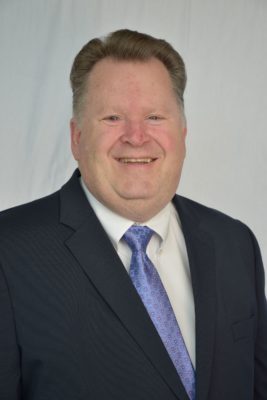 Peter D. Crouch is the senior vice president of development for PCHAS and the moderator of Mission Presbytery in Texas. You may reach him at peter.crouch@pchas.org or at 512-433-9157. Learn more about PCHAS’ mission of service at pchas.org or call 800-888-1904 to get involved.