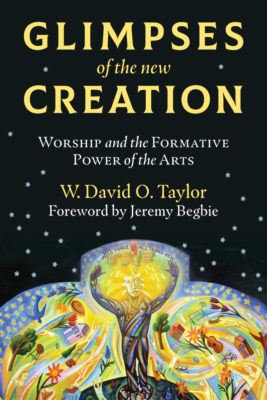
 W. David O. Taylor
Eerdmans, 312 pages
Reviewed by Kristin Stroble
As a solo pastor of a traditional congregation, I spend a great deal of time shaping worship that honors our identity and tradition while also being inclusive, participatory and spiritually rich. What a surprise and delight to read David Taylor’s book which speaks of the power of the liturgical arts to form identity in a particular context and to open up and close down “possibilities for the formation of a human life in the particular context of corporate worship.”
I own many books that give practical suggestions on the use of liturgical arts in worship. My shelves are filled with books of poetry, hymns, visual arts, multicultural liturgy and other worship resources. “Glimpses of the New Creation” provides a much needed basis for how the arts shape us and our congregations, as well as a theological understanding of the liturgical arts. He begins by defining worship and the arts before delving individually into the musical arts, visual and architectural arts, poetic arts, narrative, arts, theater arts and the kinetic arts. With each form he asks how they work, what their powers are and how might they form us as a people of God. He reminds us, “Art will not serve worship best when it is done ‘for art’s sake’ … it is art that aims not to draw attention to itself but to impart the urge to pray.”
This is a book I will keep returning to as I work with others to shape worship that unites us a body of Christ, invites an experience of the Spirit in our midst and sends us out in mission. It is a guide for worship committees as they struggle with multigenerational or multicultural worship that is hospitable and inclusive. It provides language for pastors who are seeking to introduce the arts in worship, not for its own sake, but to bring the community deeper into communion with the Triune God. Acknowledging that each context is unique and specific, Taylor provides an understanding of the Spirit’s work in worship, so that we can be grounded in our identity and open to newness.
Not to be missed in this book are the tools that Taylor provides in the appendices. He offers questions for discernment before incorporating the videographic arts in worship; affirmations on context and the worship arts; and exercises for discernment as a way to discover with others if a particular medium of art might work in a specific congregation. These resources are helpful to move the discussion beyond what is familiar in worship and our personal preferences to how specific practices of arts form and shape us.
If you are looking for a book with practical ideas to use the arts in worship, this is not it. If you are looking to enter into a deeper conversation about the role of arts in worship, the discernment that is necessary before introducing a new form of art and the powerful ways that the liturgical arts shape us as individuals and a community, look no further. No matter what shape your corporate worship comes in, Taylor’s work will guide you to intentionally reflect on how to engage the arts in worship and their particular power to form community, open us to others and to enable our praise of the Triune God.
 Kristin Stroble is the pastor of Eastminster Presbyterian Church in East Lansing, Michigan.