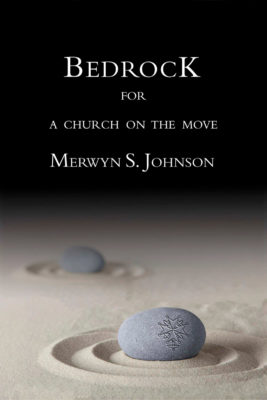
 Merwyn S. Johnson
In Christ Supporting Ministries, 244 pages
Reviewed by Thomas W. Currie
Merwyn Johnson has written a remarkable book — one that should be of interest to pastors and teachers of adult Sunday school classes. His book deals with theology, particularly Reformed theology, but not in the abstract so much as in the way that theology has shaped and is embodied in the worship and witness of the church. The author is adept in tracing the history of the church’s creeds and the development of various expressions of the faith, clearly explaining difficult concepts and distinctive aspects of the Reformed tradition. More than that, the author evidences a deep love for the church and a serious engagement with its controversies, failings and occasional moments of clarity. His grasp of the tradition is both firm and nuanced, and his ability to explain the roots of old and not-so-old controversies is extraordinarily helpful.
The book is intended to address the current turmoil within American Protestantism generally, but more specifically it is aimed at the fractious family of American Presbyterians. To that end, the author claims that the worldview bequeathed to us by the Enlightenment, what he calls the “Modernist-Pietist” paradigm, has obscured from us (if not actually distorted our understanding of the faith) and prevented us from receiving and proclaiming its gifts. Most critically, by persuading us that the faith begins with “me” and either what I “feel” or am prepared to accept, this paradigm makes it difficult for us to discern the center of our faith not in ourselves, but in Jesus Christ. The result is a Christianity unmoored from its anchor and able only to express itself in increasingly trivial stances, most of which lead to deeper divisions and unjoyful and even boring self-expressions.
An adult Sunday school class or long-term weekly gathering would benefit from this book for at least three reasons. First, it is written so clearly and is so free of jargon that its substance is readily accessible and helpful in stimulating discussion and thought. Second, in dealing with various topics, the author has comprehensively summarized the history of the faith and invited readers to see and appreciate the abundance of resources that support us today. And third, the author so clearly loves the church and is convinced that through its worship and work we participate in Christ’s mission and celebrate his presence in the world. As an unapologetic work of theology, this book is not a celebration of theology but of the faith that finds in Jesus Christ a reason to rejoice and hope.
A final note: The title of this book may seem incongruous or even contradictory. A “church on the move” might grow weary with the burden of a “bedrock” or even think it to be in the way, which is the author’s point. The church only moves forward as it stumbles over the rock of Jesus Christ. He is the way. To the extent that we would rather have an “untheological” church, we risk trivializing the gospel and soon lose our way, until the bedrock of our faith causes us to stumble, mercifully, again.
 Thomas W. Currie is professor emeritus of theology at Union Presbyterian Seminary in Charlotte, North Carolina.