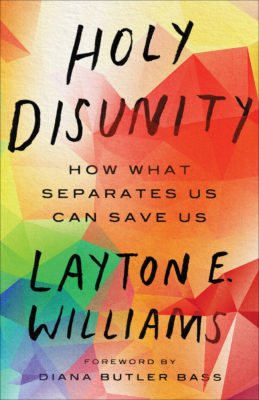
 Layton E. Williams
Westminster John Knox Press, 215
Reviewed by Karie Charlton
“Holy Disunity” is my first encounter with Layton Williams. I felt like a nosy roommate reading her diary. I wished her personal details arrived more slowly. But then again, this isn’t about my comfort (embracing diversity is never comfortable). And like two strangers in a tiny dorm room, I grew to love her after the initial oversharing.
“Holy Disunity” is about embracing our differences and still finding unity in Christ. When we acknowledge that God is in control (and we are not), we won’t feel threatened by disunity — perhaps we might find it holy.
We are all created in the image of God, each of us carrying that image in different ways. Being different can cause fear and prejudice, but it’s “a gift that allows relationship to grow. … Embracing the gifts of difference requires us to ask hard questions about why and how we celebrate diversity, and for whom.” Williams identifies as a 4 on the enneagram and brings a unique perspective on what it means to be distinct and yet be in relationships with others.
Williams shares anecdotes from seminary and from coming out as queer to show how differences and doubt can be beneficial for identity and faith formation. She weaves her experiences as someone who is labeled “different” as she continues to invite readers into her life: her experience of sexual violence, depression and anxiety that lead to disordered eating, all in order to share the stories in Scripture with new light and meaning. She weaves her experiences and our common experiences together to prod the reader to action. Each chapter is truly a gift.
In the chapter on arguments, she presents an interpretation of Abraham’s near-sacrifice of Isaac and her bravery in maintaining relationships with those who struggled to affirm her bisexuality to show that arguing can save us. “Perhaps the question for us is what to obey and how, and how to do it in ways that foster authentic relationship rather than rigid systems of decorum where people are bound by the structures of civility or nicety and can therefore only offer some fractured and restrained insight into their convictions.”
Williams’ thoughts on tension should be required reading alongside conflict management in interim/transitional ministry training. Staying engaged in relationships with (healthy and reasonable) tension allows us “to encounter the God-given complexity in ourselves, and in others, and in this world.”
Even though divisions in the church and denomination can make us feel separated, we are still “bound up together in love of the same God and in that God’s love for us.” We benefit from being in mutual vulnerability, and from being in relationship with one another and, of course, Jesus. When we see the vulnerability in others or the troubles of the world, we must protest against them and advocate for justice. Our hunger (physical and spiritual) can bring us together. Our limits and our failures can also bring us together in our humanness and give us room to learn and grow and find undeserved grace.