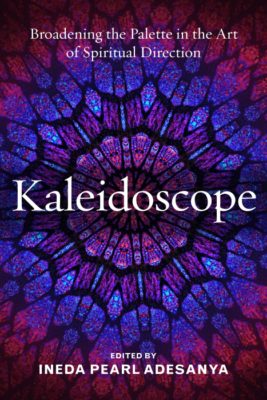
 Edited by Ineda Pearl Adesanya
Church Publishing, 256 pages
Reviewed by Ethel Hornbeck
Over the last several decades, there has been an explosion in programs and resources designed to equip those who would companion others on their spiritual journeys. Despite increasing interest in the practice of spiritual direction among people of color, these resources remain stubbornly white and Eurocentric. This book, from the Spiritual Directors of Color Network, is the third volume in a series designed to address this deficit.
True to its name, “Kaleidoscope” is a beautiful book, made all the richer by the diversity of perspectives that it includes. In a series of essays, it explores the basic principles of spiritual guidance while centering the voices of an experienced group of spiritual directors of color. Various themes, including community, storytelling, remembering and relationality, thread their way like bright colors throughout, appearing in a variety of forms, stories and tools.
One of the most memorable conceptual themes in these essays is emphasis on the African concept Ubuntu as a fundamental principal for spiritual guides. Often translated as “I in you and you in me,” Ubuntu implies we should love our neighbors as ourselves. But even more, Ubuntu offers a spiritual worldview that we are so inextricably interdependent that we can only become who God intends for us to be in relationship. Ubuntu wisdom is a direct and provocative challenge to the entrenched individualism of the West.
A unifying practical theme is the importance of understanding context, and of developing an acute sensitivity to “cultural realities beyond the Western European palette of experience.” People who do not fit into a dominant culture paradigm will have very different lived experience, ways of knowing God and spiritual practices. Sometimes lament may be a far more fruitful form than silence; gospel music may be for some a more contemplative practice than Taizé. Attention to context is necessary to ensure that the hospitality offered by a spiritual guide is life-giving and not just another form of cultural oppression.
In “Internal liberation,” one of the book’s most powerful and provocative essays, Therese Taylor-Stinson and Paula Owens Parker connect the core spiritual concept of inner freedom with the need for liberation from trauma and systems of oppression. The authors engage here with Howard Thurman, the great African American theologian and mystic, lifting up his wisdom on the inner journey and his call for the “radical change of the inner attitude of the oppressed.”
Thurman, one of the most important spiritual teachers of the last century, is a recurring voice in this collection. Long a Thurman fan, I encountered him first in studying the American civil rights movement. As I explored his wisdom weaving through this book, I wondered repeatedly: Where was Thurman in my many years of studying spiritual direction? In many years of seminary, studying spirituality, mystics and mysticism? In many years of contemplative retreats? This marginalization alone illustrates why we need this book.
Designed specifically to be a “people of color-centered spiritual direction curriculum,” this is an indispensable resource for anyone engaging in various forms of spiritual companioning across all kinds of differences, including faith tradition, race, ethnicity, sexuality, age and social location.
Ethel Hornbeck serves as director of spiritual formation and campus ministry at Shepherdstown Presbyterian Church in West Virginia.