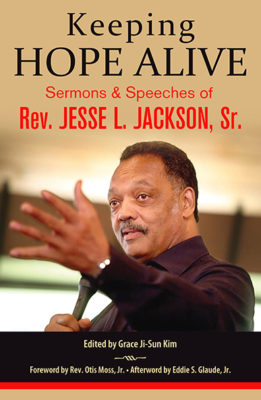
 Edited by Grace Ji-Sun Kim
Orbis Books, 256 pages
Reviewed by Sterling Morse
The offerings in “Keeping Hope Alive” remind me of what I was told by a homiletics professor at the Interdenominational Theological Center when he saw me struggling with the preparation of a message I was invited present at a non-religious event: “Whenever a preacher gets up to speak, he ought to preach.”
The missional journey of Jesse L. Jackson Jr. is the embodiment of this directive. The difference between his preaching and speechmaking is minute. This book is a collection of some of the finest prophetic preaching in the historically black church tradition. His messages are aimed at the head and heart of his listeners and speak truth to power, providing voice for, in his words, “the desperate, the disinherited, the disrespected, and the despised.”
In an increasingly polarizing world, Jackson’s sermon, “The moral center,” still resonates calling those seeking racial and socioeconomic healing to stand firm and convicted in the tension between the popular and the political. In “Justice for all,” his use of a Martin Luther King Jr. quote also provides a common theme for all of Jackson’s messages: “The arc of the universe is long, but it bends toward justice.”
The messages contained in this book allow the reader to trace the incremental growth in Jackson’s missional journey, with his passion for ministry rooted in the civil rights movement broadening to include co-organizing intercultural advocacy groups like Operation Breadbasket and PUSH (People United to Save Humanity).
This process eventually lead to his grandest idea, Rainbow PUSH, the merger of PUSH and the National Rainbow Coalition, whose organizational focus is social justice, civil rights and political activism and creates space and opportunity in a restrictive society for not only African Americans, but including people of color, women, children and the disenfranchised.
“Rainbow nation,” the speech delivered at the Democratic Party National Convention in 1984, solidified the Rainbow Coalition’s agenda as a political platform, calling the United States to become all-inclusive and make space at the national socioeconomic table to include Native Americans, Asian Americans, Arab Americans, young Americans, disabled veterans and farmers.
Jackson’s ministry emerged from the fertile dark soil of the historical black church where the spoken Word is central. This book could have closed with a new sermon, a prophetic word at the end to smoothly pass the torch to the on-the-ground activists making courageous stands at the feverish intersection where all forms of discrimination are intermingled today.
“Keep Hope Alive” is a testament to Jackson’s faithfulness to his sense of call to social activism. It is a must-read for those on the frontlines of the present-day wars for justice and equality. It provides a chronicle of progressive ideas espoused during the post-civil rights era, and the courageous efforts of people who at great risk crossed sturdy historical boundaries of race, class, gender and culture to build fledgling intercultural communities thriving on comprehensive mutuality, reciprocity and equality.
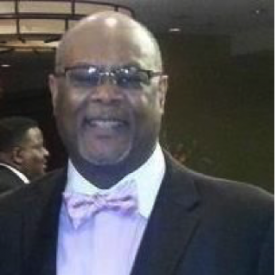 Sterling Morse is transitional pastor at Church of the Redeemer Presbyterian in Washington, D.C.