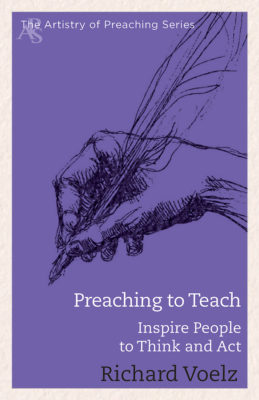
 Richard W. Voelz
Abingdon Press, 134 pages
Reviewed by Paul Rowland Jr.
When asked what to do about the dire concerns regarding Nazi persecution, missiologist Henrik Kraemer declined to tell the desperate Dutch laity what to do. Instead, he read 1 Peter 2:9-10 and told them, “If you know who you are, you will know what to do.”
So, what is a preacher? Richard Voelz begins his slim volume with a review of images of those who seek to proclaim the mighty acts of God. He begins with a pithy review of preaching roles — from Augustine’s purposes of preaching “to teach, delight and persuade” to a 12th-century “public instruction in faith and behavior” to Tom Long’s more recent “witness.” Then, Voelz suggests a particular kind of teacher and subject matter.
The role of preacher-as-teacher was revived in response to congregational decline, Voelz says, both in numbers and in knowledge about the Bible and doctrine. He discusses Paul Scott Wilson’s concern that too much emphasis on teaching about God has resulted in too little proclamation, leaving listeners without a personal encounter with God.
But, if you think that “Preaching to Teach” involves biblical literacy boosts like “tidbits about Timothy” or “facts about Acts,” think again. Voelz proposes another perspective on preaching: critical pedagogy. He presents Henry Giroux’s adaptation of Paulo Freire’s concepts, describing pedagogy not in terms of just conveying facts and theories, but doing so mindful of the environment of power structures, politics and culture. Applying these concepts to preaching enlarges the pastor’s teaching role to empower listeners.
To readers not already familiar with critical pedagogy, the sledding can be slow, but Voelz provides a helpful glossary of terms in his last chapter, which usefully summarizes themes in the book. Two terms I wish he had included are “preacher” and “teacher.” To avoid the gender issues of kings and power issues of empires, Voelz favors an alternative to terms like “the Kingdom of God” or “God’s Empire” — he prefers the Greek basileia tou theou. As preachers imagine the public sphere this way, Voelz proposes three preparatory questions:
“1. What’s the vision for the public sphere in my congregation?
2. What’s the vision for the public sphere in the biblical text? and
3. What’s the vision for the public sphere in my preaching and this sermon?”
Three annotated examples of teaching sermons comprise most of the last chapter of the book, including one by preacher and teacher Casey Thornburg Sigmon, an outstanding one by Brian Blount, president of Union Presbyterian Seminary, and one by Voelz, himself a professor of preaching and worship at the same seminary.
Walter Brueggemann has written that prophets are not so much predictors or social advocates as “emancipated imaginers of alternative.” Voelz proposes that preachers be teachers who dare to become such imaginers.
As you read “Preaching to Teach,” you may not conclude, like Jeremiah (1:9), that the Lord has put words in your mouth, though you may decide, like Isaiah (50:4), that “the Lord God has given me the tongue of a teacher, that I may know how to sustain the weary with a word.” May you and I, like Isaiah, have our ears wakened by God “to listen as those who are taught.”
Since retiring as the psychologist for North Carolina’s Services for the Blind, Paul Rowland Jr. has served as commissioned pastor of Berea Presbyterian Church in Four Oaks, North Carolina.