Following worship, the first substantive matter the 2020 General Assembly took up June 26 addressed, essentially, the scope of the business this General Assembly will consider: whether to try to do more on more subjects, or focus more intensely on fewer matters related to COVID-19, racism and social justice.
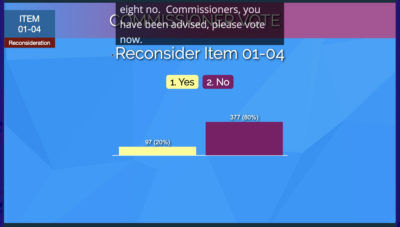
On the table was a a motion to reconsider Item 01-04 — the list of business that this General Assembly will consider, and what it will refer to the General Assembly in 2022. That motion to reconsider ultimately failed – with commissioners voting it down 377-97 – but the discussion on it reflected the intensity of views some commissioners bring to this assembly on how to address matters of race and social justice forcefully, given a truncated virtual assembly.
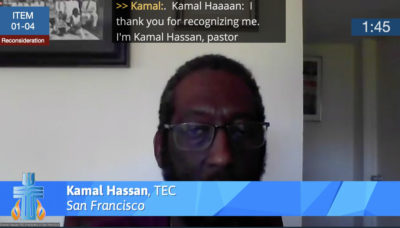 The Bible says “there is a time under heaven for everything, but this is not the time for this discussion,” said commissioner Kamal Hassan, a minister from the Presbytery of San Francisco. “We have other critical issues to discuss,” but limited time, and an urgent need to focus on “social justice for the many. … I believe that George Floyd is looking down on us from heaven and asking, ‘Jesus, what are they doing?’ ”
Some commissioners wanted to add certain items of business to what the assembly would consider this year — exactly what those might be never became clear, but likely issues such as the Presbyterian Church (U.S.A.) policy on family leave for pastors or matters related to climate change or human rights issues internationally.
The assembly had passed Item 01-04 in its first plenary on June 19, but on June 20 received a motion to reconsider, made by Megan Acedo, a ruling elder from Philadelphia Presbytery.
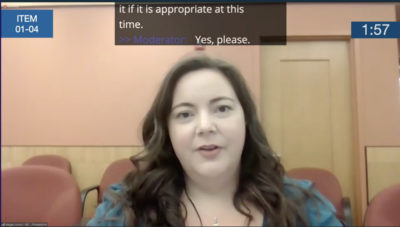 Her argument: When the assembly voted on June 19, at least seven commissioners were lined up virtually to ask that more items be considered this year and not be referred — and “it’s important to seek to hear as many voices as we can.”
The Committee on the Office of the General Assembly (COGA) is recommending that this assembly – being conduced virtually and on a shortened schedule because of the COVID-19 pandemic – consider only “critical and core” business, with the criteria for that being:
- That the item is so time-sensitive the assembly needs to address it now;
- That not addressing it in 2020 would negatively affect PC(USA) finances; and
- That not addressing it would leave important leadership positions vacant.
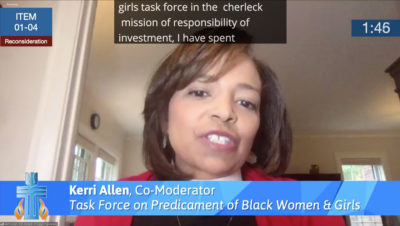 Some of those speaking against expanding the business argued, however, that because of COVID-19 and limits to internet access, some Presbyterians would not be able to participate at this assembly and their voices would not be heard. “There are people who are wading through death and illness and who will not have the bandwidth and the time and attention needed” to follow the assembly’s business this year, said Kerri Allen, a corresponding member and co-moderator of the Task Force on the Predicament of Black Women and Girls and incoming chair of the Committee on Mission Responsibility Through Investment (MRTI).
In 2022, the issues raised by recommendations being referred to the 2022 General Assembly will still be facing the church, Allen said.
Also, “the veil has been pulled back on the second pandemic of racism” – so “the question is: Where do you draw the line?” Allen said — how do you decide which items to add back in or devote time to? Allen said directly that a dispute over the status of San Francisco Theological Seminary as a PC(USA) seminary “is not more important than black women and girls.”
With discussion likely to come up later about whether to amend Item 00-29 – a recommendation from COGA that encourages Presbyterians to use existing PC(USA) policy to work for social justice, and that some may try to strengthen to include language about Black Lives Matter and possibly reparations or defunding the police – some commissioners who voted not to reconsider may have wanted to save time for that discussion, or other matters they consider significant.
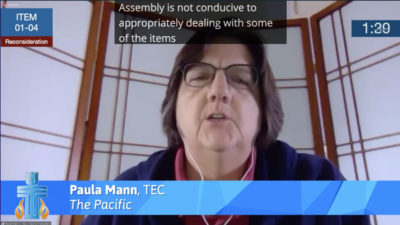 Or they may have been respecting the guidance that COGA provided. With no assembly committees this year (except the Committee on Business Referral), “we are not properly equipped” to consider many other matters in detail, said commissioner Paula Mann, a minister from the Presbytery of the Pacific.
Commissioners committed to social justice were on both sides of the reconsideration question. “The church’s role is to be engaged in witness to social justice, in witness to the problems of our time,” said Michael Casey, a Young Adult Advisory Delegate from Albany Presbytery. “We have to discuss the issues that are plaguing our society.”
So far, the assembly is on track with its schedule – but that could change if discussions intensify on a resolution on COVID-19 or Item 00-29, both of which are coming up in a plenary session beginning at 4 p.m. EDT on June 26.
People can watch a livestream of the General Assembly proceedings on the website for the 224th General Assembly and the Spirit of GA Facebook page. The order of business for the June 26 and June 27 plenaries can be found here.