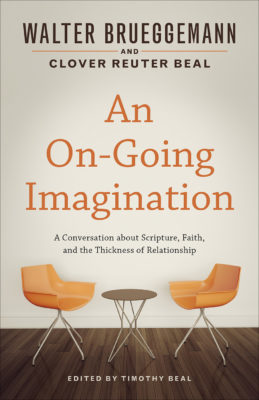
 Walter Brueggemann and Clover Reuter Beal
Westminster John Knox Press, 128 pages
Reviewed by Meghan Vail
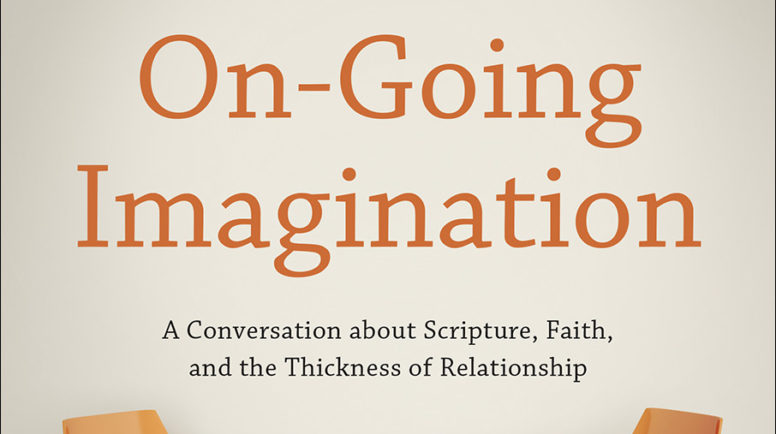
“An On-Going Imagination” is a curated collection of conversations between Old Testament scholar Walter Brueggemann and Presbyterian pastor Clover Beal, a friend and former student of Brueggemann’s. Through their exchange over a period of several years, Beal thoughtfully engages Brueggemann on matters of faith, Scripture, doctrine, hermeneutics, ministry and “Bible baggage.” Brueggemann chronicles his early years and the educational pathways that have shaped his profession as a theologian. Although this book primarily aids a reader who is curious to access Brueggemann’s systematic thinking on a given theological topic, the dialogical nature of the text ensures that the reader will emerge with essential Brueggemann insights that may not be found in a course setting, syllabus or publication.
Drawing on his own story and pathway to scholarship, Brueggemann accessibly draws parallels between psychotherapy and the task of theology, noting the ways in which self-understanding relates to one’s experience of God in Scripture. He strives to recover from the political sphere the concept of biblical literalism as an ideological commitment, and argues that the church – steeped in a confessional tradition and inclined toward essential statements – may benefit from traditional Jewish modes of biblical interpretation. Brueggemann takes on the provocative topic of biblical violence and proposes that the God of Scripture “is in recovery from having been an agent of violence.” Readers will contemplate his assertion that the work of ministry is a “life-and-death matter” in which the pastoral task is to raise awareness of one’s living in a constructed world, as well as one’s call to embody “the alternate world of the gospel.” Brueggemann explores parables as “world constructions” and affirms that the practice of biblical theology can in itself be considered sacramental.
Readers may be hard-pressed to find a more complete survey of Brueggemann’s thought than “An On-Going Imagination.” It’s difficult to identify a topic that the text does not briefly address. Although Beal occasionally references specific writings of Brueggemann’s in their conversation, the challenge for the reader is identifying sources through which to delve into Brueggemann’s thinking on a given topic or theme more extensively. Resources for further reading are available at the end of the book, but the majority of in-text citations are to writers that Brueggemann references. The reader would be assisted by references made to Brueggemann’s own work on a given subject at the conclusion of a chapter.
This book is a good choice for readers seeking a descriptive lens on the practice of theology and ministry over a prescriptive lens. Brueggemann gives greater attention to theory and principle, enhancing his assessment of a topic or question with simple anecdotes and stories from his experiences. “An On-Going Imagination” is a mutual reflection of its authors on pressing topics and approaches in the Bible, theology and ministry, and is not a how-to guide for everyday ministry matters or for ministers seeking constructive approaches to leadership, biblical interpretation, prayer and preaching.
Meghan Vail serves as associate pastor for Christian education, youth and young adult ministries at First Presbyterian Church of Logan, Utah.