What changes does the Presbyterian Church (U.S.A.) need to make to be the kind of denomination that can respond in real time to a fast-changing world — a world of fires, pandemic, climate change, political fissures, protests night after night over racial injustice?
As decisions are made, whose voices are heard — or left out?
What can be learned from the online 2020 General Assembly – the PC(USA)’s first virtual General Assembly, held by necessity because of the COVID-19 pandemic – about what could be done differently and perhaps less expensively in the future?
By the end of this year, the Committee on the Office of the General Assembly (COGA) is expected to make recommendations about the shape of the assemblies for 2022 and perhaps 2024 — whether that be online, in person or some sort of hybrid. J. Herbert Nelson, the PC(USA)’s stated clerk, has said that things need to change — with a projected $9 million shortfall by the end of 2020 for the church at the national level, the denomination can’t afford to keep holding costly, 10-day in-person assemblies in the way it traditionally has.
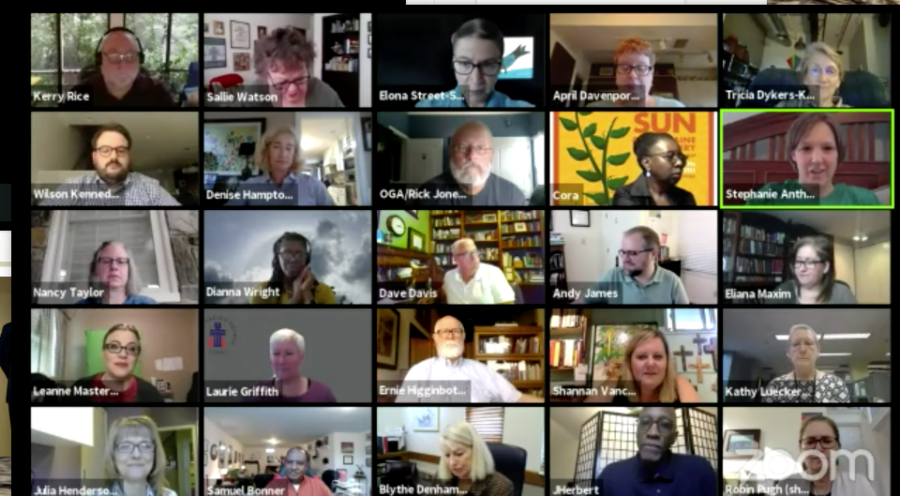
COGA is meeting online Sept. 28-30, and that gathering includes preliminary discussions from the work done so far by three work teams the committee has convened. This is the time for big-picture thinking, not actual decisions. Here’s a dip into that conversation, with screen-shot images from some of the presentations.
Innovation and discernment
A work team led by COGA member Leanne Masters is considering the way that General Assemblies make decisions — and what could be done differently. A piece of that might be to think of commissioners continuing to work through the two-year term to which they were elected, rather than completing their service in one intense, in-person General Assembly stint.
One possibility that was floated: Have a shorter in-person General Assembly focused on committees, with time for committee members to build relationships and do initial work. After that, the commissioners would go home and the committees would continue to do their work virtually — which would give the committees more time to dig deeply into issues, respond to new concerns that rise, build connection and ownership for the work across the church.
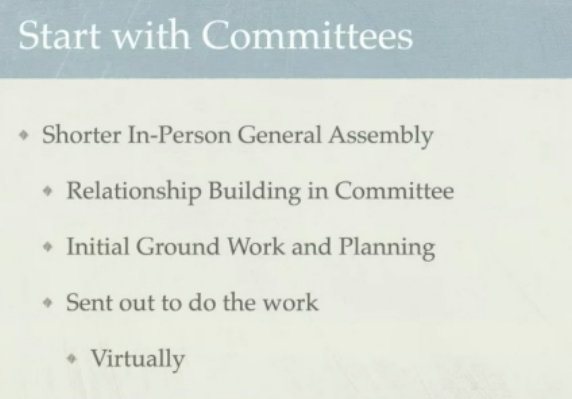
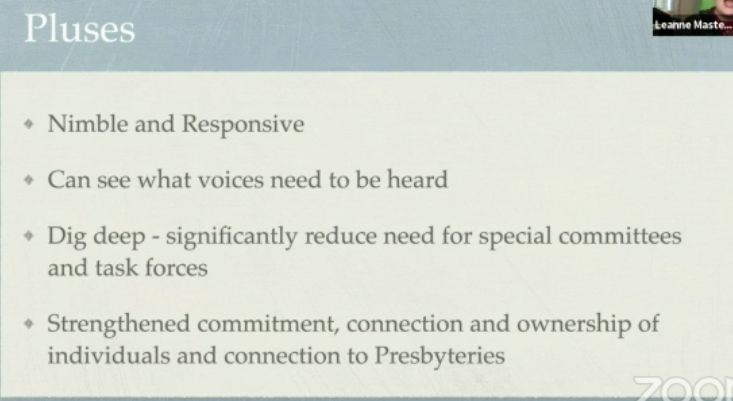
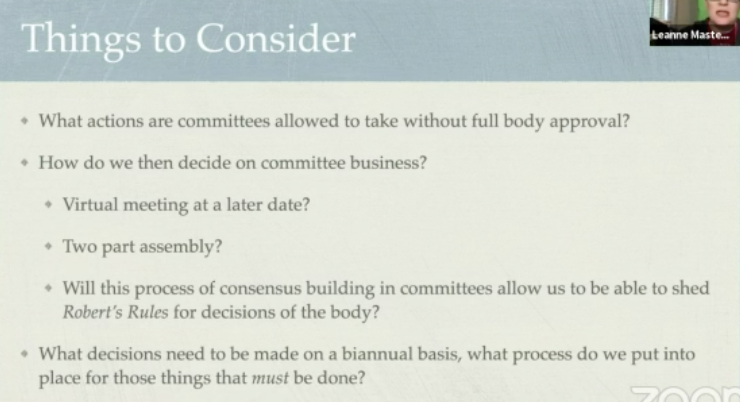
Some of the challenges: figuring out how the full assembly would take action, or what the committees are allowed to do on their own, and how the rules would need to be restructured.
One of the questions the work group is considering is “are we utilizing our people” – the gifts and talents of General Assembly commissioners – in the best way, or is the system “structured for a world and a denomination that no longer exists?” Masters said. There’s a desire to make the assembly “not so much about fighting and getting my way,” but to provide spaces and time to listen for the Spirit.
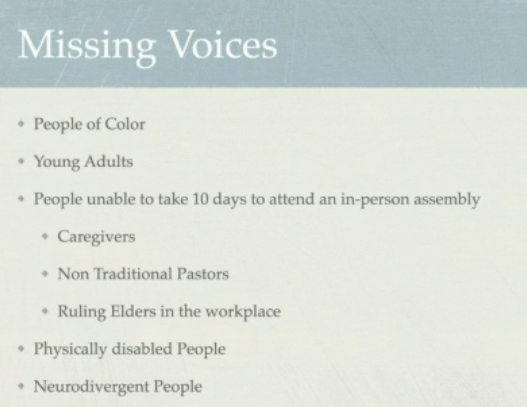
The work group also has been paying attention to whose voices may be missing in General Assembly discussions — and thinking about whether there are other ways to make collective decisions rather than following Robert’s Rules of Order.
During a meeting Sept. 26 of the Moving Forward Implementation Committee, committee member James Tse asked about the possibility that the 2020 General Assembly might reconvene. Kerry Rice, deputy stated clerk, said, “We have not received anything formal, but there has been a little chatter here and there,” particularly from commissioners who “want to be in person because they missed the full commissioner experience.”
That could be difficult, however, as Nelson has extended the travel ban for PC(USA) employees until June 30, 2021, Rice said. Another online assembly would cost about $200,000 he said — and meeting in person is not possible if state or local health departments don’t allow it.
Merger and unity
Another COGA work group is looking at issues of merger and unity — including the possibility of a merger of the Presbyterian Mission Agency and the Office of the General Assembly. COGA member Eliana Maxim stressed that whatever happens, “this cannot be simply driven by money” — what’s needed is a common vision for the denomination and how that could be implemented.
Maxim outlined some of the issues the group has identified:
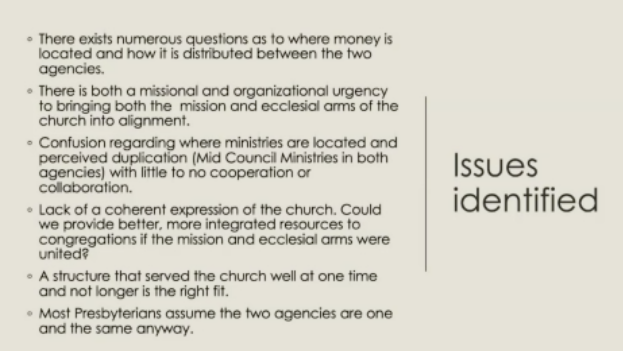
Maxim identified some next steps. The COGA work group will continue its discussions. The Presbyterian Mission Agency Board is putting together its own work group on the issue. The Moving Forward committee wants to be part of the conversation.
And Maxim raised the possibility that merger might not be the right word — that other language to think about might be “rightsizing or streamlining. … If that means blending two agencies together, so be it,” but the immediate goal is to find a structure that is flexible and offers the ability to streamline or prune the work that’s being done, so it’s efficient and what is most needed.
Unified budget
Kathy Lueckert, president of the PC(USA), A Corporation, reported that a coordinating table has been formed to begin the work of developing a unified PC(USA) budget for 2023 and 2024. That 15-member group will include leadership from PMA, OGA and the A Corporation and will involve a “heavy lift” of trying to create a budget proposal that takes a unified approach to looking at where the revenue comes from for all these agencies and how the money is spent, Lueckert said.
“We can’t have a unified budget conversation without involving the (Presbyterian) Foundation in some way,” Lueckert told the Moving Forward committee. “I don’t think we can talk about unified revenues without involving the Foundation and understanding their concerns and responsibilities.”
GA evaluations
Julia Henderson, interim director of assembly operations, presented the findings of post-assembly evaluations done with General Assembly commissioners. Research Services found that about 11% of commissioners reported they’d had to make additional arrangements for stable and robust internet access and 11% had to acquire additional equipment. But 72% reported no technical concerns with accessing the assembly.
Overall, 92% reported they were satisfied with PC-Biz, the denomination’s system for tracking business items and voting, and 82% said they were satisfied using the Zoom platform.
There was, however, a desire for doing work and building relationships in committees, which did not happen in this online assembly; for a greater diversity of voices; and for having more time for business and debate. Some commissioners wanted to discuss social justice issues, and “many would have liked to work through the week,” Henderson said.
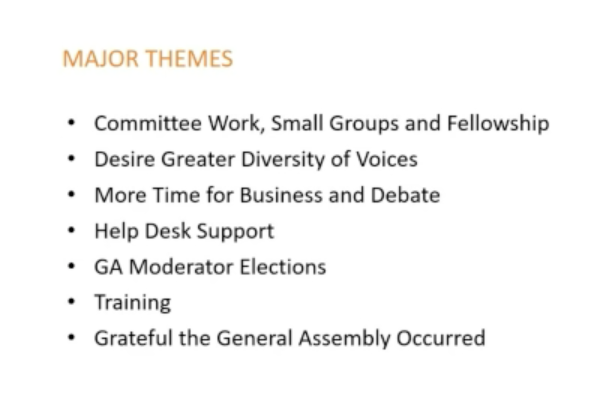
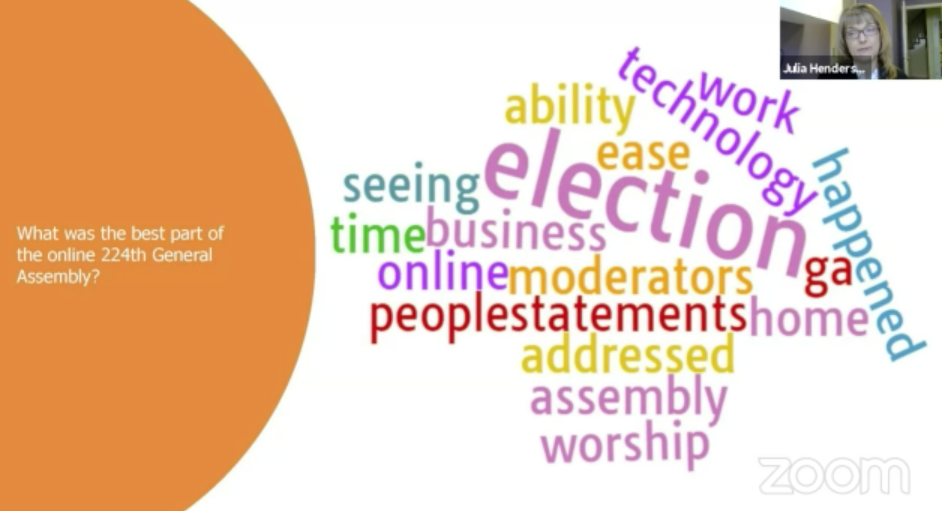
Among the things commissioners liked best: the election of co-moderators — the election is always popular, as “people appreciate the joy that comes,” Henderson said. Commissioners also were grateful that an assembly was held this year, despite the pandemic.
Co-moderators
Elona Street-Stewart, co-moderator of the 2020 General Assembly, said she and co-moderator Gregory Bentley are beginning to accept invitations to meet virtually with Presbyterians around the denomination. Street-Stewart stressed that they don’t want to be “on exhibit in the church” as an example of diversity — with people saying, “now we have two people of color” as co-moderators.
Street-Stewart said she and Bentley feel called to this role at this time, in a church “that has been blessed by our origins,” and with a commitment to join people involved in discussions of inequity, discrimination and oppression.
She also urged Presbyterians to continue to live into the theme of the 2020 assembly: “From Lament to Hope.”
In this year of pandemics, fires, hurricanes and more, “the earth is crying,” Street-Stewart said. “How do we bring comfort, how do we bring counsel and support. … It feels like it’s been a million years, but it’s only been a couple of months” since everything changed.