The Committee on the Office of the General Assembly is considering a question both practical and theological: How should the General Assembly be different going forward?
And what does it mean to reconfigure the General Assembly of the Presbyterian Church (U.S.A.)?
Does that mean somehow changing the rules — for example, how long the assembly meets; whether it’s in person or virtually or some combination; whether commissioners work for a brief, intense time or over the course of a full two years; reconsidering who has a voice and power at the assembly and who does not?
Or is more foundational? Why does the PC(USA) have a General Assembly? What does it mean for the PC(USA) to proclaim itself to be a Matthew 25 church, and to live into that? What other business should be set aside to make that a priority, to tell the world that’s what the PC(USA) stands for?
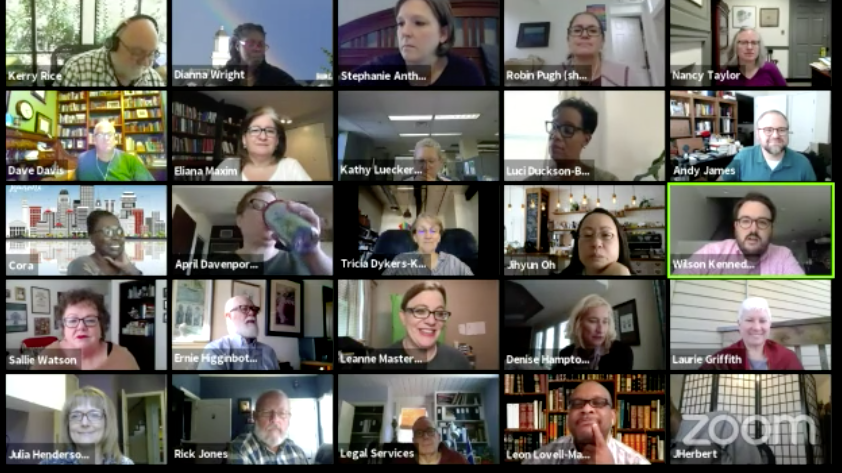
All of that surfaced Sept. 30 on the last day of COGA’s three-day fall meeting, being held virtually via Zoom. The answers will come later — two COGA work teams will spend the next few weeks trying to reach some consensus on what to present.
Eliana Maxim, vice chair of COGA, said she wants the conversation to move beyond the mechanics of restructuring to a bigger question of what purpose General Assembly serves.
“General Assembly was created to serve to serve the work of the church,” Maxim said. “It’s almost like we’re making General Assembly our golden calf. It’s the place where we feel fulfilled as Presbyterians,” when instead the assembly is a mechanism for finalizing and formalizing the broader work of the church.
That understanding is “what needs to be reformed, so we can actually be freed to do the work, not just every two years,” Maxim said. In a fast-changing world, “waiting every two years to act does not make us flexible, does not make us resilient. … We are idolizing General Assembly” in a way that takes away the freedom of Presbyterians to do the ongoing ministry that’s the church’s real work.
J. Herbert Nelson, the denomination’s stated clerk, made the case for the Matthew 25 vision being the focus of the PC(USA)’s work to end racial injustice and economic oppression — saying “this is how we define our church in the 21st century,” addressing injustice “through the lens of Jesus.”
The United Church of Christ has intentionally focused on racism — making that a hallmark of its Christian witness, Nelson said. But the PC(USA)’s proclamations are much more of a smorgasbord, he said. “What is the major focus of this denomination?” he asked. “What is our identity to the rest of Christendom?”
The way things function now, at every assembly “the laundry list of what we want is on the table,” Nelson said. Presbyterians send dozens of overtures, and the PC(USA) keeps making more policy statements. “We argue over everything under the sun, and it ends up with an up or down vote.” If something doesn’t pass, people say, “we’ll try at the next General Assembly to ram it through.”
 Nelson spoke of the possibility of another approach — of somehow assessing overtures being submitted to see if they match up with the Matthew 25 vision for the PC(USA) that the 2016 General Assembly approved.
Diane Moffett, president and executive director of the Presbyterian Mission Agency, said her agency is preparing an in-depth Bible study on Matthew 25 to help people better understand the focus of the vision theologically. Some Presbyterians still aren’t aware of the PC(USA)’s commitment to the Matthew 25 vision, she said.
Nelson said he’s seen plenty of PC(USA) restructurings over the years, and “none of it has made a difference. We’re still fighting about the same things” and figuring out “who has the savvy to outmaneuver everyone else” at the assembly.
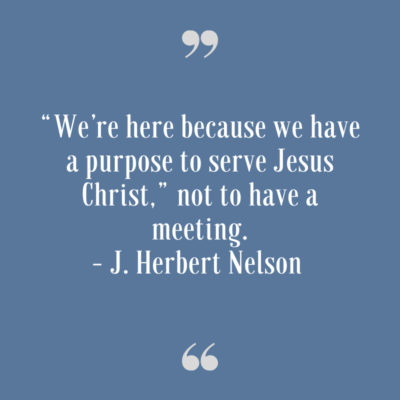
Some say, “I don’t want to change the assembly because I’m going to miss seeing my friends” or “it’s part of my vacation.” But “at the core of all this, there needs to be a purpose” for having General Assembly, Nelson said. “We’re here because we have a purpose to serve Jesus Christ,” not to have a meeting.
 Wilson Kennedy, who leads the COGA work team looking at a possible reconfiguration of the assembly, said his team has been discussing foundational values — about building a table that’s truly welcome for all voices; of gathering around a table of grace to do Christ’s work; and about being sent out from that table to continue the work.
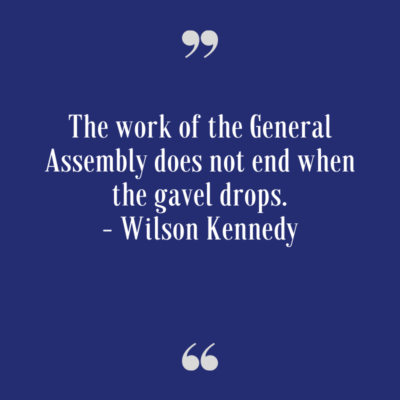
“The work of the General Assembly does not end when the gavel drops,” Kennedy said. “Truly, it’s just beginning.”
Finances. COGA also heard an update on the impact of COVID-19 on the denomination’s finances. As of about a month ago, General Assembly per capita giving was down about $800,000 compared to the same period in 2019, said DeAmber Clopton, budget manager for the Office of the General Assembly.
Kerry Rice, deputy stated clerk, said the staff has projected a likely 25% drop in per capita for 2020 — but since most of the donations come in the last two months of the year or even in January, “we really won’t know” until early 2021 how accurate those predictions are.
Some presbyteries have seen increases in giving, while others are experiencing significant declines, Rice said. He said the Office of the General Assembly is trying to walk a fine line, between “being an understanding partner” – knowing that some congregations have seen donations drop because of the pandemic, and that some presbyteries have depleted their reserves – and encouraging full payment of per capita.
COGA also heard reports on the number of employees who have accepted early retirement packages that were offered to help offset a projected $9 million budget shortfall by the end of 2020. In the Office of the General Assembly, eight of the 63 staff members have accepted voluntary separation packages.
At the end of August, the Presbyterian Mission Agency had 176 employees in the United States and 101 mission personnel serving internationally. Ruth Gardner, director of human resources, said eight people from the Presbyterian Mission Agency staff in Louisville have accepted early retirement packages, as have 25 mission co-workers.