In an online conversation Nov. 5, mid council leaders spoke of the challenges the COVID-19 pandemic and racism are presenting to Presbyterian churches — and of the innovation and creativity they see emerging in the response.
Here are some questions more than 300 presbytery and synod leaders discussed during the annual Mid Council Leaders Gathering, held virtually via Zoom.
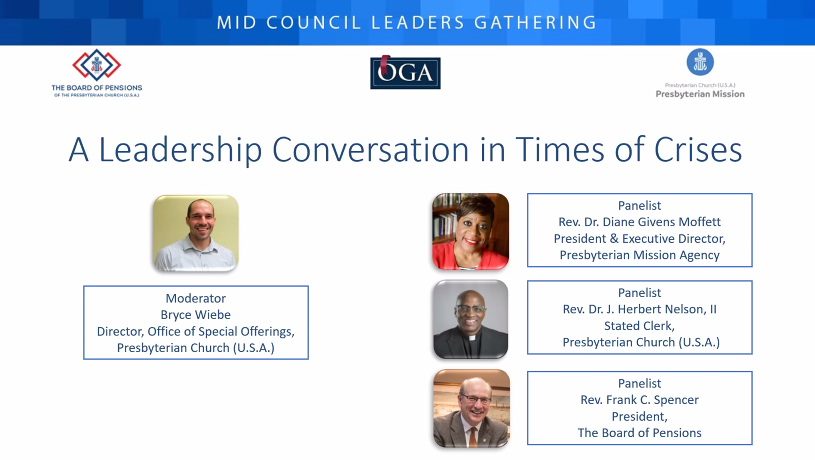
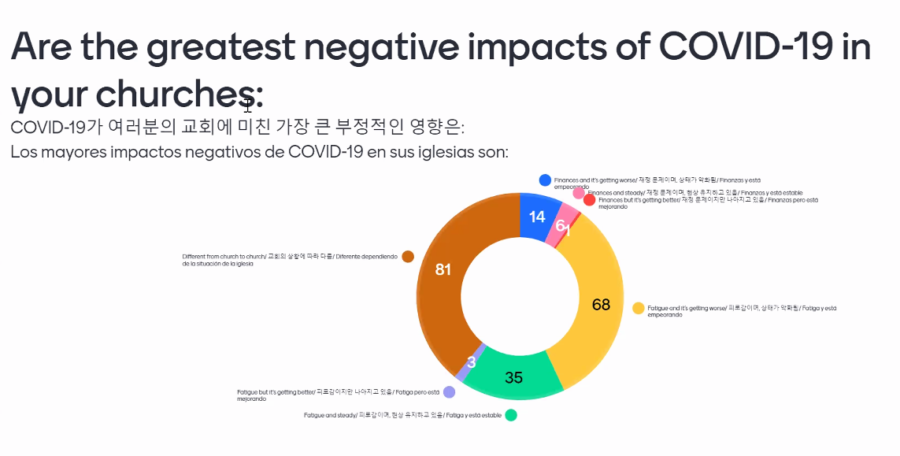
What are the greatest negative impacts of COVID-19 on churches?
“Folks are kind of figuring out how to do it as they go along, Sunday to Sunday,” said Donnie Woods, general presbyter for Charleston Atlantic Presbytery. Some of the stressors: figuring out technology, providing pastoral care at a distance, dealing with parishioners who are “yearning to be together in the old way in the sanctuary.”
For pastors, “fatigue is a big thing,” said Susan McGhee, executive presbyter of the Presbytery of Ohio Valley. Some congregations have started to meet in person, some with congregational singing, “even though we have recommended that they don’t.” Some pastors and parishioners have tested positive for the coronavirus. “I have never seen pastors work so hard and be so afraid,” McGhee said.
Sheldon Sorge, general minister to Pittsburgh Presbytery, said he’s seen an increase in congregational conflict — particularly in differences over what protections need to be taken to minimize exposure to COVID-19, including the wearing of masks. “Some are actually leaving congregations over that,” Sorge said.
In the Presbytery of Charlotte, “everybody’s exhausted, everybody’s working hard,” said Jan Edmiston, general presbyter. But she also sees a disparity in the impact of the pandemic between big and small churches. Many of the smaller congregations are meeting in person, and they can’t find supply pastors to fill in or relieve their leadership — many of those who would be eligible to help, some of whom are retired pastors, aren’t willing to preach at an in-person service. In congregations with bigger staffs, pastors can take turns leading worship.
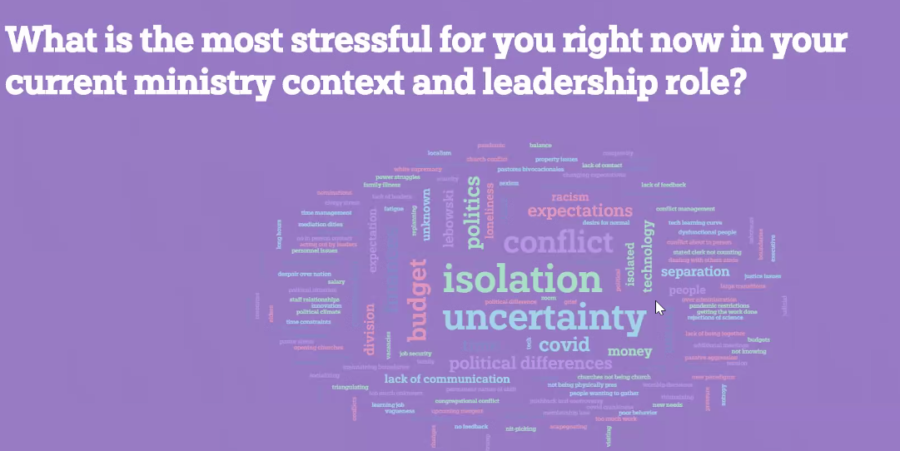
Also mentioned in the Zoom chat:
- “Frustration with not being able to comfort bereaved families in person. Essential for small churches; especially in communities of color where that is a cultural tradition.”
- “We have also seen some gender bias or ‘bullying’ of our female pastors. Sessions and/or church members trying to force them into in-person worship or to work from the church building. Male pastors are not receiving the same level of push back.”
How are the pandemic and a commitment to anti-racism work impacting the church?
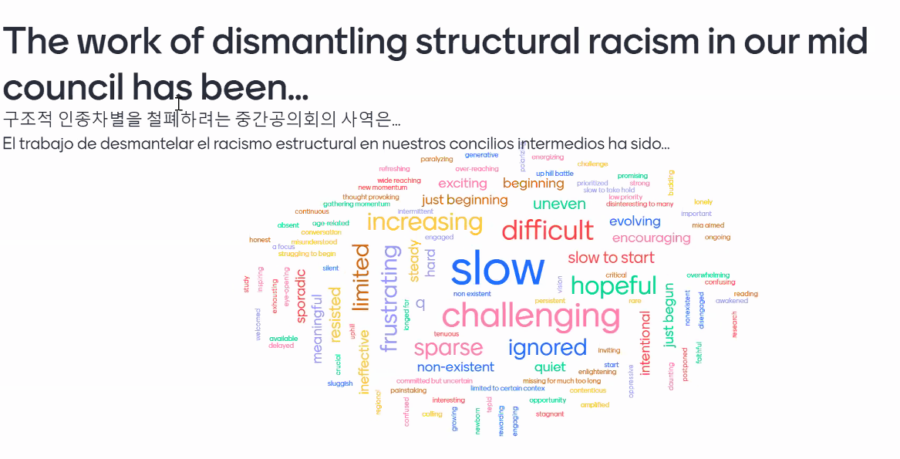
Both J. Herbert Nelson, stated clerk of the Presbyterian Church (U.S.A.), and Diane Moffett, president and executive director of the Presbyterian Mission Agency, said they have received some pushback from the denomination’s commitment to work against racism. Moffett said she’d received a letter the previous day from a Presbyterian “who wants no part of it.”
But the events of the last year – including the police killings of George Floyd and Breonna Taylor – have also meant that “people are home and they’re paying attention to it,” Moffett said. “There’s been a lot more leaning in.”
Denominational leaders said the difficulties of the pandemic have also led to innovation.
The pandemic “pushed us kicking and screaming into the 21st century” in terms of using technology, Moffett said.
The pandemic has revealed structural inequities — for example, people working for low-income wages and the disproportionate impact of the pandemic on people of color, Nelson said. Congregations are having to consider if they’re willing to move in new directions, or “are we playing at being church?” Nelson said.
“I don’t believe there is a normal anymore,” he said. The pandemic has taught churches “there is no permanent space we can continue to stay in,” and God never intended for things to stay in one place — “that’s why Jesus did so much walking.”
Before the pandemic, “the routine was there; it all felt good,” Nelson said. “Any movement of the furniture disturbed us. Now, there is this continual movement of the furniture.”
“We don’t need normal. We need faithful,” one presbytery leader wrote in the chat.
Bryce Wiebe, who is the PC(USA)’s director of Special Offerings and was moderating this part of the discussion, said that “Presbyterians do love to plan change, so we never have to do it.” And one question now, he said, is: What does a tabernacle faith – always on the move – look like in a shelter-in-place world?
What changes might emerge from the pandemic that will last?
Presbytery and synod leaders spoke of finding new ways to do the work of the church — including virtual or hybrid meetings that are enticing more people, including more young leaders, to participate. “Because Zoom is easier than fighting the traffic, we are getting more people willing to participate in leadership and even anti-racism groups,” Wendy Tajima, executive presbyter of the Presbytery of San Gabriel, wrote in the chat.
Many are having regular Zoom conversations with pastors that have proved important for building relationships and sharing ideas. Some are using technology to form closer connections with international partners. “Not EVER going back to all in-person meetings again,” one presbytery executive wrote in the chat.
Some congregations are finding their online attendance is up — with people coming to worship online who did not or could not come in person.
“The positive side of tech worship has been folks tuning in from all over the country and reconnecting to churches they had moved away from,” Kate Freeman, presbytery pastor from from the Presbytery of Nevada, wrote in the chat.
Mary Westfall, transitional presbytery for North Central California Presbytery, said in the chat that her presbytery has posted pre-recorded sermons that congregations can use when a pastor needs to be away or needs a break, and created a “Virtual Pulpit Supply” on its website where pastors, Christian educators and others from congregations have posted sermons, resources for use with children, daily devotions and more.
Frank Spencer, president of the Board of Pensions, said, “We’ve seen participation growing tenfold” in online wellness offerings, compared to attendance when such sessions were offered in person. The board is exploring ways to offer more benefits to pastors working part-time or in shared ministry or small churches. “We see an opportunity for broadening connections in ways we’ve never thought about, even though we call ourselves a connectional church,” Spencer said.
What are the challenges of wellness for church leaders?
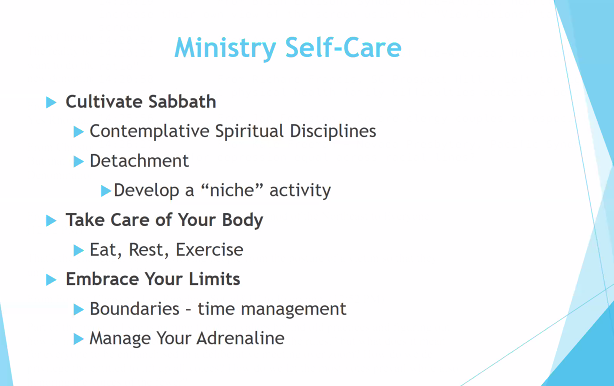
During one session, consultant Chris Adams, executive director of the Azusa Pacific University Center for Vocational Ministry, led a discussion on the stresses that church leaders face — and strategies for nurturing resilience and well-being.
After that, the co-moderators of the 2020 General Assembly, Elona Street-Stewart and Gregory Bentley, offered some responses. Street-Stewart spoke of disparities that that already existed for indigenous people and people of color, and now seem heightened in the current political climate — of “the price that some of us pay when the church and our country already are afraid of us, whenever you are considered ‘the other.’ ”
Through a history of survival, “we’ve already determined what it takes for us to be resilient,” Street-Stewart said, and “have already paid a price.”
After the Nov. 4 election, “I think we can say farewell to innocence,” about the extent of racism and misogyny in the United States, Bentley said. “It is your country. We need to face the facts and the truth about it.”
His focus is not on returning to “normal” – “normal wasn’t that good for a lot of people anyway” – but on “bouncing forward,” Bentley said, to see the opportunity, as uncertain as it is,” to create something new.
“We should understand that our ecosystems thrive on diversity,” Street-Stewart said.
There needs to be an honest look at what came before — Bentley described the “twin genocide” of stealing the lands of indigenous people and the enslavement of Blacks that marked the founding of this nation. “And the church,” Street-Stewart said.
“We can’t move forward and be healthy if we haven’t cleaned up the mess,” she said.
As a church, “we have to start seeing people at the margins … as people who bring great gifts,” Bentley said. At the margins, “you can see the whole thing. Where people at the center can at best see half of it.”
It’s time for the church and the nation to “see this great tapestry we have, the rainbow of people we have, as a real gift.”