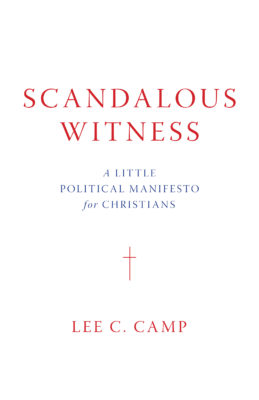
 Lee C. Camp
Eerdmans, 192 pages
Reviewed by Jordan Tarwater
Lee Camp rejects the old notion that, in polite company, you should avoid talking about religion and politics. In fact, in this concise and punchy book, he traces 15 convincing arguments for a Christianity that is neither right nor left, and not even religious, but instead a politic — a way of interpreting history and the world.
The real problem with Christianity in America for Camp is its “bastardization.” We have failed to see it for what it actually is. In doing so, we’ve privatized Christianity to a realm of personal piety that has led to both the denigration of Christian witness and the triumph of secularism. Instead of the Apostle Paul’s proclamation of God’s reconciling work as a stumbling block and a true scandal to the status quo, Americans of all stripes have embraced a different kind of gospel: illegitimate, partisan and unable to speak with either prophetic force or truthful authority.
As a remedy for our polarized times, Camp argues that Christianity must reclaim its scandalous roots. We cannot ultimately put our hope in a discipleship of American nationalism, classical liberalism or the invisible hand of capitalist markets, but rather, only in the subversive kingdom of God that presents an alternative way of life that moves beyond our convenient divisions.
He writes sharply about the “failure of Christianity in America,” that we are marked by our penchant to be “wildly partisan about presidential elections in the midst of the late days of an empire; to be ideologically hostile regarding small government versus big government; to be blindly belligerent regarding capitalism versus socialism . . . [and] to cast aside all other concerns in favor of a government-mandated pro-life policy on the one hand versus a calloused rhetoric of pro-choice on the other.”
From his proposition that the “United States was not, is not, and will not be a Christian nation” to the assertion that “every empire falls,” Camp traces a careful study – not liberal, not conservative and not even some moderate lane between these two ready political positions – but a higher standard, namely, the way of Christ. For all of his careful presentation of this third way at the heart of Christianity, it can be sometimes hard to keep focused on the “scandal” amid Camp’s tone of civility.
While civility itself is hardly a problem in a time marked by so little of it, Camp so sharply illuminates the fault lines of American Christianity’s accommodations to both sides of the aisle, that the constructive message – that Christianity is not a private, but a public matter – sometimes gets lost. If we cannot continue to consolidate the scandalous witness of Jesus as either “Democrat” or “Republican,” readers might find themselves wishing for a more forceful explanation of how this different kind of politic gets lived out in concrete terms, aside from Camp’s entreaties toward an ethics marked by humble, peaceable progress.
Though, for both Christians and armchair politicos who are already searching for a thoughtful way to transcend our current partisan divide in this election year while deepening their engagement with how Jesus can and should shape both our faith and our politics, Camp provides readable and engaging arguments that might just change your mind about long-held assumptions and will certainly help you to find new avenues for hope.
Jordan Tarwater is the executive director of the Urban Outreach Center of NYC and serves as the Jan Orr-Harter Minister of Social Justice at Avenue Church NYC on Manhattan’s Upper East Side. You can find him on Twitter @JordanTarwater.