“We are a country almost literally at war.”
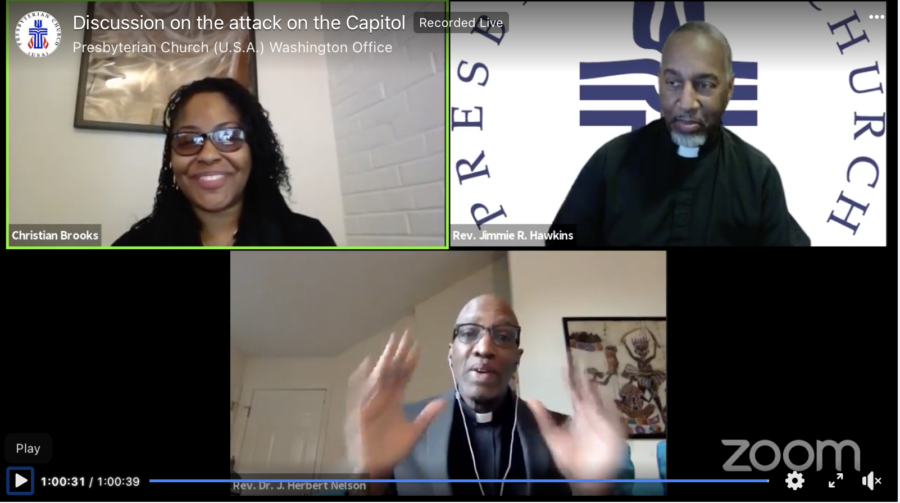
J. Herbert Nelson, stated clerk of the Presbyterian Church (U.SA.), and Jimmie Hawkins, director of the denomination’s Office of Public Witness, spoke Jan. 14 during a one-hour webinar about the insurrection last week at the nation’s Capitol, about what that says about the nation and what should be the church’s response.
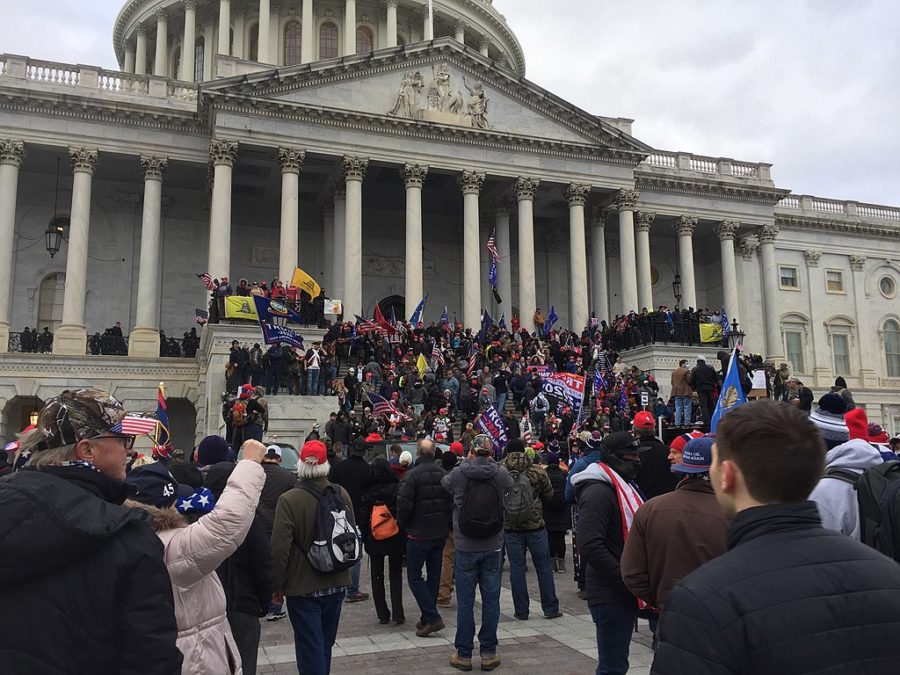
Wearing clerical collars and years of experience in public advocacy, the two answered questions posed by Christian Brooks, the representative for domestic issues at the Office of Public Witness — with Hawkins describing what he saw unfolding as insurgents stormed the Capitol on Jan. 6 and took over the building.
“It was a horrible day for America,” Hawkins said. “It was the epitome of everything we feared would happen, that the president of the United States would refuse to hand over power peacefully” and would try to prevent the inauguration of Joseph Biden. “It’s a fitting end for his administration. It’s gone from bad to worse to catastrophe.”
That day, President Donald Trump told the rioters that “we are now going to the Capitol” — making it clear that even if he didn’t march with them, “this was something he was leading,” Nelson said. The House voted Jan. 13 to impeach Trump – for the second time – charging him with “incitement of insurrection” during the besieging of the Capitol, and with House Speaker Nancy Pelosi saying that “he is a clear and present danger to the nation we all love.”
The divisions revealed that day show “we are a country almost literally at war” — well-armed and angry, Hawkins said.
Here are some highlights from their conversation.
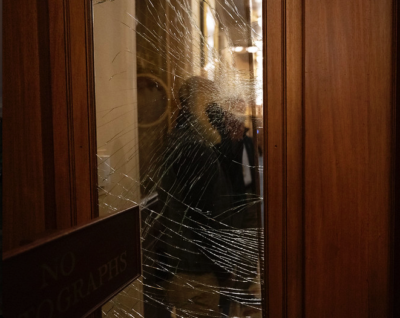
Rage and entitlement. The white supremacists and domestic terrorists who took over the Capitol, shattering windows and putting their feet on Pelosi’s desk, spoke of it as “our house” — they felt justified in taking it over, Brooks said. “Where did this attitude of rage and entitlement come from?”
Nelson’s answer: “This is the continuation of white supremacy. … I’ve seen it all my life.” Some who took the Capitol feel left behind, he said, their upward mobility stalling as the economy shifts and the nation becomes more diverse.
“This is still a racist society,” and “we’re seeing flashes of this all over the United States,” Nelson said. That was evident at the violent Unite the Right white supremacist rally in Charlottesville in 2017, he said; in the Breonna Taylor shooting in Louisville; and on Jan. 6, with “the climate set by the person who holds the highest office in the land.”
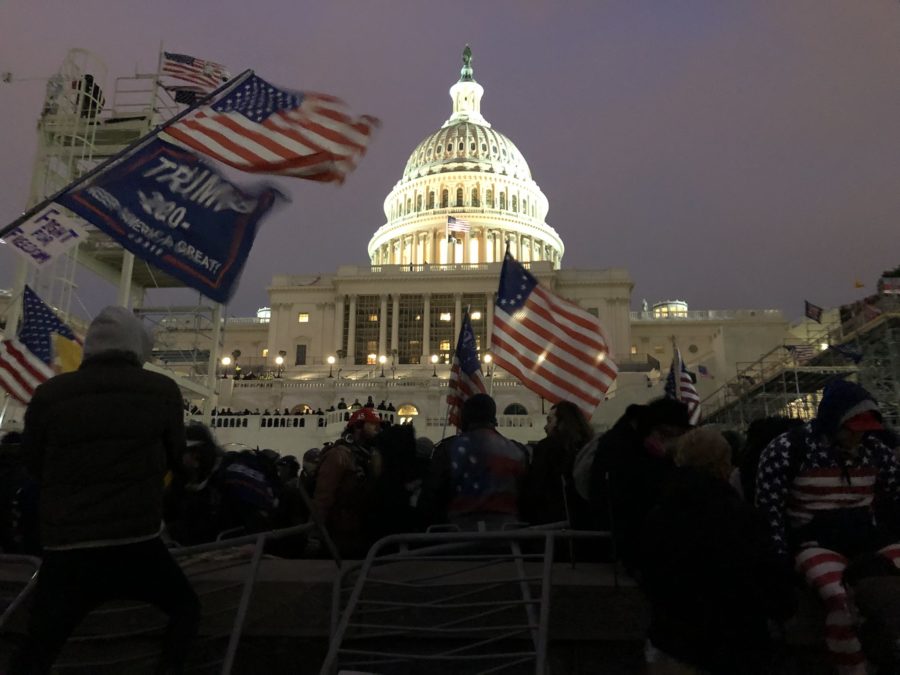
Theology and white supremacy. “The irony for us as people of faith is that all of this happened on Epiphany,” Hawkins said. Some in the crowd carried crosses and “Jesus Saves” signs; some said, “This president is our messiah. God has told us he is to serve a second term. There’s conflict there. If we serve the prince of peace, we cannot be agents of violence.”
Nelson said that Christians “have to tell the truth about Jesus” — that “Jesus was an outcast,” a liberator for the oppressed. Some deviate from that message to a prosperity gospel, “all about us and our salvation, but not about the world in which we live. … Jesus gave his own life so that others might be free.”
The church in the United States, however, has been built on a foundation of white supremacist theology, Hawkins said.
“We worship a first-century Palestinian, with brown skin,” yet on the walls of most churches there’s “the image of the white Christ. The images of the disciples are all European. … Even the divine has been cast in the white image.”
Churches supported slavery “using the Bible as a litmus test,” Hawkins said, quoting Scripture to support the subjugation of Blacks for centuries. And “segregation is a part of the Christian church today,” with people of color and whites often worshipping separately on Sunday mornings.
Often, pastors “do not challenge white supremacy in our local congregations,” Hawkins said. They “don’t want to talk about it, people get upset,” saying the church is getting too political when the pastor talks about racism.
In many churches, “our politics has become more important than our faith. … We determine who we hang out with based on our political affiliation,” and with Presbyterians describing their congregations as red, blue or purple. Hawkins warned pastors: “Don’t allow your members to define your congregation by a sense of political affiliation.”
And don’t be afraid to speak out against structural racism. “Advocacy must be described as a spiritual discipline.”
Where were the police? Nelson said he has real questions about the lack of a greater law enforcement presence at the Capitol on January 6 — particularly since there was plenty of warning on social media that the insurgents were coming and would be armed.
“What allows people off of the street to walk in, take over a building, bring guns? … And there are policemen opening doors to let them in and taking pictures with them,” he said. “It says something.” Was it a lack of organization? “Or was this a mandate of our president” for law enforcement to stand down?
Before the rioters took the Capitol, “the warning signs that this would happen were there,” Hawkins said. “They should have been read.” But law enforcement “basically puts their head in the sand when it comes to these white extremist groups.”
People of color have a very different experience with the police, Brooks said – they know the history of white police being used as slave patrols and to enforce Jim Crow laws.
Often, Black Americans “do not see law enforcement as a friend,” Hawkins said. “Being a Black man in America, seeing a police car behind you, you get very nervous” — knowing the encounter can turn dangerous fast.
For those whites who broke into the Capitol to claim, “this is my house, I own this house … to feel you have the right to abuse it” shows they don’t feel vulnerable in the same way.
The man walking through the Capitol carrying a Confederate flag believes “his skin color gives him a right above others,” Hawkins said.
Speaking truth. Nelson called for Presbyterians to use their moral authority to take a public stand as the Moral Mondays movement led by William Barber has done — to say, “you have to love something more than yourself. You have to love you neighbor.”
He hopes that’s rubbing off on corporate America as well, as businesses and institutions have begun distancing themselves from Trump and his corporate dealings. “The church has to be a place that pushes those institutions to do those things,” Nelson said.
And “the church has to be a leader in the promotion of the truth,” Hawkins said. Some members of Congress still are spreading the “blatant lies” that the 2020 presidential election was stolen from Trump. He recently got an email from a Presbyterian minister, a Trump supporter, who said of the Capitol occupation: “The media is distorting what is going on. Antifa are the ones who are supporting the violence.”
Christians need to be “a people who can handle reality, who can handle the plain truth, that racism is a part of American life,” Hawkins said. “We’ve got to talk about reparations in this country. … We’ve got to talk about wealth redistribution.”
What’s next? What happened in Washington should send a signal to local communities that they need to work on issues of racism, injustice and what Nelson described as “the proliferation of guns, the idolatry of guns” and the resulting violence. “I learned so much from Jim Atwood,” he said — referring to the Presbyterian pastor who dedicated himself to working to stop gun violence and who died in 2020 of COVID-19.
Hawkins is from North Carolina — where in many communities the haves and have-nots are literally divided by a railroad line. One can track school achievement levels and incarceration rates by which side of the tracks a person lives on, he said.
“We’ve got to have a reckoning. We’ve got to talk about the way that race impacts every system in this nation,” Hawkins said.
Some say the church shouldn’t get involved in politics. In the comments on this Facebook Live event, one pastor wrote: “I actually had a parishioner say, ‘Stick to sin, Preacher. Stay away from politics.’ ”
But Hawkins contends that policy issues such as food insecurity, affordable housing and access medical care are justice issues, and “we are called to have a prophetic voice. … It needs to be very loud and unapologetic.”
A recording of the webinar is available: