J. Herbert Nelson, stated clerk of the Presbyterian Church (U.S.A.), says, “We have to rethink church in the 21st century in order to be relevant.”
So he and the Committee on the Office of the General Assembly (COGA) are trying to redesign the 2022 General Assembly “so it is not a shoot-it-out at the O.K. Corral at our General Assemblies,” as Nelson put it, but instead focuses on relation-building, listening, discernment and justice work — and saves some money as well.
In December, COGA took some votes to set the dates for the 2022 General Assembly committee meetings and to determine that the next assembly will be a mixture of in-person committee meetings in Louisville, Kentucky, and online plenary sessions — a plan that’s expected to save the PC(USA) $900,000 over holding the whole event in person.
Meeting virtually Jan. 19, COGA presented information to try to help the PC(USA) more broadly understand how those decisions were made — and the values those decisions represent.
It also heard a report on the amount of uncollectable per capita, including that mid councils failed to pay $1.31 million in General Assembly per capita in 2019. That’s about $87,000 more that went uncollected than the $1.22 million of uncollectable that had been projected in the 2020 budget. (However, when the COVID-19 pandemic hit in spring 2020, after the budget had been created, it was feared that the uncollectable amount might have grown far more in 2020 than the actual end-of-year figures now show.)
Nelson presented a document called the “Stated Clerk’s Vision for the Church” – something COGA did not formally vote on, and which COGA member Dave Davis called “an aspirational glimpse of the broad vision” – a commitment, as the document states, to being ”more fully inclusive, flexible and faithful.”
For example:
- “We are a church that aspires to empower all voices and privileges none;”
- “We are a church that sparks radical reconciliation;” and
- “We are a church that aspires to connect and collaborate more than simply through a biannual meeting.”
In his remarks, Nelson said the PC(USA) needs to find ways to be relevant to younger people and for “a whole group of folks out here on the street who go to nobody’s church.” Even his own young adult daughter – whose father, grandfather and great-grandfather all were Presbyterian pastors – is wrestling with how or whether the church can be meaningful to her life, he said.
COGA member Leon Lovell-Martin raised concerns about a part of the document that speaks of the PC(USA) having “an expansive public theology that speaks to the world with a distinctive Reformed-Presbyterian voice.”
Lovell-Martin has lived in Florida for 30 years, but grew up in Guyana. And he questioned whether the creeds and writings often drawn upon in developing that Reformed voice are expansive enough, “especially for immigrants and people of color who are finding a place in this country we call the United States of America. … Are our voices heard in that Reformed, Presbyterian context?” Lovell-Martin asked.
Eliana Maxim, COGA’s vice moderator and an immigrant from Colombia, said the Reformed identity often “is not porous,” allowing for new voices to flow thorough, but seen as a solid, firm foundation — set in stone. But being Reformed “is a continuous process and it needs to constantly be informed by a myriad of cultural and sociological experience,” Maxim said. As an immigrant, “my Reformed experience has just as much heft as the cradle Presbyterian whose great-great-great-great-grandfather was a Presbyterian minister. … Both of those elements have to inform our future identity.”
Nelson spoke of the need of contextual ministry that’s innovative and open to transformation. In today’s culture, “nobody puts their hand upon a gospel plow because they heard of a man named John Calvin,” he said.
COGA also presented a “Decision Process Report,” which lays out what went into the decision to change the location and format of the 2022 General Assembly, and provides more information on alternatives considered and their cost implications.
And during its two-day meeting this week, COGA is meeting with representatives from a variety of groups — including the Advisory Committee on Social Witness Policy and the Advisory Committee on the Constitution (on Jan. 19) and the General Assembly Committee on Representation (on Jan. 21) to get some feedback on the proposed new model.
Some of their questions were practical — such as whether they should plan to have representatives in Louisville for all two weeks of the committee hearings from June 19-July 2, 2022.
And representatives from the Advisory Committee on the Constitution (ACC) raised some constitutional concerns — stemming in part from the requirements in the PC(USA) constitution for full participation and representation.
Among them: there has been discussion of having a “hybrid” opening plenary — with members of the first three assembly committees that would meet forming a “minimum quorum” in person, and with other commissioners participating virtually. During that plenary, commissioners would need to vote to suspend the standing rules to allow for a virtual plenary, and at least a quorum would need to be physically present in Louisville to do that.
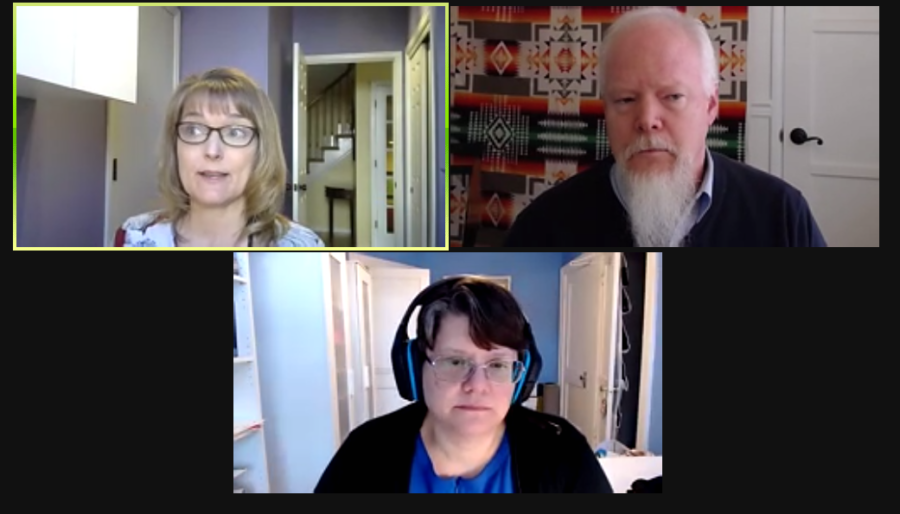
But Forrest Claassen and Carla Campbell from the ACC said the constitutional requirements for full participation would mean that COGA couldn’t deny any commissioner the right to be at that gathering — even if that made everything more expensive and their presence wasn’t needed to reach a quorum.
Even if the business during that plenary were straightforward, some commissioners might say, “I’m going to be there,” Claassen said. “It would be out of order to bar them from that if they didn’t happen to be on the invite list.”
The Presbyterian system is built on connectionalism, and for some “that connectionalism is inextricably bound to in-person assemblies gathered to allow the whole assembly to discern the will of God,” Campbell said. It’s even possible some “may be actively looking to be commissioners because of those objections.”’
In considering changes, Claassen urged COGA to think not just of constitutional particulars, but of the big picture. “It’s frequently easy to think of our polity and procedures as rules,” that become impediments or “sledgehammers that we use for attacking one another,” he said.
“Deeper than that … both our polity and our procedures are ultimately a covenant we have made with each other at the broadest level of the church. We make changes to those covenants as God’s Spirit leads us, but we do that in a way that actually is in the covenant itself.”
COGA member Leanne Masters said there also is conversation about using a variety of discernment methods beyond Robert’s Rules of Order at the 2020 General Assembly.
“A change like that would require a constitutional amendment,” Claassen said.
But COGA member Andy James said there’s a provision in Robert’s Rules for using alternative discernment processes — as long as you “bring that back for a traditional vote at the end” under Robert’s Rules.
A constitutional amendment would only be needed if Robert’s Rules were no longer to be used as “the deliberative authority,” Claassen said. As far as “using all 853 pages of Robert’s Rules for the benefit of the body’s discernment — go for it.”
The COGA meeting will continue Jan. 21 (with a break Jan. 20 for the presidential inauguration). The agenda and meeting papers can be found here.