 The Committee on the Office of the General Assembly is continuing its work of shaping the 2022 General Assembly of the Presbyterian Church (U.S.A.) — which will be a hybrid of in-person committee meetings and online plenaries, and will require considerable imagination and planning to figure out how to do things in a new way while holding on to what Presbyterians have valued most from the old approach.
Another question: What in recent assemblies hasn’t worked so well?
Traditionally, at least in recently memory, the General Assembly has met in person at a convention center for eight days every other year. At the next assembly, the committee meetings will be held in person in Louisville, Kentucky, on a staggered schedule, three at a time from June 19 to July 2, 2022.
Julia Henderson, interim director of assembly operations, has given COGA an April 15 deadline for making a decision for when the plenary sessions will be held, and COGA has set up work groups to deal with particular pieces of the planning work.
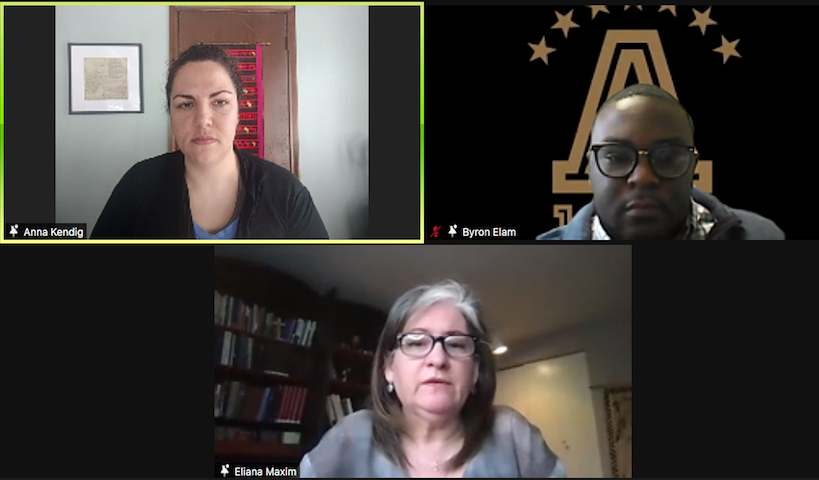
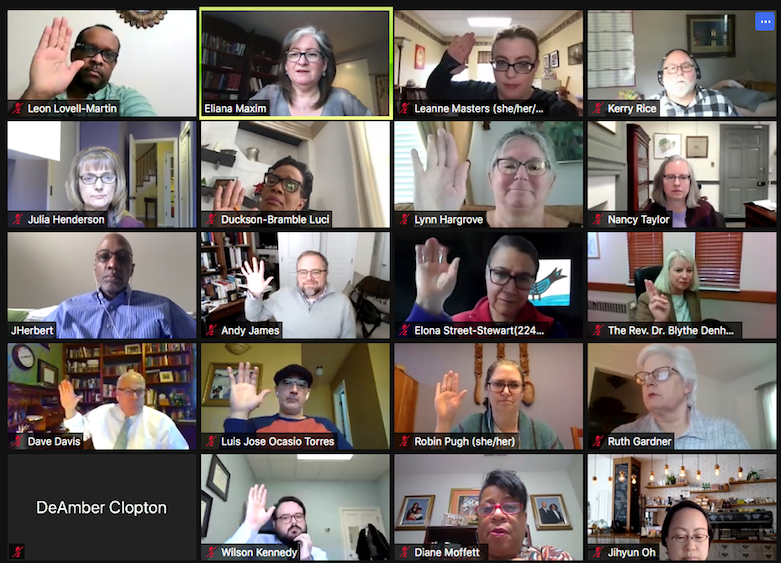
The co-moderators of the General Assembly Committee on Representation, Byron Elam and Anna Kendig Flores, met with the Committee on the Office of the General Assembly (COGA) via Zoom Jan. 21. The Committee on Representation doesn’t yet have all the data it needs to evaluate the 2020 General Assembly, its co-moderators said. But they raised some concerns going forward for COGA to think about.
Young adult advisory delegates. During the 2020 General Assembly, which was held entirely online, participation from the YAADS declined over time, Elam said. Initially, 130 YAADS were registered as participants. But only 92 voted in the opening session, and even fewer – only 76 – on the last vote of the night. Only about half the YAADS – 71 of 130 registered – voted during the election of co-moderators. “That’s an obvious area of grave concern for us and certainly the rest of the church,” Elam said.
More broadly, Kendig said, “what is the purpose of advisory delegate votes” at the assembly? “How does that honor or not honor our ideals of representation? … That is a big question.”
Who gets to the microphone? The committee called for information and more transparency about the microphone queuing system — basically, who’s called on to speak on and why. There is monitoring of that, but Kendig said it’s helpful for commissioners to be able to see in real time how many people are lined up to speak — that’s something they could see on the plenary floor when the assembly met in person. “It helps them understand the process and be more involved and engaged,” she said.
Collaboration. Planning for the online 2020 General Assembly happened in a hot sprint in the spring of 2020, as the COVID-19 pandemic made meeting in Baltimore, as had been the plan, unsafe and impossible. But for 2022, COGA has time to collaborate more closely with groups that might have concerns about representation, such as Presbyterians for Disability Concerns or a group of Presbyterian leaders of color who sent an open letter to the church saying the 2020 assembly had “silenced Brown and Black voices” – part of a chorus of criticism of white privilege at that assembly.
Elona Street-Stewart, who is co-moderator of the 2020 General Assembly along with Gregory Bentley, encouraged the Committee on Representation also to look at the preparation of General Assembly commissioners and at how presbyteries select those commissioners.
“Some are so prescriptive (in selection processes) it is atypical of choosing by representation,” Street-Stewart said. “It is based on a person’s longevity or what committees they have served on,” or other systems of seniority or rotation.
“Shifting that culture is years in the making,” Kendig said — and involves ways of creating pipelines of people “who understand and know the process and who come from diverse backgrounds” in terms of race, gender, sexual orientation, disability and age.
Shannan Vance-Ocampo, vice chair of the Presbyterian Mission Agency Board, asked about accountability. “What are our intervention points,” she asked, when a presbytery consistently does not send a diverse group of commissioners to serve at General Assembly?
A big issue, Kendig said, is in the PC(USA) “we have an invisible sort of way that we rank values. We do value representation. But when push comes to shove … it can easily get sidelined by things like budgets or crises. On the one hand, that’s understandable. On the other hand, it happens again and again and again in the church.”
Another question: With a virtual format for plenaries, how can more Presbyterians get involved?
J. Herbert Nelson, stated clerk of the PC(USA), predicted that some groups will find ways to organize themselves organically — as the Presbyterian Peace Fellowship did by holding a virtual Peace Camp at during the 2020 General Assembly. “We’re not planning everything, for everybody. … We are planning a meeting,” Nelson told COGA. But he predicted the new format will provide a sense of openness “for creativity and for opportunity,” for groups who “will find other ways to be part of this GA.”
Kendig asked COGA to consider other ways for Presbyterians to engage virtually around the 2022 assembly.
“It’s no substitute for actually having the right (voting) representation at the table,” she said. But “how does this informal gathering that happens around the formal gathering actually add to the richness?”
And what are the possibilities for that in a virtual world?