In a nation that’s deeply divided – rich and poor, red and blue, with fissures of race and religion and so much more – what does it mean to be a church really committed to work on the difficult issues of racism and social justice?
What does it mean to declare that the Presbyterian Church (U.S.A.) is a Matthew 25 church? And is the church willing to do advocacy work that’s sometimes controversial even when a segment of Presbyterians will push back and criticize that as being too political?
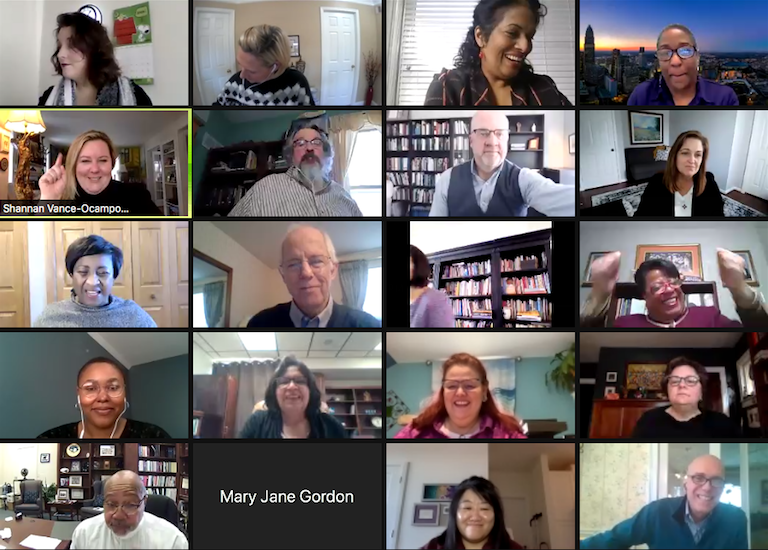
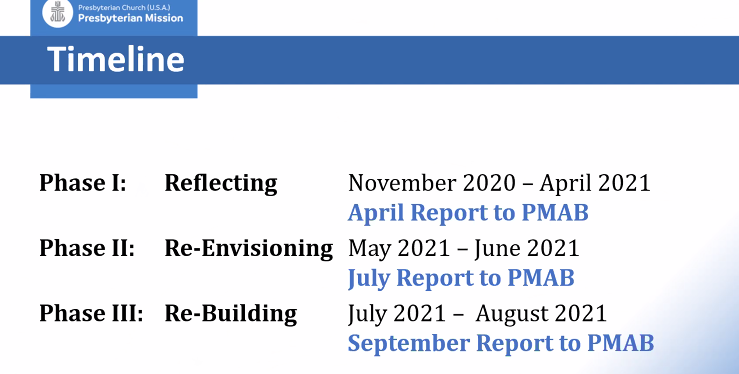
Over much of this year, the Presbyterian Mission Agency will be investigating that through a Vision Implementation Process that will culminate, in September, with recommendations for revisions for how PMA structures itself and does its work.
That’s coming at a time when “we have hope for a new administration,” Diane Moffett, PMA’s president and executive director, told the Presbyterian Mission Agency Board, meeting virtually Jan. 22. “We have hope for new vaccines that could bring an eventual end of the pandemic and an end to the sorrow” and the chain of deaths from COVD-19, already 400,000 in the United States and counting. With evidence of white supremacy and political division all around, the Matthew 25 call to feed the hungry, clothe the naked and work on behalf of the least “has never been more relevant,” Moffett said.
In an opening devotion, board member Jenny Lee of New Jersey, who represented Presbyterian Women on the board, said she was stunned and saddened at the vandalism and desecration of the U.S. Capitol on Jan. 6. The democratic ideals the nation holds in such high esteem “were shown to be so fragile,” Lee said.
She asked herself: “Where did this hatred come from? I realized that the hatred has been here all along,” the racism and white supremacy. “But many of us did not pay attention. We looked the other way. … How do we clean up the litter piled up in our minds and hearts?”
A first step is repentance, Lee said. That word makes some Presbyterians feel defensive — they’re more comfortable with the idea of reflection. “Repentance can be messy and doesn’t come in a 30-minute time frame,” she said. “We’ve got to go deeper. We’ve got to get personal,” and let the spirit lead people to unknown places.
In her poem “The Hill We Climb,” youth poet laureate Amanda Gorman said during the inauguration of Joseph Biden as the nation’s 46th president that “being American is more than a pride we inherit. It’s the past we step into and how we repair it,” Lee said, reciting from the poem.
She challenged the PC(USA): “Isn’t that what repentance is for us?”
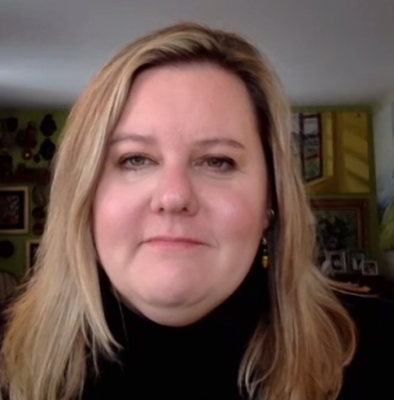
The PC(USA) needs to be bold and responsive to “the hurts of our world” — or if its leaders are not, “we will probably be the group that presides over the death of the church,” said Shannan Vance-Ocampo, vice chair of the Presbyterian Mission Agency Board.
Moffett said the vision process, done with the help of consultants, will ask what’s in place at PMA that’s working? What’s not? What’s not part of the structure that needs to be? What does the agency need to put aside?
Through that process, “there is going to be loss,” Vance-Ocampo said. Reimagining means “saying goodbye to some things” that some Presbyterians may consider sacred and holy, and “it’s going to mean saying goodbye to some folks we have journeyed with.”
As she’s participated in PMA’s process of investigating the implications of Matthew 25 – which so far has involved a series of virtual retreats with Bible study and consultations – board member Kathy Maurer of Michigan said she realized that “the more I learn, the less I know.” It feels like “we’re going in the basement and we’re looking under the rugs. And what’s under there isn’t very pretty. … Our church has been built on white supremacy and racism.”
Board member Ken Godshall said he’s found the consultations useful. Godshall said that during one of those sessions, Elona Street-Stewart, who is co-moderator along with Gregory Bentley of the 2020 General Assembly, said that “Matthew 25 is not just a ministry program or a budget item. It’s what the Presbyterian Church will be remembered for in our time.”
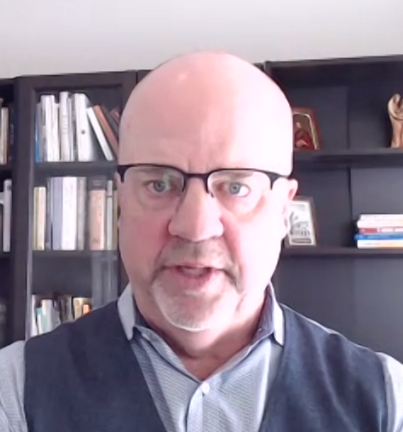
The board also had time for discussion with Allen Hilton, a former professor of New Testament at Yale Divinity School and founder of House United — a movement to bridge the gaps between progressive and conservative Christianity, and one of the consultants on the project.
Board member Kevin Johnson of Detroit asked: What about community organizing? The PC(USA) has strong ecumenical partnerships — but often those who are “partners in the trenches” in community activism aren’t connected to churches or other faith groups.
“The hope is that we can learn wherever learning can be had,” Hilton responded – saying that World Mission is increasingly considering the question of how it can partner with nonprofit organizations. “God speaks and moves even outside the Presbyterian Church,” he said.
In Baltimore, in the aftermath of the protests following Freddie Gray’s death, Presbyterians learned “yes, we have to listen to folks who are not like us,” said board member James Parks. “But we have to go seek them out. They didn’t come to us … We have to actively seek out their help, not wait for them to come.”
The New Testament parables show that Jesus was criticized for eating with and spending time with sinners, with those on the margins, Bentley said.
“If we are going to be in solidarity with Jesus of Nazareth, we need to be in solidarity with the people he would be in solidarity with,” he said. “We’ve got to seek these people out who are already doing the work. They are not interested in more discussion. They are interested in ‘Do you have a plow to put into the ground we are tilling?’ Let’s get to it.”’
Board member Beverly Brewster of California raised the concern that the board may be more diverse, and more progressive or “woke,” than white Presbyterians across the country tend to be.
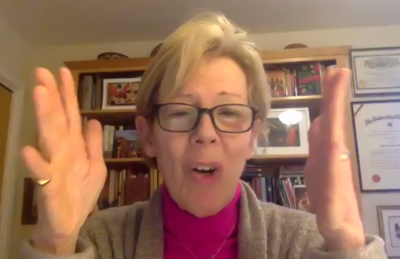
The board is “fantastically diverse and really does not look like the church as a whole,” which is predominantly white, Brewster said.
So the call to work for social justice at board meetings is to some extent “preaching to the choir,” to “a woke and enlightened board,” she said. “How do we move that message and energy to the members of the church across the country? … You can’t lead people where they don’t want to go.”
Hilton responded that how to move that commitment from the PMA board and staff “to the people in the pews who don’t yet share that consensus is a ball game issue.”
The challenge is figuring out how to present the Matthew 25 initiative – with its commitment to congregational vitality, ending systemic racism and eradicating poverty – in a way “that has a chance of moving people across early resistance” and is sensitive to where they are politically whether progressive or conservative. The message: Whether congregants are red or blue, “we’re going Jesus’ way,” Hilton said.
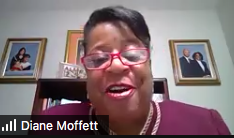
Moffett is unapologetic that the PC(USA) needs to stand for justice — even if that makes some Presbyterians uncomfortable.
“Good news is not good news for everybody” — for those committed to empire and holding on to power, who want to dominate and hoard, she said. As a Black woman who pastored congregations for years, “my congregations, every single one of them, expected me to come to the pulpit and speak to the issues of the day. … It was about being Jesus and what was right. And we were gong to talk about it.”
The call to be a Matthew 25 church came from the 2016 General Assembly and is gospel-based, she said. “It is the word of God. You don’t need to go to seminary, you don’t need a degree to know you are supposed to feed people who are hungry. … You don’t need a committee or a task force. Either you are going to do it or you are not.”
Brewster called for language that is “accurate and nuanced,” saying that there are Presbyterians “who feel like they have been doing the Matthew 25 work their whole lives. That is what church is like” to them — they feed the hungry. “They don’t see that as dismantling racism,” and “some of it does come across as shaming” if they don’t use the same social justice language the board often does.
Moffett pushed back, saying that “it’s time to expand” and ask deeper questions. Along with providing food, ask systemic questions: Why are people are hungry and food insecure? What kind of leadership training is needed to encourage congregations to dig deeper?
Even if some Presbyterians see justice advocacy work as “too political,” it’s important work and gospel-based, board members said.
As Bentley put it: “We have to be careful not to let a vocal and recalcitrant minority veto this movement.”
Johnson said: “Some folks just got to die in the wilderness,” if they can’t see the way forward.
“Yes, it’s uncomfortable,” but the call do this work is a gospel challenge, said board member Rola Al Ashkar of California. “If the church is not called to reform the society, whose responsibility is that? … The moment we stop transforming, we die.”