 The Presbyterian Foundation is considering making a change in the spending formula it uses to provide mission funding to the Presbyterian Mission Agency — meaning that increases in available funding would decline in the short term, but compounding interest on a larger endowment fund should produce greater payouts over time, depending on how the financial markets perform.
The board of the Presbyterian Church (U.S.A.), A Corporation – the administrative and financial services arm of the denomination – heard a report on the proposed change during the first afternoon of its virtual meeting Feb. 11-12.
The A Corporation board also heard updates on denominational giving and the progress of the Coordinating Table, which is working to develop a unified budget for the PC(USA) for 2023 and 2024. Here are more details.
Spending formula
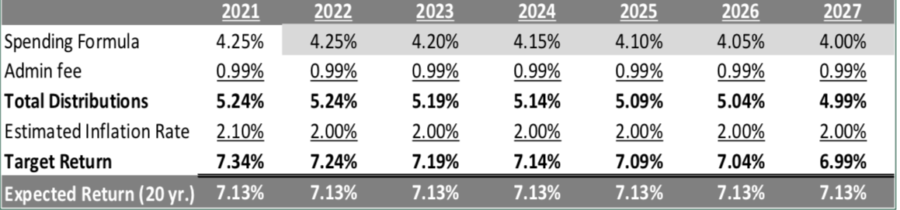
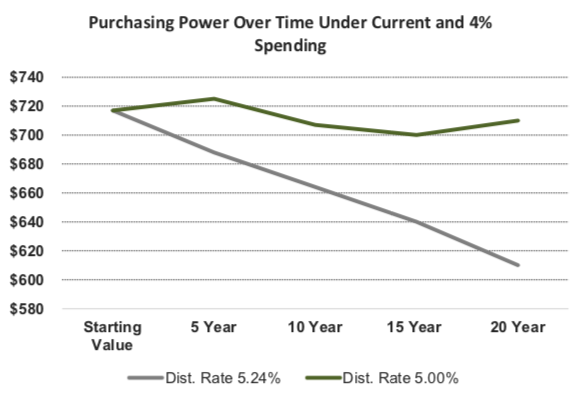
The Presbyterian Foundation is responsible for managing and investing PC(USA) endowments, and currently provides funds to the Presbyterian Mission Agency using a spending formula — currently 4.25% of the average market value of endowments held at the Foundation (based on a 20-quarter rolling average with an 18-month lag). The proposal: starting in 2023, to reduce that incrementally down to 4% by 2027.

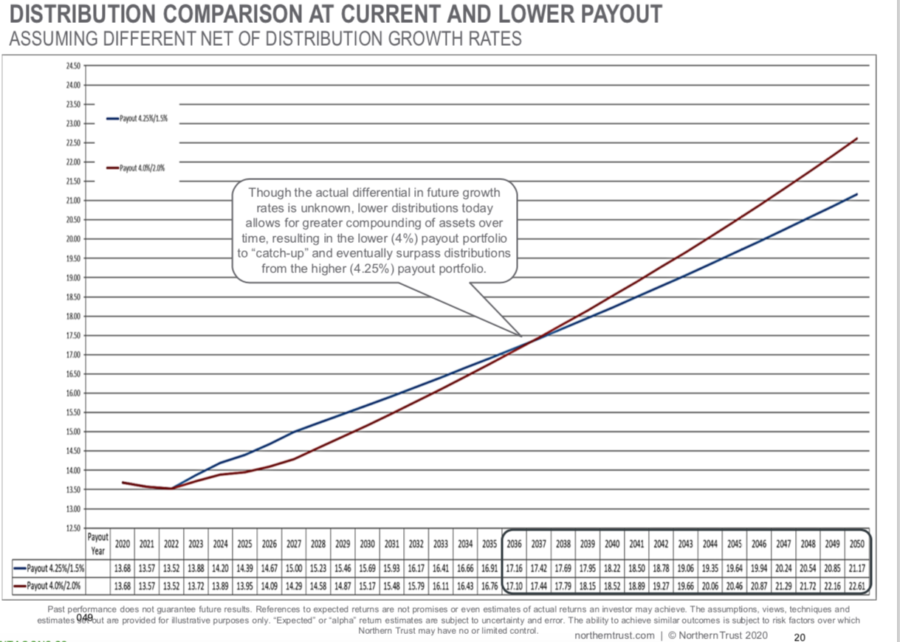
Paul Partington is a senior vice president with the Northern Trust Corporation, which is the outsourced chief investment officer the Foundation contracts with to manage the portfolio. Partington said the intent of the proposed changes is to maintain the endowment’s purchasing power for the future so that over time, “you actually get more distribution at a lower distribution rate. … There are more dollars in the portfolio that compound over time. That compounding is a very powerful element.”

Anita Clemons, vice president and managing director of investments at the Foundation, said “we’ve had strong markets” in recent years, which allows the Foundation to adjust the spending formula in a way that helps future beneficiaries, and still allows the annual payout to the Presbyterian Mission Agency to rise during the time of transition, although not by as much as it would if the formula was not changed.
In 2023, for example, the distribution to the Presbyterian Mission Agency is projected to increase by $200,000 under the adjusted formula, compared to $370,000 if there were no change. In 2027, the increase is expected to be $570,000, or $700,000 less than if there were no change.
Over time, however, the distributions for mission are expected to be greater than they would be if the Foundation didn’t adjust the spending formula, Clemons said — with the transition point projected to come starting in 2036.
Chris Mason, who is co-chair with Bill Teng of the A Corporation board, asked whether the projections take into account the possibility of the Foundation’s endowments increasing because of new gifts or bequests. Clemons said no — major gifts often come through planned giving and wills, and “many of them are surprises.” But the Foundation’s board evaluates the spending formula every year, and if a large gift comes in or the markets perform differently than projected, changes can be made along the way.
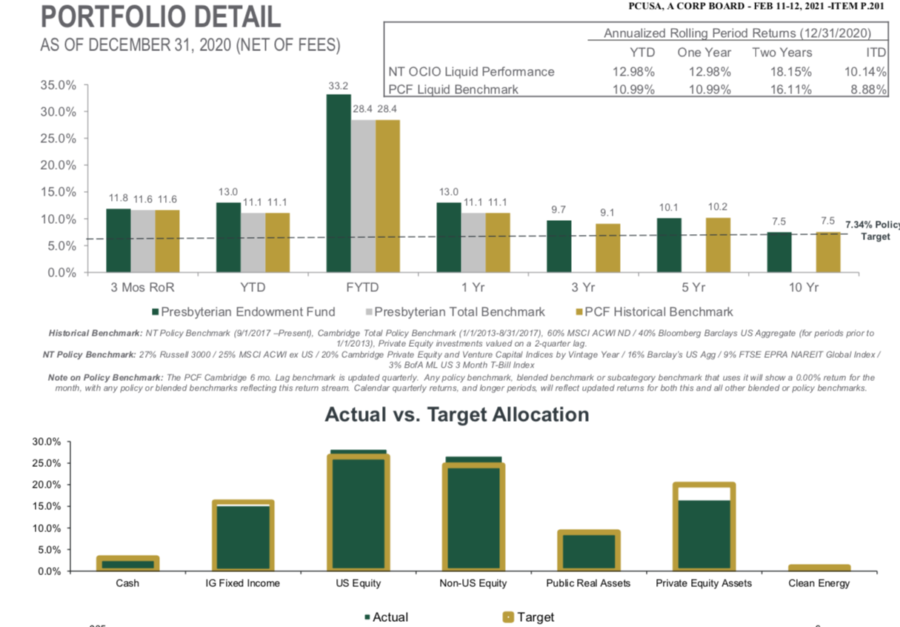
Partington also reported that the performance of the Foundation’s investments portfolio “was meaningfully strong” in the fourth quarter of 2020 — resulting in the year-end returns increasing by about 13%, despite a global pandemic and a difficult market earlier in the year. That’s the second year in a row of double-digit returns, he said.
A Corporation board member Bridget-Anne Hampden, who also serves as vice chair of the Foundation board, said the Foundation board will consider the proposal to revise the spending formula at its meeting Feb. 19.
“We’re happy with the portfolio,” and the returns in 2020 “were very good,” Hampden said.
Budget
Denise Hampton, the PC(USA)’s controller, reported a preliminary, end-of-year decrease in contributions of 14%, or $7.4 million for 2020, compared with 2019 — with much of that decline attributable to the COVID-19 pandemic. Given much worse projections in the spring of 2020 of how much income might drop, denominational leaders cut budgets in May 2020 and expenses dropped as staff travel essentially ceased. So the actual financial impact of the pandemic “isn’t as bad as it could have been,” Hampden said.
Per capita giving was down about 6%, or $700,000, she said. And giving to the PC(USA)’s Special Offerings declined about 22%, or $2.7 million, with the drop in giving particularly evident in donations to One Great Hour of Sharing. Donations to Presbyterian Disaster Assistance were down by $1.6 million, or 26%.
Those declines in giving were offset somewhat by reduced expenses – including reduced costs for staff travel and for meetings which were held virtually, and vacant positions which weren’t filled.
“These results are really pretty amazing, and we should give thanks to God,” said Kathy Lueckert, president of the A Corporation. When the pandemic hit, PC(USA) leaders feared the financial impact would be even worse and carefully tracked the dollars. So to come out with only a 14% decrease in giving for 2020 compared with 2019 “is pretty amazing,” Lueckert said. “It’s been a great team effort.”
She also gave a report on ongoing work at the A Corporation – including an effort to make cybersecurity stronger. In recent months, “there have been a number of breaches that have been in the news,” and increasingly, insurance underwriters are focusing on cybersecurity — what protections are already in place and what needs to be improved, Lueckert said.
Coordinating Table
Marco Grimaldo, chair of the Moving Forward Implementation Special Committee, gave an update on the work of the Coordinating Table — which is trying to develop a set of shared values that will guide discussions among top denominational leaders of how much money the PC(USA) has to spend and how those funds should be divided up.

“We’re struggling with what comes next,” Grimaldo said. The focus will shift soon to discussing what process to use to develop a unified budget — in which, for the first time, the leadership of the Presbyterian Mission Agency, the Office of the General Assembly and the A Corporation will try to make financial decisions together, instead of each entity developing separate budgets. That’s happening because Moving Forward required, in an administrative action it took in June 2020, that such a table be convened.
“I don’t think we’re all on the same page by quite some distance,” Grimaldo said of the Coordinating Table. Among the questions to be determined are what might be the limits of what’s expected, and the extent to which the agencies can be compelled or encouraged to work collaboratively. “I also hope we challenge ourselves to move past our own reservations,” Grimaldo said — to try a new approach even when some have doubts.
The Coordinating Table will hold their next virtual meeting Feb. 16.
The A Corporation board meeting continues Feb. 12 with committee reports and discussion of the 2022 General Assembly.