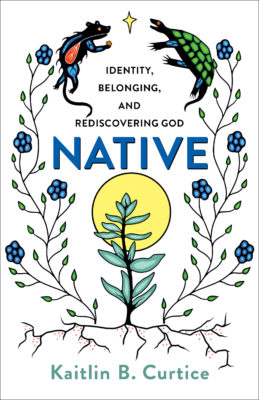
 Kaitlin B. Curtice
Brazos Press, 208 pages
Reviewed by Susie Carter-Wiggins
Writing this review through the lens of a white woman who is also a Presbyterian pastor, mother and grandmother, I found Kaitlin Curtice’s book not only revealing of her heritage, but revealing of my own as well. Curtice takes readers on a journey toward discovering a new world for our children and our children’s children by looking back at our ancestral roots, and then forward into a better world for us all, even as she navigates her own journey. With expansive reflection, she explores her deeply embedded sense of self as a Potawatomi Anglo-European Christian woman, and she invites us to join with her in a discovery of our own sense of selves asking: “Who are we?” “Who are our ancestors?” “What does it mean in our lives that they’ve gone before us?” “What are our responsibilities to carry on their traditions, songs, foods, and worship?” “What is the legacy we want to leave for those who will come after us?”
Because Curtice’s writing is so personal, engaging, hospitable and invitational, readers quickly come alongside of her, accompanying her in her journey while beginning their own. She weaves stories of journeying, wandering and creation into the structure of her writing, and invites and then challenges her readers to unpack the hard topics of white supremacy, racism and European settler colonization that have affected each one of us since the Europeans first arrived in this land determined to strip Native Peoples of every trace of their being — personhood, identity, land, language, culture and society. She shares raw narratives of what it is like when “Native Americans are bombarded with Thanksgiving myths … and kind, well-intentioned parents message asking for book lists, churches ask for Thanksgiving reflections that don’t center celebration of Pilgrims.”
In other words, Curtice reminds us white people that we need to do our own work and stop expecting Indigenous peoples to do the work of anti-racism for us. Furthermore, white people need to sit with the reality of what their own ancestors did in order to seek forgiveness and then repent, do all we can to make reparations and become activists for Native, Black, and brown Americans, so that white supremacy is stopped in its tracks and is a part of history, but not a part of our future. The stories we tell our children and our children’s children matter. They will be handed down just as the Thanksgiving myths have been generation after generation. She writes, “We must carry one another’s stories with grace and honor, and lead each other toward a kind of healing that heals whole systems, not just people.” We can be the ones who break the cycle of these harmful narratives; we can be the ones who teach our children true narratives about Indigenous peoples — their sorrows, trauma, grief, resilience, strength and courage.
The prophet Micah said, “The Lord has shown you, O mortal, what good is; and what does the Lord require of you but to love kindness, seek justice, and walk humbly with your God” (Micah 6:8). God has been about reconciling the world back to God’s self since humankind first turned away from God. Curtice’s “Native: Identity, Belonging, and Discovering God” serves as a guidebook for us to participate in God’s reconciliation with God, with each other and with ourselves.
Susie Carter-Wiggins is the associate pastor for congregational care at Germantown Presbyterian Church in Germantown, Tennessee.