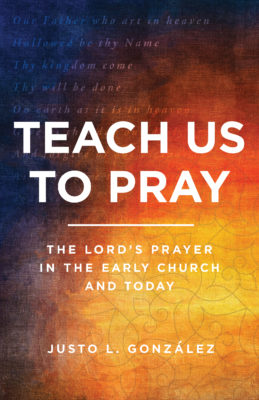
 Justo L. González
Eerdmans, 192 pages
Reviewed by Mary Austin
How many times, I wonder, have you said the Lord’s Prayer, over the years of your faith? With the gathered people of God during worship, certainly, plus at weddings, baptisms and funerals. Perhaps at the close of a contentious church meeting, or with a dying loved one. With a child before bed, or at a family meal. As a chaplain, I said it countless times in hospital rooms and with people who were dying. We might say different words, and then catch up with each other for the end. Even across different religious traditions, it brought a sense of connection to each other and to our shared God.
In this wise book, Justo González explores that communal aspect of the Lord’s Prayer. He takes the prayer phrase by phrase, and the elegant design of the book supports this meditative tour through the words. For each line, González gives us the history of the Lord’s Prayer in the early church, and then a theological reflection on what we’re saying when we pray the familiar words.
For those who struggle with the “Our Father” at the beginning of the prayer, González traces a historical line through the places in Scripture where a masculine noun includes the feminine, and allows us to imagine that the same is true here. When we address God as our father, González says, “we certainly are not saying anything that couldn’t be expressed by also calling God ‘Mother’ or ‘Loving Parent.’ ” For González, the claim of God as father means that early Christians, severed from family members by their new faith, found a new home and family in God. “Rather than saying God is like an earthly father,” he adds, “we would do much better to say that earthly fathers should take God as a model of parental love, a love that God is constantly pouring out.”
González roots the Lord’s Prayer in the world of the early church, and also firmly in our world. When we pray “thy kingdom come,” he urges, we must also be willing “to tear down barriers, to forgive enemies, to bring good news to the poor and to liberate the oppressed. When we do this, we not only announce the kingdom, but we also practice living in it.”
In keeping with the communal nature of the prayer, this book would make an excellent church study. It can be read as a solitary devotional, and yet it feels like it would have an even greater impact on a church willing to read and talk about it together. For González, praying the Lord’s Prayer is an extended exercise in aligning ourselves with God, and with the realm of God. For all of the hundreds of times each one of us has prayed the Lord’s Prayer, there are still new understandings in this book. On a topic that could easily be tedious or repetitive, he finds new ways to lead us into the depth of this prayer and toward God.
Mary Austin is the pastor of Gaithersburg Presbyterian Church in Gaithersburg, Maryland.