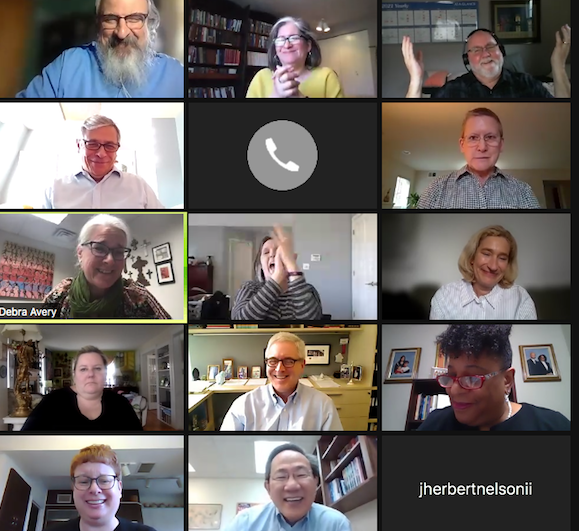
 The Coordinating Table – a group of 15 denominational leaders given the task of developing a unified budget for the Presbyterian Church (U.S.A.) for 2023 and 2024 – is still long on big-picture questions, short on specifics.
The Table is meeting monthly. Its March 11 Zoom meeting focused on three questions — questions, as Debra Avery from the Moving Forward Implementation Special Committee put it, that are intended to reflect the kind of curiosity Jesus showed in asking his own questions (“Who do you say that I am? What do you want me to do for you?).
The Coordinating Table’s three questions this day were:
- Are there traditional or customary ways of doing things that keep us from seeing possibilities? Have we built cultures of behaviors that no longer serve us well and are there things that are in our power to change but we have been unwilling to do so?
- What is mission? Does the Office of the General Assembly (OGA) do mission? If so, would a new definition of mission make some restricted funds available for the work of OGA?
- Do we agree to make a good faith effort to achieve a unified budget through the work of the Coordinating Table? It seems that there is good work to be done by staff, mostly the staff in the Administrative Services Group (ASG), but it is important that OGA, the Presbyterian Mission Agency and ASG all agree to this so that the effort is not lost.
Customary ways
When Avery presented the first question, the immediate response was a long stretch of silence. The conversation moved forward from there — touching more on ideas than dollars and cents, and the difficulty of being an innovative, flexible church in an institution with a long track record of doing things in particular ways.
The Committee on the Office of the General Assembly is running into the question of traditions and rules when trying to figure out how to conduct the 2022 General Assembly differently, said COGA’s moderator, Stephanie Anthony. For example, “we only use Robert’s Rules” of Order in making decisions.
Within the national offices, “OGA is like a family,” said deputy stated clerk Kerry Rice, and PMA is working on becoming more collaborative and less hierarchical, focusing on the Matthew 25 vision, said Diane Moffett, PMA’s president and executive director.
A difficulty is the proclivity in the PC(USA) for “hanging on to the vestiges of the church that we once were,” said COGA vice moderator Eliana Maxim — with “a real fondness for our history and our past accomplishments,” both for congregations and the national church. A “strange cloak” of worry over scarcity hangs on such an affluent denomination, Maxim said. “There’s an underlying fear that change equals loss,” or a diminishment of power and voice.
The PC(USA) has to deal with a lot of rules and regulations – “we have to look at a lot of old books” – in trying to be innovative and adapt to changing times, said J. Herbert Nelson, the denomination’s stated clerk.
What is mission?
There was some resistance to the terminology of “mission.”
Anthony said she thinks in terms of “missio Dei” — that “it’s the work of God in the world that we’re joining and being a part of.”

Maxim, a native of Colombia, said, “I come from a part of the world where ‘mission’ is not a particularly positive word” — with its connotation of doing mission for others, as the North American church has tended to think of it,
Sara Lisherness, interim director of World Mission for the PC(USA), said that her office is hearing from global partners that “the term ‘mission’ is problematic.” It’s transactional, yet the global partners invite the PC(USA) to partner in transformational ministry. Following the lead of other denominations, World Mission may change its title to Global Ministries, Lisherness said.
Shannan Vance-Ocampo, a presbytery executive who serves as vice chair of the Presbyterian Mission Agency Board, said she has learned how much work OGA does to support ministry — something she didn’t understand as a local pastor.
And the question of whether mission funding can flow to OGA depends largely on the restrictions that Presbyterians placed on donations when giving the money and which agency does work that matches those restrictions. There may be more flexibility in considering whether additional unrestricted funding can be given to support the work of OGA, said Barry Creech, director of policy, administration and board support for PMA.
Is there a good faith effort for a unified budget?
“I don’t feel like we have a choice,” Rice said — contending that the church has been confused by the multiple budgets presented in the past. “We’ve got to find a way to do it.”
Maxim said church leaders need to find a way to have ongoing collaborative conversations — and not just about funding.
Chris Mason, who serves as co-chair of the PC(USA), A Corporation board, along with Bill Teng, said he supports whatever can be done effectively on a tight timeline — just over a year.
His caution: “Saying the words ‘unified budget’ doesn’t tell you what it is,” and he doesn’t want people to say the effort failed or wasn’t done in good faith if it isn’t fully accomplished this time around.
A unified presentation of multiple budgets, rather than consolidating all the expenses and revenue into a single budget, could be a victory this time, “so long as we did not stop our work,” Mason said.
Nelson concluded that “this is a spiritual problem as much as it is one of money” — part of the PC(USA)’s ongoing struggle to come to terms with injustice, race, who has power in the denomination and who does not. The church has struggled with those questions for decades, he said, while the world around is changing faster than the PC(USA) is.
While the church continues to sift through institutional questions, “we are in a very different place, at a much more vulnerable place, than we have been in previous years.”