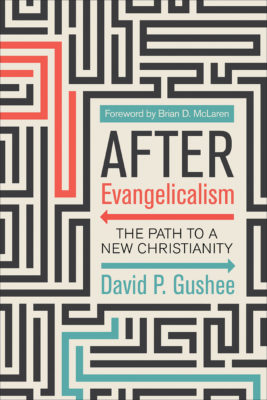
 David P. Gushee
Westminster John Knox Press, 242 pages
Reviewed by Don Meeks
As one who joyfully identifies as an evangelical Christian, it was with no small interest that I read David Gushee’s newest offering, “After Evangelicalism: The Path to a New Christianity.” Gushee wastes no time identifying his intended audience: “This book is for people who used to be ‘evangelicals’ and are now post-evangelicals or ex-evangelicals or #exvangelicals or somewhere painfully in between. I am one of them. One of you.”
Written with a polemical and pastoral urgency, Gushee seeks to engage those who may be tempted not only to leave the church, but Jesus as well. I believe readers will deeply resonate, as I did, with the human concern of this book. What pastor doesn’t weep over the wounded and those who walk away?
As an insider to the evangelical world (24 of 25 boxes checked – see page 3!), I find myself in broad agreement with many of the excesses and deficiencies he names. He rightly identifies the evangelical subculture’s penchant for politics, shallow theology, para-churchiness and sexual purity to the exclusion of the weightier matters of justice and mercy. Thank you, Professor Gushee, for calling out these failures and lifting this pastoral concern before the church.
The substance of the book consists of a set of three proposals for post-evangelicals to consider in the areas of authority, theology and ethics. Each proposal argues against some feature of evangelical subculture and for a new way of being faithfully Christian. He robustly challenges the tendency within many evangelical churches to embrace reductionist approaches to authority (biblicism and inerrancy), theology (nothing but the blood of Jesus) and ethics (traditional marriage and conservative politics).
I was moved by Gushee’s poignant narrative of his personal and transforming encounter with a Holocaust documentary in his ninth-grade year of high school. Unable to escape the haunting images, this traumatic encounter compelled him to engage the Holocaust at all stages of his formal education. He cites an essay by Rabbi Irving Greenberg in which he describes the burning of children at Auschwitz. The “burning children test” became for Gushee the starting point for all theological reflection. Any statement about God, theology, morality or faith must account for such a world in which children can be burned alive. Indeed.
This book is rich with historical, theological and cultural awareness. The endnotes alone (31 pages) are worth the asking price. Where I find fault with this book is in the author’s failure to distinguish evangelical belief from the particularity of subcultural practice. Rather than offer historian David Bebbington’s widely accepted framework of evangelical belief or even the National Association of Evangelical’s own self-definition, Gushee presents a straw man of “Hallmark-Christmas-Movie Jesus” and “Vacant Jesus Fillable with Any Content.” Too often the faith and movement he critiques is but a caricature of the Christ-centered, compassionate and holy fellowships I have known for nearly 40 years.
Who should read this book? Certainly those for whom it is intended: the wounded and weary of church. In addition, I would urge my evangelical ministry colleagues to engage this important work. Let it serve as a goad to love and good deeds, especially toward those whom we once baptized and with whom we have broken bread and walked in holy fellowship, yet have walked away.
 Don Meeks is pastor of Greenwich Presbyterian Church in Nokesville, Virginia.