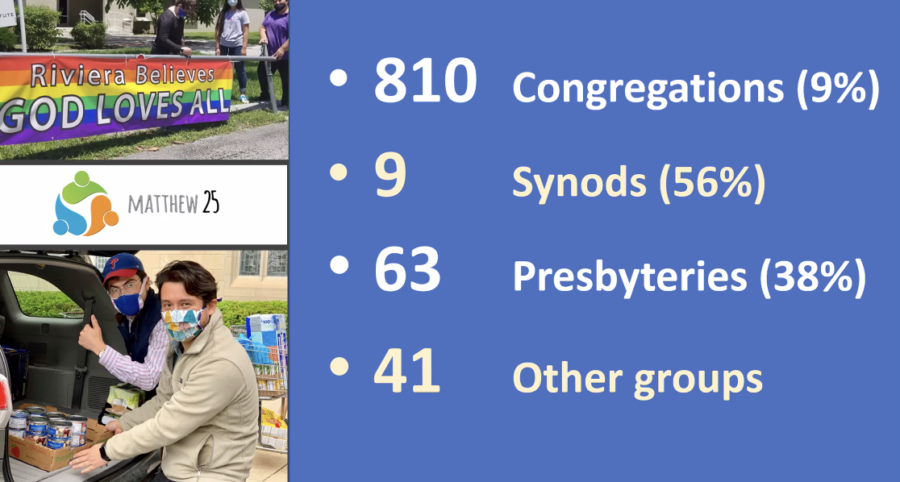
The Presbyterian Mission Agency Board is deliberately shifting the way it does work — moving from focusing in its meetings mostly on items of business (things to be voted up or down) to spending chunks of time training and educating board members, so they can go out and help other Presbyterians understand the importance of the church’s Matthew 25 initiative.
The emphasis of the board’s April 22-23 Zoom meeting is on eradicating poverty – and what churches can do to help achieve that.
Follow Jesus
In an opening devotion, Kate Murphy, pastor of The Grove Presbyterian Church in Charlotte, North Carolina, shared an opinion piece she wrote after a Gallop Poll was released showing that fewer than half of American adults now are members of religious congregations.
Some blame the young people, the media, the government for taking prayer out of schools, she wrote. But she contends that “while church membership is declining, people are still as hungry for things of God as they have ever been” — for justice, hope, mercy, meaning, second chances. “People are still seeking the holy and the Holy One is still seeking people,” Murphy said.
The problem as she sees it is that “most of the church in America looks more like America than the body of Christ” — that too often, Christians don’t stand for mercy, justice and love.
“I love the church,” Murphy wrote. “But I love Jesus more, and the church has done a terrible job being faithful to the way of Jesus. When we who love the church see these numbers, we shouldn’t kid ourselves. People aren’t rejecting Jesus — they are turning away from churches that represent him badly. Churches that are full of programs instead of prayer, full of doctrine but empty of mercy.”
And she said: “What the church needs is not more members, but more Jesus.”
Progress report
Diane Moffett, president and executive director of the Presbyterian Mission Agency (PMA), updated the board on PMA’s Vision Implementation Process, a three-step process for determining a new structural design for helping the PMA live into its Matthew 25 vision.
Starting in May, a 37-member Leadership Innovation Team will begin meeting weekly, with the help of consultants David Hooker and Allen Hilton, to develop goals, objective and outcomes.
In October, the board will be asked to approve a plan for restructuring PMA, with the resulting staff changes taking effect through 2022.
Mental health network
Donna Miller, the PC(USA)’s associate for mental health ministry, described the growth of the Presbyterian Mental Health Network over the past three years — starting with an action of the 2018 General Assembly and building into a national network that provides resources to Presbyterians and grants to congregations involved in mental health ministry.
The board and the network now have a formal missional partnership agreement that calls for raising awareness of the network around the denomination and connecting those involved in doing the work.
Matthew 25 calls Presbyterians to “a place where we have been afraid to go,” with a commitment “to make sure we area centering people who have been on the margins,” said Dan Milford, who is pastor of Covenant Presbyterian Church in San Antonio and moderator of the Presbyterian Mental Health Network.
And with the COVID-19 pandemic, “experts predict the mental health impact will be with us for years,” Miller said.
How to work on poverty?
A group of PMA leaders led presentations and small group conversations on how congregations can work effectively to try to eradicate poverty — to really make a difference.
“What is it that moves us from charity to solidarity?” asked Laurie Kraus, coordinator of Presbyterian Disaster Assistance and one of the presenters. “From feeling and sorry about the suffering of others” to something deeper — “the wrenching of the gut” that Jesus experienced when he healed the leper who told him, “Lord if you are willing, you can make me clean.”
What happens that’s “so deep and profound that it stops us in our tracks” – that’s so transformative “it makes us quite literally turn in a different direction?” Kraus asked.
When PMA staff members began to investigate common elements of congregations “doing our best work” – moving from “thoughts and prayers” to transformation, as Kraus put it – five elements rose to the top. They’re not sequential or mutually exclusive, she said. All the pathways are important for Presbyterians wanting to do this work.
- Do theological and biblical work using resources focused on systemic poverty.
- Educate yourself on the root causes of systemic poverty.
- Listen to people who are living the experience, forming relationships that are respectful and not paternalistic.
- Engage in public policy advocacy and community organizing, working to create economic and environmental justice.
- Give generously to the work, providing time, talent, money and skills.
Among the feedback after the small group discussions:
- “It’s not just political. It’s actually the gospel message.”
- To find out who opposes change, ask “who makes money from the poor?”
In a closing devotion, board member Kathy Maurer of Michigan spoke of the false narrative that often surrounds those living in poverty. People say: “They just need to get a job. Nobody wants to work” — that people would rather collect unemployment. “We’ve decided how they ended up poor. The reality is there but for the grace of God go I.”
People of faith “need to learn to listen and hear our siblings who are in pain,” Maurer said. “Christian love is justice in the public square.”
The board’s meeting will continue on Zoom April 23.