This Sunday is Trinity Sunday. While the Triune God is a core theological idea, it is a particularly tricky one to explain to children. In fact, many adults struggle to clearly define it! (One Sunday a church member in his 60s leaned over and whispered to me, “I still don’t totally understand the Trinity, but I like it.”) In this lesson, you’ll explore the mystery of the Holy Trinity with your children through reading and art.
Begin the time with your children by asking them to think of all of the different parts of their life: family, school, activities, etc. Then ask them to think of who they are in each of those areas. For example, at school, the child is likely a student. At home, they are probably a daughter or son, a brother, sister or sibling. After each child has shared the roles she fulfills in each area of life, ask her to consider what happens to the other roles when she is in a particular context. When she is at home, is she still a student? When she is at school, does she stop being a daughter or sister? When he is playing a sport, do the student, son, brother, etc. roles disappear? Note that people are always all of the roles they play in life. However, different aspects of a person’s personality shine or are most notable in particular contexts.
Share with your children that they will be watching a reading of a picture book that that talks about the three different parts of God. We call this the Trinity or the Triune God. Encourage them to listen for the reader to share each of the three parts.
Watch this reading of “A Picture of God: 3 in 1” by Joanne Marxhausen. (Or, you can read the book aloud to your children if you own a copy or are able to borrow one from your local library.)
After watching the video, ask your children to share what they learned about the Triune God. What are the three parts of God? Note that the book uses the terms Father, Son, and Holy Spirit to refer to the three aspects of God. You may use other terms such as Creator, Redeemer, and Sustainer, or Parent, Jesus, and Holy Ghost. As you talk to your children about the video, feel free to shift from the author’s language to the one that they will hear in your house and in worship services.
Next, ask your children how the three parts of God work together. Note that God is always fully each of these, but we may notice one more than the other depending on how we are thinking about God at the time. For instance, if we are on a walk and notice the beauty of creation, we might give thanks to God the Creator. If we are talking about ways we can love our neighbors, we might look to the life and actions of Jesus. If we are trying to notice where God is in a moment in our lives, we might ask the Holy Spirit to help us. God doesn’t stop being all three things when we focus on a particular aspect of God. We’re just more in tune with that part in that moment. (Don’t be discouraged if your children don’t fully understand the Trinity at the end of your discussion. It’s a complex concept and it’s one that requires the ability to accept seemingly contradictory ideas. Your goal is expose your children to Trinitarian language and to plant the seeds of the concept so that they can grow over time.)
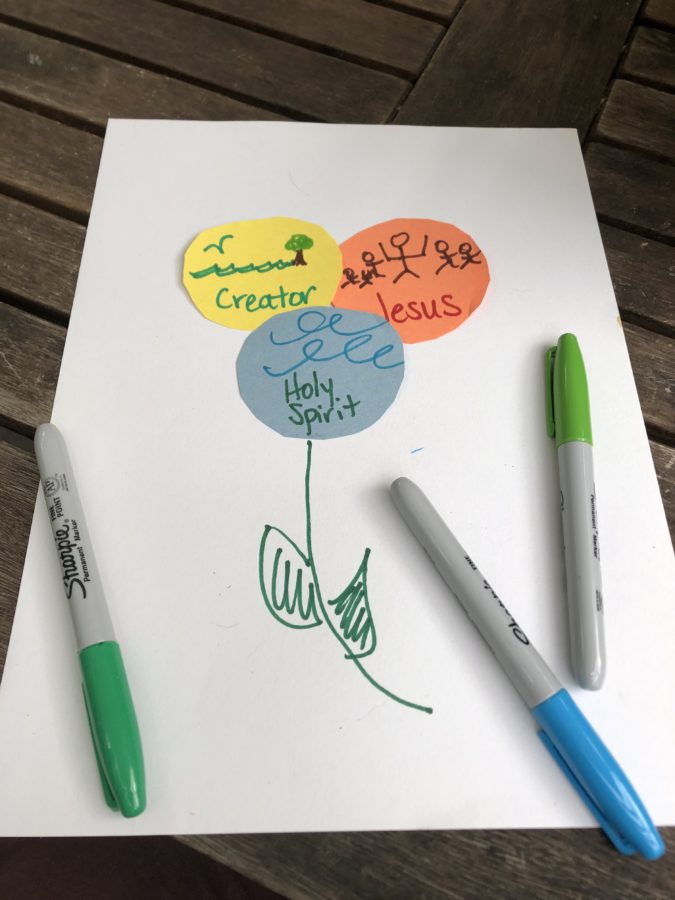
To help your children visualize the idea of God being three-in-one, gather some supplies to create a piece of art that will represent the Trinity. You’ll need blank colored paper in three different colors, blank white paper, markers or crayons, glue and scissors. Begin by asking each child to cut one circle out of each sheet of colored paper. He should try to cut equal sized circles. If your child is younger, you can cut the circles out for her. Next, have your child draw or write each of the three aspects of God on the circles. Use the language that you use at home or that children will hear in worship services. Then, ask your child to glue the three circles on a blank piece of white paper so that the circles overlap, creating a flower design. Have your child then draw a stem for the flower as well as decorating the rest of the page. Hang the piece of art somewhere your child will see it throughout the week. It will serve as a reminder of the Triune God.
 JOELLE BRUMMIT-YALE is the director of children’s and youth ministries at Chapel in the Pines Presbyterian in Chapel Hill, North Carolina. When not at the church, she can usually be found at home with her son and husband caring for their many animals and developing their family homestead.