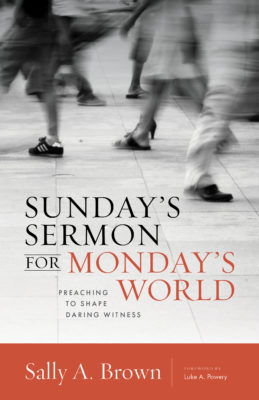
 Sally A. Brown
Eerdmans, 216 pages
Reviewed by Alice Rose Tewell
Over a year into this pandemic, having gone through the intricate steps of going digital, pastors are now asking the more global questions of where God is calling the church to transform. “Sunday’s Sermon for Monday’s World: Preaching to Shape Daring Witness” by Princeton Theological Seminary professor Sally A. Brown comes just in time.
She invites the pastor on a journey to rethink how each of us preaches to testify “to the radical mercy, inclusive love and restorative justice of God.” In order for the church to show up and interrupt “the regimes and routines of this world that diminish human lives,” including “webs of consumerism, mistrust of the ‘other,’ entrenched racism, and forms of power that dominate and threaten,” Brown powerfully argues that the preaching moment must inspire and equip “ordinary prophets” — those who participate in the life of the church week after week and act in the name of Jesus Christ in both small and momentous ways “as agents of (redemptive) interruption.”
Brown accomplishes her prophetic task in two parts. Part one provides a theological backdrop and considers different approaches to Christian public witness. Her insight that “missional theology” has been dominated by white male voices paying little attention to issues of race is particularly poignant.
After framing the book theologically, in part two, Brown lays out four preaching tasks clearly presented so that the preacher can easily return to each chapter as a reference. The four preaching tasks are rooted in the first one: helping the listener see God’s extraordinary promise and hope nestled inside ordinary situations. In this age of social distancing, what a life-giving notion that is!
With warmth and compassion, Brown weaves in some of the best practices of preaching including her frequent admonition to eliminate the “must,” “ought” and “should” language that often creeps in at the end of the sermons. This kind of proscriptive language tends to make the listener tune out — and, as I would venture even in our digital preaching age, how easy it is to put the preacher on mute! Instead, rooted in promise-grounded hope, she invites the preacher to end sermons with realistic and improvisational actions grounded in grace and hope.
Brown examines selections of sermons by a somewhat diverse cross section of preachers to demonstrate the various preaching tasks. I wish I could have read the entire sermon text and was left craving more. I have attempted to engage her preaching tasks inspiring more engagement with the central Christian practices, particularly the sacraments, and to employ more storytelling that is easier on the ear and more inspiring for the heart. Her last chapter, “Sermons that travel,” on metaphorical preaching will provide me some needed guidance for later this year.
Reading this book during an at-home continuing education week would be an excellent use of time. It requires a careful read, but is well worth the time for it provides much needed inspiration and practical guidance to be easy on the ear, inspiring to the heart and moving to our feet to engage God’s justice. Particularly in this time of social distancing when the church is equipping members for at-home Christian formation, this call for preachers to equip virtual and in-person pew sitters to practices of justice and transformation comes as a prophetic message in itself.
Alice Rose Tewell is the pastor at Clarendon Presbyterian Church in Arlington, Virginia, exploring how to pastor, co-parent and exist with boldness during these changing times.