 Claudia Rankine
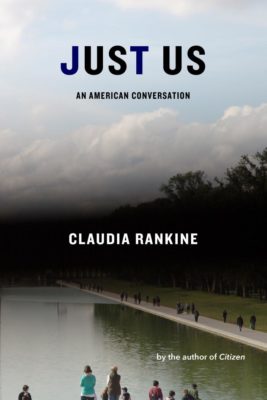
Graywolf Press, 360 pages
Reviewed by Jon Nelson
Not long after the murder of George Floyd, I was in conversation with a Black friend who told me that her son-in-law stopped running outside after Ahmaud Arbery was shot while on a jog. Running while Black is evidently a dangerous activity in America. Knowing that I am an avid runner, she asked, “Do you ever have to think about your safety when you go out?” She was not looking for an answer. She already knew what I would say. “No, I do not.”
Poet, essayist and playwright Claudia Rankine interrogates interactions not unlike this one in her new collection of poems and essays, “Just Us: An American Conversation.” Rankine, recipient of several awards for her 2014 best-seller, “Citizen: An American Lyric,” takes readers into airports, planes, workshops, schools, police training seminars, museums, hallways, theaters, coffee shops and dining rooms where racial aggressions and incidents occur. She invites her readers to observe interactions among friends and colleagues where racist assumptions and ideas are made and revealed. All of these places and interactions exist within a history where whiteness is the obliterating standard of Western culture. “Universalized whiteness, that racial imaginary,” Rankine states, “lives in every moment.”
The title is drawn from a Richard Pryor line: “You go down there looking for justice. That’s what you find — just us.” That line, and Rankine’s project, serves as a reminder to those calling for justice before and after the deaths of George Floyd, Ahmaud Arbery and Breonna Taylor that equity is not only sought in changed policy, but among “us” in every moment and every place. The “us” that is humanity has been dissected and divided along devised racial lines. Whiteness was made supreme over every color and that supremacy is seen everywhere — from demographics of power to depictions of people. Rankine evidences this in “Just Us” with graphics, anecdotes, screenshots, collected studies and statements made by people from presidents to passengers on a plane.
“Just Us” is an immersive experience. As she did in “Citizen,” Rankine places tweets and graphs – like clippings from a racial landscape – alongside her poetry and prose pictures. On the right-hand pages she analyzes interpersonal interactions, and on the left-hand pages she provides studies and notes that anchor her analysis. This layout helps the reader remember that every moment exists within a history marked and molded by racist ideas. For example, as Rankine deliberates attending a parent-teacher conference, she annotates her thoughts with findings of studies demonstrating inequity and unfair treatment of schoolchildren along racial lines.
Rankine has collected definitive data that shows how white people have reduced Black people in every time and place. But this book does not serve only as an archive. For the patient reader, “Just Us” prompts reflection and examination. As Rankine notes at the end, this book does not propose a “strategy” to confront racism. Instead, it provokes readers to examine their moment, their place and their interactions in order to see the dehumanizing impact of racism.
Having read this book, I will run with recognition — an understanding that my whiteness grants a freedom not afforded to all as I move through neighborhoods. “Is understanding change?” Rankine asks — and she answers, “I am not sure.”
Jon Nelson is associate pastor at Ark & Dove Presbyterian Church in Odenton, Maryland. He is a runner, reader and listener.