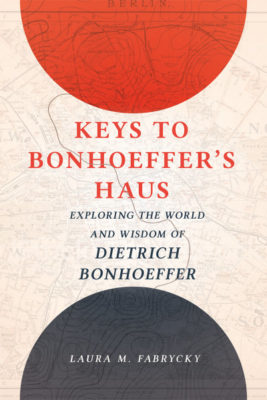
 Laura M. Fabrycky
Fortress Press, 275 pages
Reviewed by Lisa D. Kenkeremath
Laura Fabrycky’s book is a captivating melding of genres: part travelogue, part history/biography and part spiritual memoir. “Keys to Bonhoeffer’s Haus” is a deeply personal account of Fabrycky’s immersion in the life of Dietrich Bonhoeffer while serving as a tour guide at his boyhood home in Berlin. From this three-year engagement, Fabrycky draws spiritual and ethical lessons and considers the claims that Bonhoeffer’s life and theology make on us today. The book’s narrative structure is based on seven “keys” that help unlock the “haus” of Bonhoeffer’s life, relationships and teaching. Using these keys, she explores themes of belonging and identity, boundaries and inclusiveness, the use of language to reveal truth or serve as a shield against it, the obligation to care for others and facing mortality.
A central question animating Fabrycky’s inquiry into Bonhoeffer’s life and the choices he made (or that were made for him) is how ordinary German citizens, mostly Christian, fell for the lies of Hitler and the Nazi party, and how Bonhoeffer and his colleagues were able to resist them.
As the wife of an American diplomat assigned to Berlin, Fabrycky saw Bonhoeffer as a hero as she entered her experience in Germany. This long-held image was challenged one day while she conducted her usual tour and reflected on Bonhoeffer’s leadership of the seminary at Finkenwalde, which was shut down by the Nazis after two years of operation: “The Confessing Church seminary … was an innovative effort marked by both its brevity and its intensity – terms commonly used to describe something doomed and futile. Indeed, its brief dates, its relatively ad hoc existence, and its far-flung location distant from recognized power centers marked it, by and large, as a failure. … The seminary’s fleeting and fragile reality gripped me as I described it to the group, and a flood of pity swallowed me as I imagined Bonhoeffer and the seminarians there.”
She goes on to conclude that Bonhoeffer’s life, rather than a model of heroism and success, was “a masterpiece in the art of dying.” This is a fruitful insight, but it misses something that was central to Bonhoeffer’s own thought: his theology of the cross. Bonhoeffer’s understanding of a God who “allowed himself to be pushed out of the world and onto the cross,” to use Bonhoeffer’s own words, shaped his path of discipleship as he shepherded his obscure and doomed seminary.
Fabrycky’s imaginative synthesis of an extraordinary life remembered and the challenges of a life of faith for ordinary people today is searching, thoughtful and sometimes brilliant, but her exploration would have been better informed by a deeper engagement with Bonhoeffer’s own writing. Her work is well-researched, but most of her references are to chroniclers of Bonhoeffer’s life and thought, most notably Eberhard Bethge. As a result, we hear little of Bonhoeffer’s own voice.
The last key, in the chapter titled “Befriending Bonhoeffer,” suggests that Bethge’s friendship with Bonhoeffer can be instructive for us. Bethge, who carried a burden of sadness, was the person in charge of preserving his friend Dietrich’s memory — not as a hero or a plaster saint, but as an embodied human being who shows us what it is to engage fully with the world and its suffering. “I think Bonhoeffer would have us not focus on him but embrace the responsibility of our own lives,” Fabrycky writes: the responsibilities of friendship, compassion and “civic housekeeping” that honor the bonds of our common humanity.
Lisa D. Kenkeremath is a writer and Presbyterian pastor in Virginia.