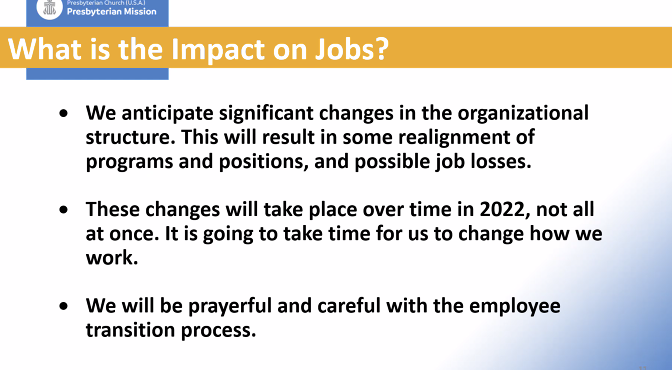
In October, the Presbyterian Mission Agency Board will be asked to vote on a restructuring plan for the Presbyterian Mission Agency — a plan that’s the result of a year-long Vision Implementation Process and that could result in some job losses or changes for agency employees.

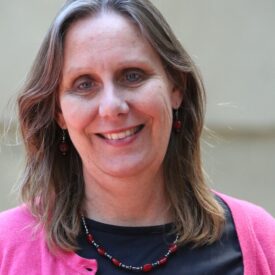
Diane Moffett, president and executive director of the Presbyterian Mission Agency (PMA), told the PMA board during a July 21 Zoom meeting that “the world is changing and so is the church” — and that it’s those changes, not financial difficulties, that are compelling the restructuring. “I want to say to you that money is not the driving force behind these decisions,” Moffett said.
Repeatedly, those involved with this process spoke about the importance of the church taking real risks to do God’s work and to stand with those on the margins, as the Presbyterian Church (U.S.A.)’s commitment to being a Matthew 25 church – to fight structural racism, try to end systemic poverty and work for congregational vitality – calls it to do.
They also spoke of the likelihood of pushback or resistance to the decisions the board will be asked to make.
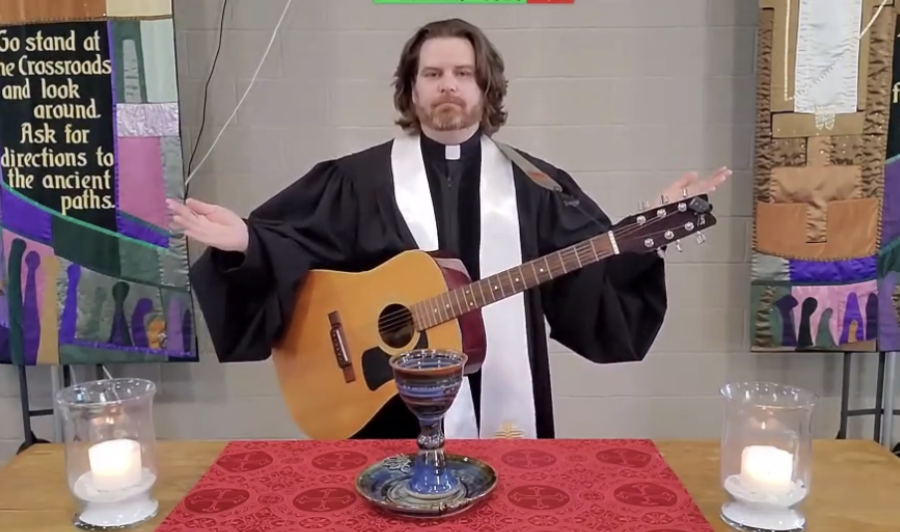
Board member Brenton Thompson of Pennsylvania, in an opening devotion, spoke of “all the opposition we know we are going to face” in living out the gospel. But he also told how Jesus sent out the 12 disciples – describing their “jittery energy” before they departed in pairs – and said this season can be seen as an exciting beginning for PMA, a time of opportunity “when there are miracles to behold and to be celebrated.”
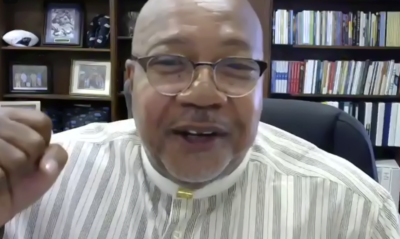
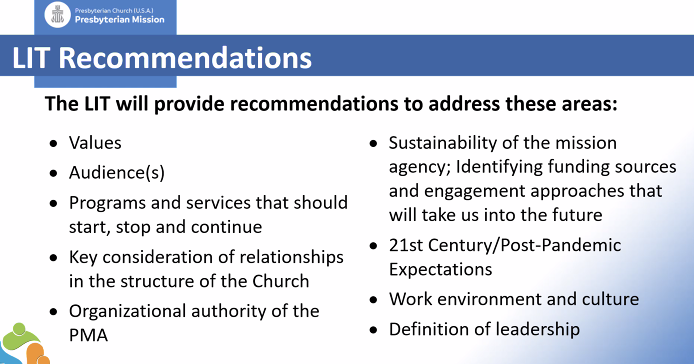
Warren Lesane, chair of the Presbyterian Mission Agency Board, said his participation in the Leadership Innovation Team, known as LIT – a group of about 45 to 60 “lovers of Jesus,” as he described it, primarily board members and PMA employees who are helping shape the recommendations the full board will vote on at its Oct. 6-8 meeting – has been one of the most transformative experiences of his life.
“LIT is the most spiritual, generative, inclusive” body he’s ever participated in, Lesane said. “I just wish we could duplicate it across the church.”
He also said: “It’s holy work. It’s the work of being. It’s sacred work. It’s the work of a new era.”
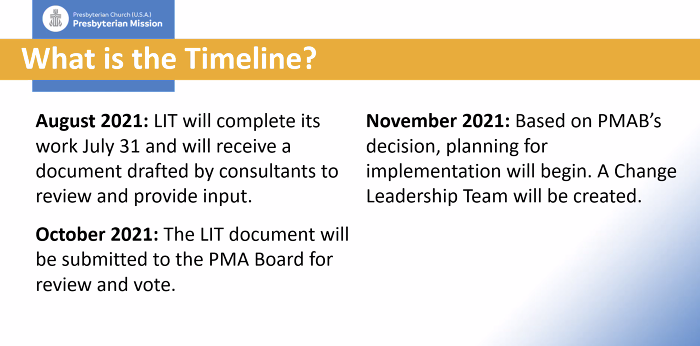
Moffett reminded the board that the Vision Implementation Process, led by consultants David Hooker and Allen Hilton, has three phases:
- Reflecting (from November 2020 to April 2021), involving listening sessions with PMA employees, agency leaders, board members and more;
- Reenvisioning (from May 2021 to October 2021), in which LIT is working with the consultants to craft recommendations; and
- Rebuilding (beginning in November 2021 and extend into 2022), which will involve the actual restructuring of PMA, led by a Change Leadership Team.
Changes “will occur gradually,” Moffett said. “We also know this uncertainty will be unsettling,” particularly for PMA employees. “We will be prayerful and careful” with the employee transition process. “We do not want to create undue anxiety in our work environment. We want our employees to know they are valued and we will be thinking deeply of them” as PMA finds its way into a new way of being.
Kathy Francis, PMA’s director of communications, outlined a plan for communicating this “reimagined mission agency to the General Assembly” and to Presbyterians in the pews — a plan that will include suggestions for discussing the changes with posts on social media, for having board members get out the word and for gathering feedback.
The board broke into small groups to learn more about the process from LIT participants.
Afterwards, a few board members shared their thoughts.
Judy Wellington, a board member from Arizona, said her group discussed “moving forward and being (church) in a way that is willing to risk the loss” — the loss of members and possibly donors. “Not being driven by fear. Not being afraid to act or to be a church that God is calling us to be. … The willingness to just go forward, knowing, knowing there will be those who will not like it.”
Board member Kevin Johnson of Michigan said that “how we tell this story is going to be critical,” because in many churches “folks don’t really take well to new and change. … I always get back to the issue of money. We say it’s about ministry and not necessarily about jobs,” but some “are going to see it as a story of downsizing and rearranging deck chairs.”
The Bible speaks extensively about wealth, and “we’re still wrestling with some significant wealth inequalities within this family,” Johnson said. Wrestling with “the 900-pound gorilla in the room is going to be a significant challenge.”
Moffett described the Vision Implementation Process as having “a lot to do with the quality of our spirituality. Who will we be as a church? Are we looking for comfort to ourselves, or are we willing to take up the cross?”
She asked Presbyterians to “pray for our church. The churches that are on the ground and are on life support, and they still don’t want to change.” And for support for those that are willing to move forward, but trying to figure out how.
Moffett and others spoke of pushback — particularly if PMA chooses to stop doing particular types of work, or to engage more deeply in ministry some might find challenging or controversial. It’s like a muscle, Moffett said. “If you don’t have any resistance, you’re not going to get stronger.”
Board member James Parks of Maryland began a devotional time by playing a recording of jazz musician Gregory Porter’s song “Take Me to the Alley.”
Parks said as he reads the Bible, “it occurs to me that Jesus must have spent a lot of time with people who are pushed into the dark alley” — those who are outcast, poor, oppressed, sick, sinners, lonely, afflicted, “folks who have lost their way.”
Porter has explained his inspiration for writing the song, Parks said. He was a boy, living in California, and his mom bought a new – to them – Cadillac El Dorado. The first time he rode in the car, Porter settled into the back seat, pretending his mom was his chauffeur. But his mom, a minister, noticed a man lying on the pavement. She stopped and picked up the man, who had soiled himself. She drove him to their house, gave him food, sobered him up, gave him clothing. Porter was angry at his mother, but later realized that following Jesus, being a person of faith, means going to the alley
Parks described the alley as “a passageway between the God we serve and the world we live in.” The PC(USA) has pontificated on race, poverty and war, “but we have not as a church gotten our hands dirty and acted in a real way. … Our church is still 90% white” and affluent, while many neighborhoods are filled with crime, poverty and hunger.
“It’s past time for us as a church to live our faith,” Parks said — to become “active, aggressive instruments of God’s peace, love and reconciliation. … Jesus calls us to empty our pews. Go out in the alley. And love everybody we find.”
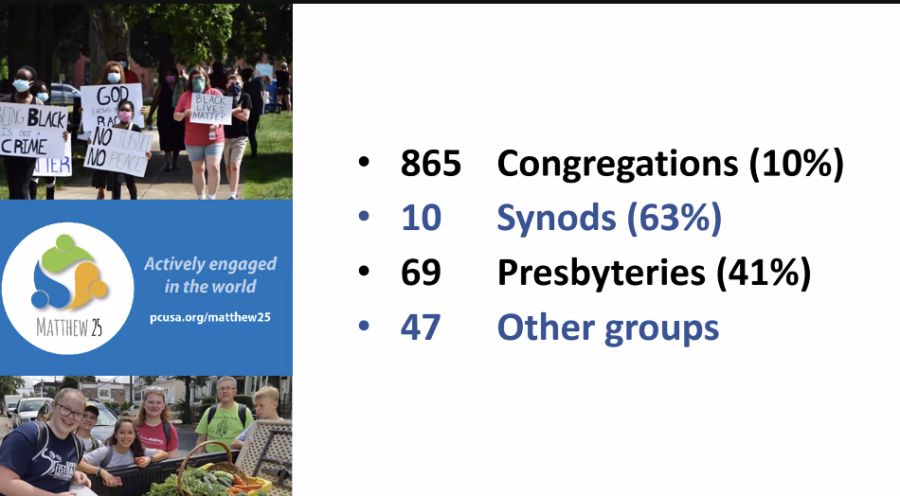
Moffett gave the board updates on a number of initiatives — including updated statistics for participation in the Matthew 25 program; new resources available for congregations and mid councils; and plans for the Presbyterian Week of Action, Aug. 23-29, with the theme “Shades of Oppression, Resistance & Liberation.”
Later in the meeting, PC(USA) stated clerk J. Herbert Nelson spoke of his vision of a church being transformed at a time when the role of Christianity in the country is in flux — “we have to rethink the ministry of the Presbyterian Church (U.S.A.) in the 21st century,” Nelson said.
He also spoke of his hope that the PC(USA) national offices in downtown Louisville, the first floor of which is being renovated for $2.4 million in preparation for the 2022 General Assembly, can become “a transformative change agent in the city,” a place of hospitality for the community and a voice of progressive Christianity.
“What does it mean to embrace all people?” Nelson asked. “People coming across the border. People who don’t have enough to eat.” Children with access to guns, and experiencing gun violence. When the PC(USA) first came to Louisville in 1988, the denomination was given the building at no cost — with the hope that it could become an anchor of downtown revitalization, he said.
Following the police killing of Breonna Taylor in March 2020 and the protests that filled the streets for months, “I believe this is a time when the very work we could have been doing years ago we have an opportunity to engage with,” Nelson said. Many of the problems Louisville faces – gun violence, inequity, poverty, racism, systemic injustice – are the same problems other communities confront as well.
Congregations all over the country are struggling with how to respond to those immense needs, this broken system, this human pain, Nelson said. Parks says Christians are called to follow Jesus into the darkest alleys, the places of suffering.
Presbyterians are being called “to go to places where we dare not go, and where we fear going, actually,” Nelson said. “This is not about a building. It’s about a love for Jesus Christ and his world.”