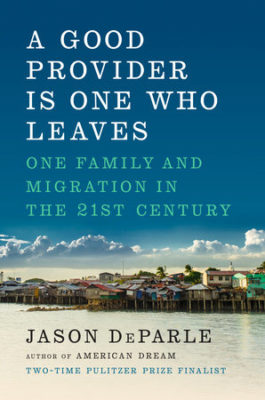
 Jason DeParle
Penguin Books, 400 pages
Reviewed by Cathy Chang
“A Good Provider Is One Who Leaves” follows three generations of a Filipino family from their home in the Philippines to the Middle East or United States. Tita, the matriarch, has already experienced how her husband Emet, with their children and extended family members, have left home to work abroad.
More than three decades ago, author Jason DeParle befriended Tita while working as a journalist in Manila. The story of their family history includes a well-researched analysis of migration with political, historical and economic contexts.
This book spotlights the family members who work abroad as well as the numerous family members who stay behind and benefit from their remittances. Although this book was written before the COVID-19 pandemic, the observant reader will perceive the impact of upended lives and livelihoods on those who were working abroad — and on the family members who depend on them. After filling the world’s demands for domestic workers, nurses and cruise ship employees, now they must return home to an uncertain future.
DeParle wraps up his book with the rise of President Trump who framed his narrative around immigrants as “predatory invaders.” DeParle rightly identifies, “The politics of immigration is in part a contest of narratives.” I agree; however, I wish that he could have provided additional counternarratives to illustrate his point.
Jason DeParle’s self-defined “immersion journalism” privileges the voices and experiences of the family members; his in-depth analysis also privileges the status quo of the conditions that led them to work abroad. For over four decades, government policies and programs in the Philippines have touted migration as the solution for every family’s needs and the national economy, therefore the government does not prioritize education, employment and medical care for its citizens.
The Villanueva family’s experiences with stable jobs, good grades and full-size homes in the Middle East and the United States are only part of the story of 21st-century migration. Although DeParle followed this family through their struggles and triumphs and acknowledges them for “letting me see America through their eyes,” this “model minority” stereotype could absolve the people and systems that contribute to immigrants’ challenges.
Filipino migrant and Filipino-American immigrant experiences are both familiar and new to me. I am the US-born daughter of Korean immigrant parents. Over four years ago, my husband, daughter and I moved to the Philippines to respond to a call to mission service with Presbyterian World Mission. Filipino colleagues from churches and migrants’ organizations tell their own story of how to assert their human rights and welfare toward a life of dignity in the midst of migration. This work provides a critical counternarrative to the government policies and programs that promote how migration helps families and the overall economy.
If DeParle could return to the Philippines, I would ask him to meet my Filipino colleagues. They work alongside migrants as they strive for the education, healthcare, social services and employment that would empower them to work in their country rather than forcing them to go abroad. Although Tita’s niece Peachy Portagana Salazar affirms that “a good provider is one who leaves,” my Filipino colleagues would retort, “and a better country is one that provides for its people.”
Cathy Chang is a mission co-worker based in the Philippines, who also works in the region of southeast Asia with churches and organizations as they address forced migration and human trafficking.