 Makoto Fujimura
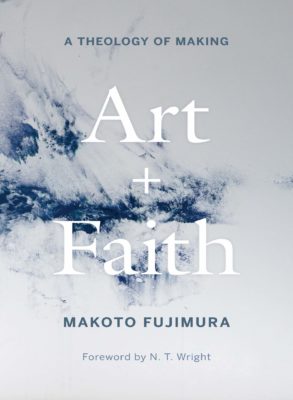
Yale University Press, 184 pages
Reviewed by Paul Rowland Jr.
The most powerful ideas are simple, as is Makoto Fujimura’s theology. He believes “that unless we are making something, we cannot know the depth of God’s being and God’s grace permeating our lives and God’s Creation.”
Fujimura, a painter who crafts his own paints from precious metals, creates multilayered paintings that have been described by David Brooks of The New York Times as “a small rebellion against the quickening of time.” In “Art and Faith,” Fujimura rejects the limited view that much of what we assume about faith is based on “an analytical approach to understanding truth as a set of propositional beliefs,” in favor of a similarly layered perspective.
Fujimura describes God as the greatest creator, who sang the world into being with a love song. While humans create from our needs, Fujimura says that God creates from love. Contrary to the poet James Weldon Johnson’s dramatic version of “The Creation,” God didn’t create humans because God was lonely, but out of love. When we love, we make. When we make, we receive making and we make again, leading to a gift economy. When love motivates the economy, the community comes alive with the fruits of the Spirit. When love is embedded in what we do, we possess love, joy, peace, patience, kindness and self-control.
Fujimura invites us to create as well, noting: “When we make, we invite the abundance of God’s world into the reality of scarcity all about us.” As Walter Brueggemann has often observed, fear of scarcity has led to many of the world’s troubles; abundance is an antidote. Adam’s naming the animals is the first act of human creation; Fujimura notes that God did not second-guess Adam, saying: ‘Giraffe’? You sure you want to call it that?” When we name, we are paying attention, being honest — being vulnerable.
When we mend, we also re-create. Fujimura notes that many of us assume something is well-mended when the broken places can’t be seen. Fujimura calls for a Kintsugi culture. Kintsugi, the Japanese art of making something broken into something more beautiful by healing the fractures with gold, ensures that fractures are treasured rather than erased.
We are created to take things in and “to experience transcendence through everything — there are burning bushes everywhere” if we learn to slow down – to look and hear – as Fujimura suggests. For example, God waits for us in the Eucharist, if we slow down and accept the invitation. According to Fujimura, God has invited us, not to a church program, but, as N.T. Wright has said, to a meal.
Fujimura is a gifted storyteller. His example of “practicing resurrection” tells of a taxi ride with a tap-dancing preacher wordlessly leading not to fixing feelings, but to empathetic comfort for the grieving driver. He is also, in the words of Wright, an artist “with the ability to explain what he does, why he does it, and how his vocation makes sense within his larger worldview.” For Fujimura, making art “is a discipline of awareness, prayer, and praise.” Amen!
Since retiring as the psychologist for North Carolina’s Services for the Blind, Paul Rowland Jr. has served as commissioned pastor of Berea Presbyterian Church of Four Oaks, North Carolina.