 Jennifer Butler
Faith in Public Life, 178 pages
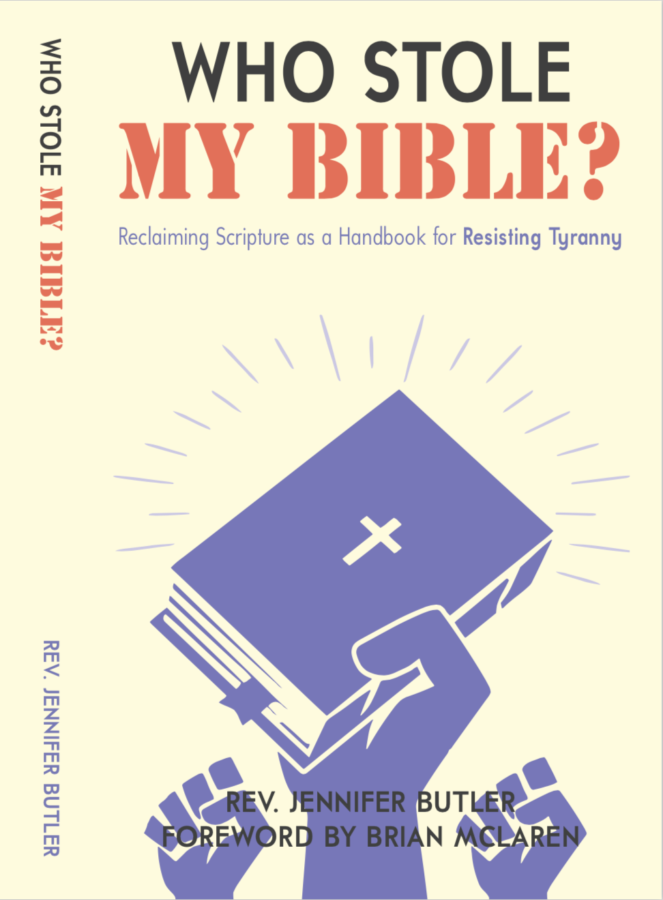
The title and subtitle for “Who Stole My Bible?: Reclaiming Scripture as a Handbook for Resisting Tyranny” leads the reader to believe that one is about to devour an exacting and biting polemic (presumably against the religious right). The cover art of a hand holding a Bible with clinched fists on either side adds a tinge of radical élan. While the book undoubtedly names specific individuals and ideologies that have distorted the Christian canon throughout American history, it’s more than a diatribe, and many elements took me by surprise.
Jennifer Butler, CEO of Faith in Public Life and an ordained Presbyterian Church (U.S.A.) minister, is no stranger to the world of faith-based activism. She makes a clear case that the Bible (and specifically its more notable and powerful passages) has been co-opted in American society; therefore, people of faith must reclaim the power of Scripture in the public square. What surprised and impressed me was Butler’s creative interweaving of personal narrative, Hebraic midrash, biblical exegesis and interpretation — all to invite the reader to engage with the ancient texts that Butler artfully animates, while simultaneously confronting the toxic theologies, worldviews and ideas that propel Christian nationalism to the mainstream. From the creation story in Genesis to the trial and crucifixion of Jesus, Butler provides historical context, adds a creative and interpretative firsthand account from one of the characters in the biblical story and ties it to America’s political moment. Despite its title and combative content, the book reads less polemical and more pastoral in both development and tone, and I sense that I experienced the Sunday morning preaching-style of Butler in literary form.
Butler wrote the book during the end of the Donald Trump’s presidency and during the COVID-19 pandemic. She highlights and interprets passages that made me reexamine my own understanding of certain books within the Bible and biblical characters that I was taught to emulate in Sunday school. At one point, she depicts the book of Ecclesiastes as a “cautionary tale” from the lessons of a “ruler gone astray — a king seduced by power and wealth.” I personally maintain the view that this argument would hold only if we assumed that the biblical figure we know as Solomon actually wrote the book, and of course my own amateur readings and long-held attraction to existential philosophy certainly gave me a pause while reading Butler’s take. But that’s also what I love about this book — she engages with the reader by challenging their preconceived perceptions of the famous biblical stories, passages and characters whom cradle Christians may have held dear, and she does so in the modus operandi of a top-notch minister.
I couldn’t help but recall the insurrection of January 6, 2021, as I read. The ideologies and harmful theologies that Butler dissects are the same forces that combined that day to hinder the American democratic experiment. These forces still reveal themselves across the country in nefarious ways, and it’s for that reason why prospective readers should engage Butler’s book in return.
Miguel Petrosky is a Presbyterian writer, journalist and essayist based in Washington, D.C. You can follow him on Twitter @petrosky_miguel.