 Michael Battle
Westminster John Knox, 390 pages
Editor’s note: This review was originally published on October 19, 2021, and updated in the wake of Archbishop Tutu’s death on December 26, 2021.
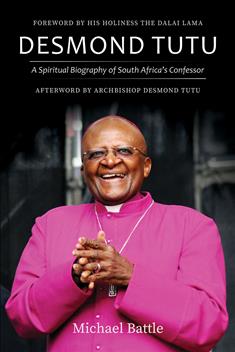
Desmond Tutu will have turned 90 years old this year, so it’s only fitting that a spiritual biography of him is now before us. As a biographer, The Michael Battle is uniquely qualified to take on such a work, having known Archbishop Tutu for nearly 30 years.
This book is so much more than “a spiritual biography.” It is also a memoir of Tutu and Battle’s decades-long relationship as mentor and mentee, a book on mature spiritual exercises with Archbishop Tutu’s life as a lens, and a defense of Christian mysticism as a this-world concern.
Battle lived with Archbishop Tutu in the early 1990s and was ordained a priest by Tutu in 1993. As Tutu approaches such an important milestone, we have in this book a deep reflection of his life, written by his mentee, who has gone on to have his own distinguished career as a scholar, teacher of spirituality and prayer and accomplished preacher.
If the book has a weakness, it is that Battle spends too much time defending his right to embark on this writing project. Battle has written numerous other books on Tutu’s theology and nonviolent ministry in the face of the distorted world of apartheid. In both the preface and introduction, and at other moments throughout the book, Battle appears to joust with imaginary critics who question how impartial he can be in telling the spiritual story of Tutu and just how his spiritual roots shaped the leader who helped shape the post-apartheid South Africa.
Battle would have been better served by embracing his place in Tutu’s life rather than defending his right to tell Tutu’s story. Who better to share the daily practices of prayer and study that shaped Archbishop Tutu than a young cleric who spent ongoing time observing the prayer and study and daily habits of the Archbishop?
Early in the book, Battle states that “Tutu’s life demonstrates God.” After this, the book’s “voice” grows stronger as it becomes clear that Battle intends to show us how he believes this is so. Battle makes the case that Tutu is both a Christian mystic and saint. In calling Tutu a saint, Battle is not attempting to place the Archbishop in some other-worldly category. Rather, the kind of sainthood that Battle endorses for Tutu comes from the definition of sainthood given by Thomas Merton where, “for me, to be a saint is to be myself.”
The book includes a foreword by The Dalai Lama and an afterword by Archbishop Tutu himself. By bookending the story with the words of these two elders in the spiritual life, we realize that Battle has accurately captured the gist of their work in an increasingly secularized world, where matters of the spirit are mostly either marginalized or held up for scorn. Battle reminds us that “apartheid was a spiritual movement”, with underlying theological claims to support racial separation. Tutu’s mysticism, therefore, was fully engaged in rejecting such a demonic and distorted view of God’s world.
Presbyterian Outlook supports local bookstores. Join us! Click on the link above to purchase “Desmond Tutu” from BookShop, an online bookstore with a mission to financially support local, independent bookstores. As an affiliate, Outlook will also earn a commission from your purchase.
Brian Cole is Bishop of the Diocese of East Tennessee in the Episcopal Church.