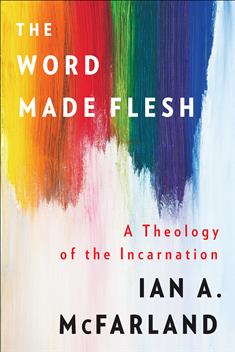
 Ian A. McFarland
Westminster John Knox, 260 pages
Those who take the time to dig into Ian McFarland’s work will gradually realize how deeply his theology of the “Word Made Flesh” is not only about Jesus, but also about our humanity woven into the life of the triune God.
McFarland’s central argument is straightforward: “To know God rightly, one must look at Christ’s humanity only.” McFarland argues that Jesus’ divinity and humanity as “two natures in one hypostasis” is the most adequate account of Christian convictions about Jesus. The book unfolds in three parts:
- The Great Divide: radical discontinuity between Creator and creature
- The Bridge: hypostatic union is the bridge across the divide, in which the person of Jesus is fully divine, while the flesh is fully human
- The Crossing: Jesus’ resurrection enables new redeemed existence rooted in God’s own life, eventually catching up all creation in glory.
Each section sustains conversation with ancient and recent theologians (including Athanasius, Maximus, Martin Luther, Karl Barth and, surprisingly, Rudolf Bultmann), rendering them freshly accessible today. From these conversations emerges McFarland’s own arresting argument for orthodox Christology that responds to contemporary critiques. In a counter-intuitive move reminiscent of his teacher Kathryn Tanner, McFarland excavates the details of Chalcedonian orthodoxy to show how it focuses on Jesus’ humanity and invites us into participation in the triune God. Developing an image from Maximus, he describes human lives as “logoi” that are most fully realized in the context of the comprehensive Logos story.
There are many gems here: a clarification of the distinction between “hypostasis” and “nature;” attention to the ontological difference between creature and Creator in a way that does not diminish creaturely goodness; focus on the “quotidian realities of Jesus’ flesh and blood” as vehicles for God’s self-revelation, to name a few. Particularly valuable is his luminous reflection on Jesus’ resurrection: “the declaration that he lives, but in a new mode, as God lives—eternally and not in temporal sequence.” Easter preachers will benefit especially from this section.
Throughout, McFarland emphasizes Jesus’ ordinary humanity as revelatory. He insists that for Jesus to be “perfect in humanity” means that he was “perfectly ordinary,” and not superior to other humans. I applaud this move. Even so, I longed for more attention to the specific shape of Jesus’ humanity and its ethical implications. More direct engagement of contemporary liberation Christologies might expand his critique of Christologies that undergird oppressive systems. McFarland hints at his concern for Christologies that glorify power in discussing Jesus as “Lord,” and he usefully expands what it means to say Jesus “suffered,” with attention to his interactions with the Samaritan woman, the Canaanite woman and the “sinful woman” of Luke 7. Even so, I longed for more engagement of the ethical implications of Christological formulations, as well as more attention to the socio-historical particularity of Jesus’ humanity, beyond the brief attention to his Jewishness.
Despite these concerns, McFarland’s book yields many treasures, concluding with a captivating eschatological vision of incarnation reaching through humanity to bring the whole creation to glory: “the mystery of the Word’s embodiment … includes its purpose and result: that all human beings should subsist directly by the power of God just as the risen and ascended Jesus does” (206). “The Word Made Flesh,” then, is about both incarnation and deification: Word taking a body in Jesus and our bodies living in and by the incarnate Word.
Presbyterian Outlook supports local bookstores. Join us! Click on the link above to purchase “The Word Made Flesh” from BookShop, an online bookstore with a mission to financially support local, independent bookstores. As an affiliate, Outlook will also earn a commission from your purchase.
Martha Moore-Keish is the J.B. Green Professor of Theology at Columbia Theological Seminary in Decatur, Georgia.