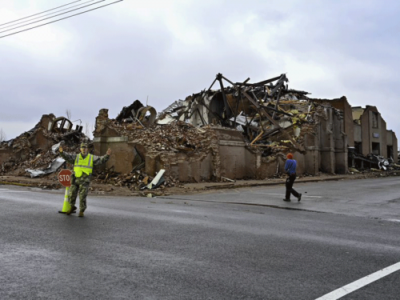
The randomness of it: that’s the first thing we noticed. One stretch of road, the houses and yards and Christmas decorations were just fine. A little bit farther along, suddenly, everything was obliterated. We’re not talking about shingles and boards ripped off a roof. More: there used to be a house here, someone’s life, a home, and now it’s decimated. The trees all down, the homes, the outbuildings, everything: flattened.
I don’t have a comprehensive sense of how the tornadoes of Dec. 10-11 scourged Mayfield and Dawson Springs and other communities, killing at least 76 in my home state of Kentucky. The randomness takes your breath away: one person is killed while co-workers huddled near them in the same buildings survived.
On Dec. 18, a solid week after the tornadoes blasted through, after journalists and disaster emergency crews descended, after President Biden flew in to survey the damage and offer support to the survivors, I was one of a team of people who drove to Earlington, Kentucky, to cook hot meals.
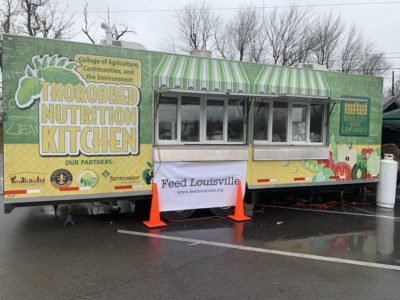
In the parking lot of Earlington Elementary School, we met Donny Greene, a leader of our team who’d already been working in the area for several days. He described a surreal feeling of ordinary life juxtaposed with destruction — how the night before, an Applebee’s restaurant was buzzing, filled with people eating and drinking, while two blocks away, everything was flattened. “It’s dystopian,” Greene said, shaking his head as he unlocked the trucks and fired up the generator.
This is not a story of how we swooped in and made everything better. It’s a more organic accounting of connections — how, in hard times, people become creative and flexible and work together. This team was organized through an outreach program called Feed Louisville — an initiative that Greene and chef Rhona Kamar formed in early 2020 in the heart of the COVID-19 pandemic to feed unhoused people in Louisville when many in-person feeding programs were shutting down. Every weekday, volunteer cooks gather in the kitchen of a church — a church that, like so many, has dwindled in membership and has more space than it needs, but has found innovative ways to use its resources to assist other nonprofit groups.
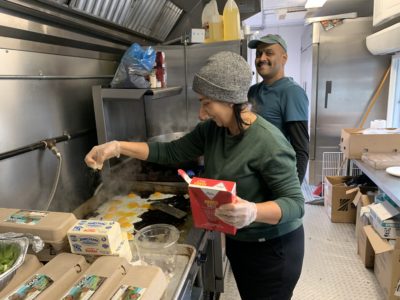
Led by a lead chef – usually, an experienced and fearless home cook – the team churns out 250 or 300 meals per day, using mostly food that has been donated by grocery stores, restaurants, organic farmers, and the Dare to Care Food Bank. The trick is: when the cooks walk in any given day, they have no idea what food they will find. A mountain of eggplant, a box of avocadoes. Whole turkeys. Split peas. Canned pumpkin. Muffins and pastries and cookies from a high-end bakery. Bananas on the cusp.
Somehow, like magic, the lead cook comes up with a plan, volunteers start to chop and stir and roast, and within a few hours close to 300 hot meals are stacked on trays in the warming bins. Another team gathers up the meals in the late afternoon and delivers them to hungry people at encampments.
When the tornadoes struck, Feed Louisville took its volunteer show on the road — combining forces to cook in western Kentucky in collaboration with experienced disaster relief responders, led by World Central Kitchen, founded by chef José Andrés.
Sam Bloch, director of field operations at World Central Kitchen, gave an update in this video posted on Twitter, saying about 25 food trucks and restaurants were providing meals in addition to World Central’s two food trucks, with some food then being delivered to more rural areas, where people whose houses were intact had taken in their neighbors, where “two-bedroom homes have 30 people sleeping in them” even with no electricity or running water.
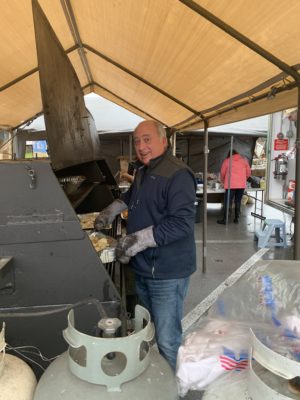
As part of that relief effort, Feed Louisville set up operations in the parking lot of Earlington Elementary School, using a food truck, grills and other supplies donated by Kentucky State University and the Kentucky Department of Agriculture and with food provided by organic farmers, the Louisville grocer ValuMarket, and more.
On Saturday, Feed Louisville’s lead cook was Ellen van Hamburg, who had mobilized a team including a man she’d known since grade school; friends from her exercise class, church and the neighborhood; and Ellen’s son’s girlfriend’s mother, who Ellen was meeting for the first time that morning and who she immediately hugged. The day before, volunteer cooks had prepped trays of pasta and potatoes in the church kitchen. We loaded up the cars and pickup trucks with supplies, left at dawn, drove to Earlington, and had hot breakfast – eggs, sausage, potatoes and pastries from some of Louisville’s best bakeries – ready to hand out by 10:30 a.m.
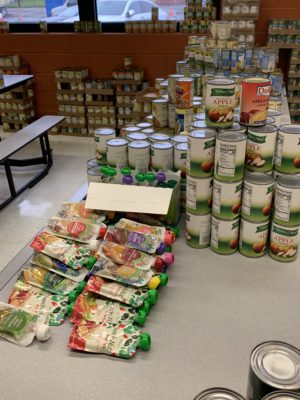
In the school, volunteers from the school district and community were offering table after table of supplies to those hit by the tornado — canned goods, diapers and formula, work gloves, hats, clothing, blankets and much more. They’d been at it all week.
Out at the food truck, the Feed Louisville team cranked up for lunch, and with the help of volunteer caterer Bhavana Barde and her husband Ash quickly produced trays of barbecue turkey and pork sandwiches and coleslaw; vegetarian fried rice; chicken pasta salad; stir-fried vegetables; chicken rice and potato casseroles; plus grapes; apples; chips; cookies, water, hot coffee, sandwiches and more We handed out meals to families with children; to senior citizens; to young guys working in the recovery effort and needing lunch. Feed Louisville representatives went out into the community, trying to ascertain if there were places where meals might be delivered. A kindergarten teacher brought cardboard boxes from the school to fetch food for families shopping inside.
“This is for a husband, wife and three children,” she said.
“Do you have soft food? I think she has problems with her teeth.”
People drove up, whole families climbing out of the car.
“I need food for eight.”
“My husband has diabetes.”
“My son will love this” — the chocolate chip cookies.
“God bless you.”
“We’ll take anything,” one exhausted-looking woman said. “Anything is better than nothing.”
Late in the day, a local church sent word they needed 200 meals — so Feed Louisville went into overdrive, packing up and sending all the food we had left, a flurry of assembly-line preparation as a cold wind blew through the grade school parking lot.
This, in an increasingly secular age, is what community can look like: churches partnering with community non-profits and seeing their buildings as resources to share; disaster specialists building networks with local volunteers; farmers, grocery stores, food banks and restaurants sharing their resources so food gets where it’s needed and doesn’t go to waste; public agencies, schools, businesses and citizens all doing their part; people of faith joining hands with groups outside the church.
“It’s the recognition of the self in others,” Kamar posted on Facebook. “It could as easily been me – or you – reeling from this catastrophe.”
And there’s another reality: often, we move through the world not knowing if indeed we do make an impact. Driving to Earlington, while I hoped to see firsthand the destruction, to get a sense of the storm’s power, I was hoping not to behave or come across as a tornado voyeur. I realized the people who live there – who have lost homes, businesses, jobs, family members, memories, pets, community, electricity, shelter – will have months and months of fear and grief and pain ahead of them. Driving in, we passed many trailers and modest homes in the areas the storm spared — this is not a rich community. The challenges of rebuilding run deep.
So we drove in from the city for a day. We cooked some hot meals, a very small part of a much bigger constellation of caring and expertise. How often does life feel like that, that we try to do our part – bake that casserole, write that sympathy card, march in that protest, read to that child, pray for that person – knowing that our small part might not make a sizeable difference and certainly won’t fix the big, systemic, enduring issues like gun violence and racism and poverty and hunger. We do it anyway. We show up with our poster-board signs and our oven mitts and our hammers and our megaphones.
A barbecue sandwich won’t fix the world — we know that. But being part of a bigger movement that calls for love, that calls for compassion, that calls for equity, that calls for repair of pain and of the earth, that teaches us to improvise and be flexible and collaborative, to work together to show kindness amidst suffering on a cold winter day — that’s worth showing up for, even for a very small part.