In many churches, it’s the subject people never talk about.
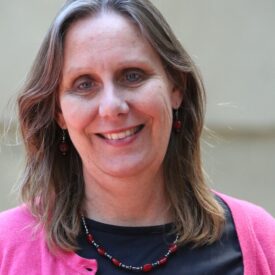
Yet the Guttmacher Institute estimated in 2017 that nearly one in four American women will have had an abortion by the time she’s 45 — with the incidence even higher, about one in three, a decade or two earlier. So when Sonja Miller, a graduate of Austin Presbyterian Theological Seminary, encourages congregations to become involved in reproductive freedom work in Texas, she tells ministers that “when you stand in that pulpit and you look over your congregation, I want you to count 1, 2, 3 — that one.”
As it is becoming increasingly difficult for American women to access legal abortions, some Presbyterians are working to amplify the voices of people of faith who believe in a women’s right to choose — saying it’s vital that progressive congregations in the Presbyterian Church (U.S.A.) and elsewhere become places where people end the silence and talk honestly about abortion and reproductive health.
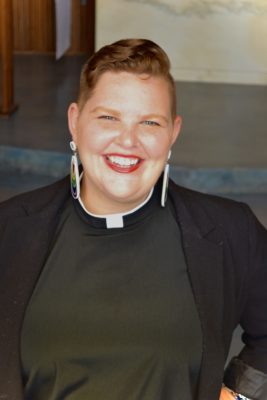
In Texas, a restrictive new abortion law that went into effect Sept. 1 “comes from a particular dominant religious narrative that does not reflect the PC(USA),” said Angela Williams, a minister ordained by Mission Presbytery in September 2020 to work for LGBTQ equality and reproductive freedom. “When the folks in the PC(USA) and other places don’t talk about this from the pulpit, don’t talk about it in Christian education classes, don’t even mention it in the life of their congregation, then people just assume that silence is complicity with that dominant religious narrative. … We’ve got to talk about it.”
Williams is helping to organize a virtual event Jan. 25-26, called SACReD – an acronym for the Spiritual Alliance for Communities of Reproductive Dignity – bringing together religious leaders from across the country in support of reproductive freedom and access to legal abortion. Their message for the gathering: In the same way that people of faith support justice work on issues such as racism, immigration, poverty, or climate change, “it is deeply faithful for congregations to speak out in favor of reproductive dignity, including abortion.”
The question of whether the U.S. Supreme Court will overturn Roe v. Wade or significantly curtail access to abortion is currently a potent concern in American political life — with particular attention being paid to a challenge to a law in Mississippi, which bans most abortions after 15 weeks, and on which the court is scheduled to hear arguments Dec. 1.
On Nov. 1, the Supreme Court heard arguments in a challenge to the controversial new Texas law, known as S.B. 8 — the most restrictive abortion law in the country, banning almost all abortions in the state after about six weeks of pregnancy, which is when fetal cardiac activity can be detected and is before many women know they are pregnant. The law, which would apply even in cases of rape or incest, took effect Sept. 1, after a midnight 5-4 ruling from the Supreme Court refused to block it.
The law also is distinctive because it delegates the power for enforcing the law to individuals – whether they live in Texas or not – allowing them to bring civil lawsuits in Texas state courts against anyone who performs an abortion or “aids and abets” an abortion, which could include friends, family members and potentially ministers, with penalties of $10,000 or more if a case is successful.
Public opinion polling shows a majority of American adults think abortion should be legal in all or most cases — a Pew Research Center poll from May 2021 found 59% of American adults think abortion should be legal in all or most cases, and a Washington Post-ABC News poll taken in early November 2021 found Americans say by roughly a 2-1 margin that the Supreme Court should uphold its 1973 Roe v. Wade decision affirming a woman’s constitutional right to choose an abortion.
In 1995, Cecile Richards, who later became president of the Planned Parenthood Federation of America, founded the Texas Freedom Network, an organization formed as a response to the religious right and committed to advocacy in support of public education, religious freedom and civil liberties.
In 2016, Texas Freedom Network began an effort to designate Reproductive Freedom Congregations — congregations willing to take a public, pro-choice stance. The network hired Miller specifically to work with faith communities, building on the work done in previous decades for LGBTQ equality in congregations. Miller held that job until the summer of 2021 when she left to become director of people and culture for Whole Women’s Health Alliance, an independent abortion provider in Texas. So far, 25 congregations in Texas have achieved the Reproductive Freedom Congregation designation, including many Unitarian Universalist congregations and three Presbyterian churches in Austin. About 100 more are working towards achieving the designation, Miller said.
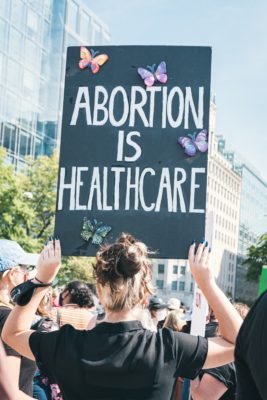
That work involves encouraging people from those congregations to tell their reproductive stories — knowing that culture change in congregations and in society came when gays and lesbians and their families began sharing their personal stories publicly, being honest about who they are and who they love. For many people of faith, the stories of their reproductive lives – of sexual intimacy, of love and heartbreak, of contraception, of becoming a parent or choosing not to have children, of miscarriage and infertility, of abortion – is also deeply entwined with their faith journey.
So often, with abortion, with miscarriage, with infertility, with sexual assault, people don’t talk about what’s happened to them, hiding the impact it has on their lives, Miller said — so the silence becomes a pastoral concern, an impediment to true Christian community.
“A lot of times, we just lock it away. You put it in a box, you store it deep. But we know those things affect us. So being able to be a community where we care for each other on that deep level, where we can bear witness that yes, we are all beloved children of God. … This is fully who I am. And you can bring your full self, with all of the choices and decisions and things that have happened to you in your life, and be fully human and fully present in this community. You don’t have to shut away in the shadows a big piece of who you are. I think the LGBTQ movement is the beginning of this conversation. These are the same kinds of things I imagine 40 or 50 years ago were conversations that were being had.”
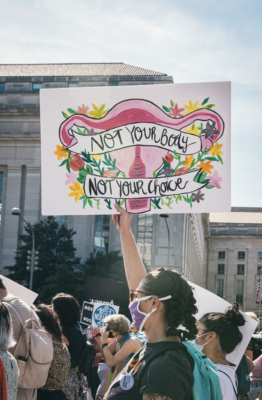
Some ministers and church members are committed to advocating publicly for abortion rights as well — from testifying in legislative hearings to marching in the streets.
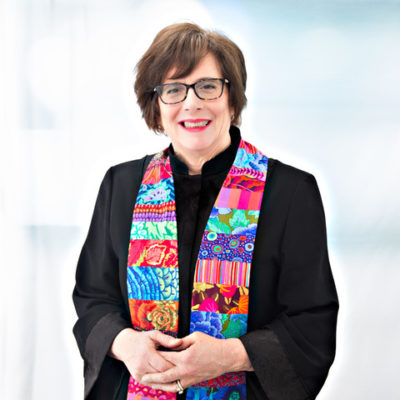
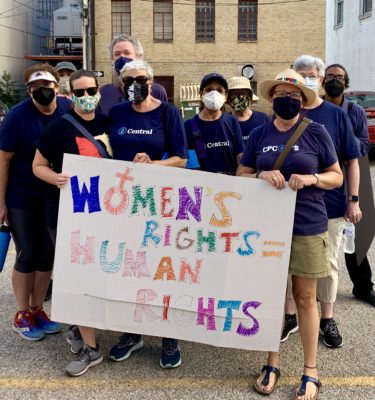
Katheryn Barlow-Williams, pastor of Central Presbyterian Church in Austin, has preached on abortion rights — and in September wrote an opinion piece for the Austin American-Statesman, saying S.B. 8 seemed to come “straight from the pages of a dystopian novel” and “is nothing more than oppression masquerading as love for an unborn child.”
Barlow-Williams wrote that her congregation, in becoming a Reproductive Freedom Congregation, has made this commitment:
- We trust and respect women.
- We promise that people who attend our congregation will be free from stigma, shame, or judgment for their reproductive decisions, including abortion.
- We believe access to comprehensive and affordable reproductive health services is a moral and social good.
In an interview, Barlow-Williams said she wrote the letter because she believes the new Texas law “is just so wrong. My purpose wasn’t to change somebody’s mind. My purpose in writing it was to support women … for them to know they are respected and loved and heard.”
Jim Rigby, pastor of St. Andrew’s Presbyterian Church in Austin, another Reproductive Freedom congregation, sees theological implications in reproductive freedom work. “It really is about the personhood of women,” he said. “If women don’t belong to themselves, if they don’t have bodily integrity, if they are not considered moral agents, I don’t know that they are being considered people. To me, this is a hugely important human rights issue. “
In Texas and elsewhere, advocates for reproductive freedom are concerned that new restrictive legislation will have the biggest impact on those who are already marginalized — particularly women of color, young women and those without financial resources.
Most of the time, when a woman comes to a clinic and finds she can’t have an abortion, she doesn’t have an immediate Plan B in mind, Miller said. It takes time and resources to figure out what to do next. Some go to nearby states for abortions, “and I’m told there are waiting lists,” she said. “Our neighboring states are seeing a big uptick — New Mexico, Louisiana and Oklahoma. That’s if a person has the ability to travel. This disproportionately affects women of color, women in marginalized communities. They don’t necessarily have the resources to travel. To take more time off from work.”
Some women who wanted abortions will end up having a baby instead — in places where affordable housing, access to health care, living wages and child care aren’t always a priority.
While many Americans today are too young to remember a time when abortion was not legal in the U.S., some in the reproductive justice movement do — a time when women drove across states to get an abortion, when safe abortions were generally more available in urban areas than rural ones, more available to wealthier people than poorer ones. A 1966 series in the Washington Post described how women in the Washington, D.C., area obtained abortions — riding blindfolded to an unmarked house or apartment, finding pop-up clinics that appeared for a few months and then went away traveling to other countries, trying to induce abortions themselves.
Religious leaders played a role in accessing abortion services prior to the Roe v. Wade ruling, as Protestant ministers and rabbis formed the Clergy Consultation Service on Abortion in 1967, a network of faith leaders who helped pregnant women find places to get safe abortions, and sometimes to navigate logistics including transportation and funding. Charles Landreth, then pastor of First Presbyterian Church in Tallahassee, Florida, was among those who participated — even filing a lawsuit challenging two Florida statutes that prohibited advising or assisting women in their efforts “to procure miscarriage.”
When a pregnant woman wanted an abortion, “They’d say ‘OK, you’re in Missouri, there’s not a clinic here, but there’s a clinic in New York. We’ll get you to New York,’” Williams said. “There is a strong history of clergy supporting women’s bodily autonomy and reproductive freedom. We have just forgotten about that.”
Today, with access to abortion becoming increasingly restricted, Williams says she is hearing from more religious leaders who want to preach about abortion and support reproductive rights. Miller is trying to organize congregations willing to “adopt” particular abortion clinics — providing food and support for the staff, escorting women who come for abortions.
With the Supreme Court poised to rule on crucial abortion cases, Williams thinks the time is right for the SACReD gathering — to take the work of reproductive advocacy among faith communities to the national level. As states try to make access to abortion more restrictive, her phone has been ringing.
Williams put it this way: “There are more and more Presbyterian clergywomen who are coming out of the woodwork and ready to burn things down.”